
Vorkommen in der Schweiz
Einheimisch (INN)
ⓘⓧ
Gefährdungsgrad
Gemäss den Kategorien und Kriterien der Roten Liste der IUCN oder gemäss Duelli et al. 1994.
(exp = Einschätzung von Expert*innen)
Schutzstatus (CH)
Gemäss den entsprechenden nationalen Gesetzen und Verordnungen.
Gefährdungsgrad (CH)
Nicht bedroht (LC)
Schutzstatus (CH)
ⓘⓧ
Gemäss den aufgeführten Gesetzen und Verordnungen
–
Gesetze und Verordnungen
–
ⓘⓧ
Gemäss der Vollzugshilfe: Liste der national prioritären Arten der Schweiz.
Nationale Priorität
–
Handlungsebene
–
Hinweis zur Handlungsebene
–
Dringlichkeit (CH)
–
Sicherung Einzelvorkommen
–
Bestandsüberwachung
–
ⓘⓧ
Landwirtschaft (OEA/UZL)
Zielart/Leitart gemäss: Umweltziele Landwirtschaft „Arten und Lebensräume“.
(* = Einschätzung von Expert*innen)
Wälder
2: Waldzielart gemäss: Biodiversität und Wald: Ziele und Massnahmen. Vollzugshilfe zur Erhaltung und Förderung der biologischen Vielfalt im Schweizer Wald (Imesch et al. 2015).
1: Ergänzende Zielart im Wald, definiert im Rahmen von BAFU-Aktionsplänen (z. B. Aktionsplan Lichte Wälder).
Landwirtschaft (UZL)
–
Wald
–
✓
Taxon gut untersucht, Karte nahe an der tatsächlichen Verbreitung Mehr Info
Karte
Karte der Beobachtungen von Bombus terrestris in der Schweiz (Auflösung 5 x 5 km).Karte anschauen
Zeitraum
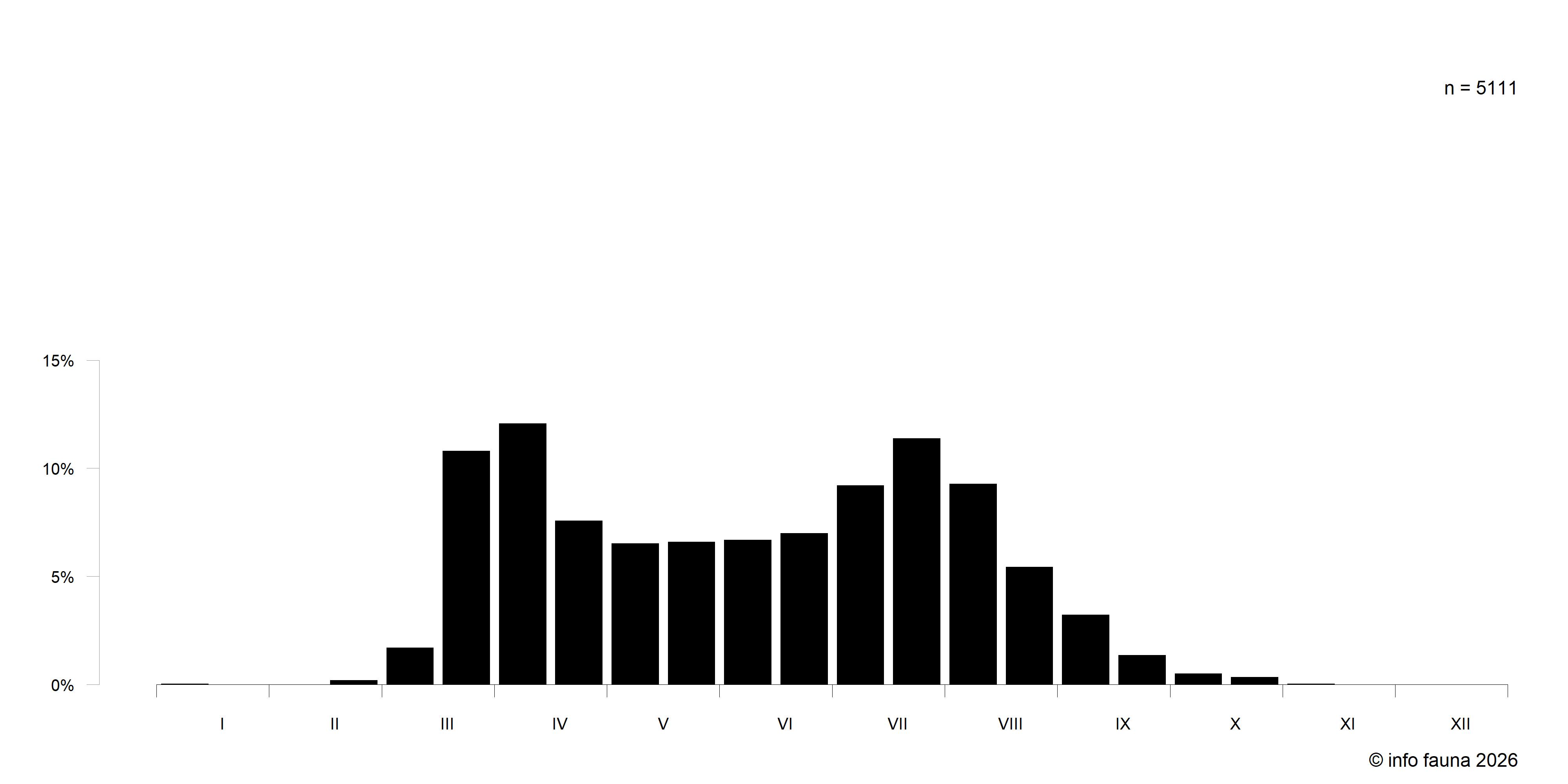
Zeitraum der Beobachtungen von Bombus terrestris in der Schweiz. Die Grafik zeigt den Anteil aller Beobachtungen pro zwei Wochen.
Klassifikation
- Arthropoda (Phylum)
- Insecta (Klasse)
- Hymenoptera (Ordnung)
- Apidae (Familie)
- Bombus (Gattung)
- Apidae (Familie)
- Hymenoptera (Ordnung)
- Insecta (Klasse)
Weitere Informationen
Artporträt
Autor-inn-en
Dimitri Bénon, Sophie Giriens, Christophe Praz
Porträt
Feldkennzeichen und Taxonomie
Bombus terrestris ist eine große Art, die zur Untergattung Bombus sensu stricto gehört. Diese Untergattung umfasst in der Schweiz vier Kryptospezies, die hier unter dem Namen "Gruppe B. terrestris" zusammengefasst sind. Diese Gruppe umfasst B. terrestris, B. lucorum, B. cryptarum und B. magnus. Diese Arten zeichnen sich durch einen schwarz behaarten Thorax mit gelbem Collare aus; der Abdomen ist auf den Tergiten 1 und 3 schwarz, auf Tergit 2 gelb und an der Spitze weiß. Im Gegensatz zu B. argillaceus, B. hortorum, B. jonellus und B. ruderatus ist das Scutellumhaar schwarz.
Weibchen von B. terrestris sind im Feld nicht zu erkennen, mit Ausnahme von Königinnen mit einem feinen, sehr dunkelgelben Collare. Andere Arten haben meist einen breiteres und/oder zitronengelbes Collare. Es ist jedoch zu beachten, dass einige Königinnen von B. lucorum und B. cryptarum einen dunkles oder reduziertes Collare haben. Eine sichere Identifizierung erfordert daher immer die Beobachtung unter einem Binokular.

Königin auf Erica carnea. Diese Form mit einem sehr feinen Collare ist im Feld zu erkennen (Neuchâtel, Ende März 2018). Foto © Sophie Giriens.
Im Gegensatz zu B. lucorum und B. magnus ist bei den Männchen von B. terrestris die Behaarung des Clypeus und der Scheitel völlig dunkel, ein Merkmal, das sie jedoch mit B. cryptarum teilt. Männchen von B. terrestris können daher im Feld außerhalb des Bereichs vonB. cryptarum identifiziert werden.

Männchen auf Centaurea jacea (Frankreich, Department Ain, Ende September 2014). Foto © Sophie Giriens.
Der Status der Art in der B. terrestris Gruppe war lange Zeit umstritten. Mehrere neuere Studien mit molekularen (Barcoding und Mikrosatelliten) oder chemischen Methoden (enzymatische Elektrophorese und Analyse von Labialsekreten der Männchen) zeigen jedoch, dass die vier Arten tatsächlich unterschiedlich sind. (Pamilo et al. 1984, Bertsch et al. 2005, Bertsch & Schweer 2012, Carolan et al. 2012, Williams et al. 2012a, Vesterlund et al. 2014, Giriens 2015, McKendrick et al. 2017).
Biologie und Lebensraum
Lebensraum
Bombus terrestris ist eine allgegenwärtige Art. Diese Hummel ist in vielen Lebensräumen zu finden, hauptsächlich in offenen Umgebungen, einschließlich städtischer Gebiete.
Nahrungspflanzen
B. terrestris hat eine mittleren bis kurzen Rüssel. Die Art ist sehr generalistisch und sammelt Pollen von fast allen Pflanzenfamilien, sowohl auf einheimischen als auch auf kultivierten Blüten. Zu seinen regelmäßigen Wirten gehören die Fabaceae, Rosaceae, Lamiaceae und Orobanchaceae. (Teper 2006, Kleijn & Raemakers 2008, Leonhardt & Blüthgen 2012).
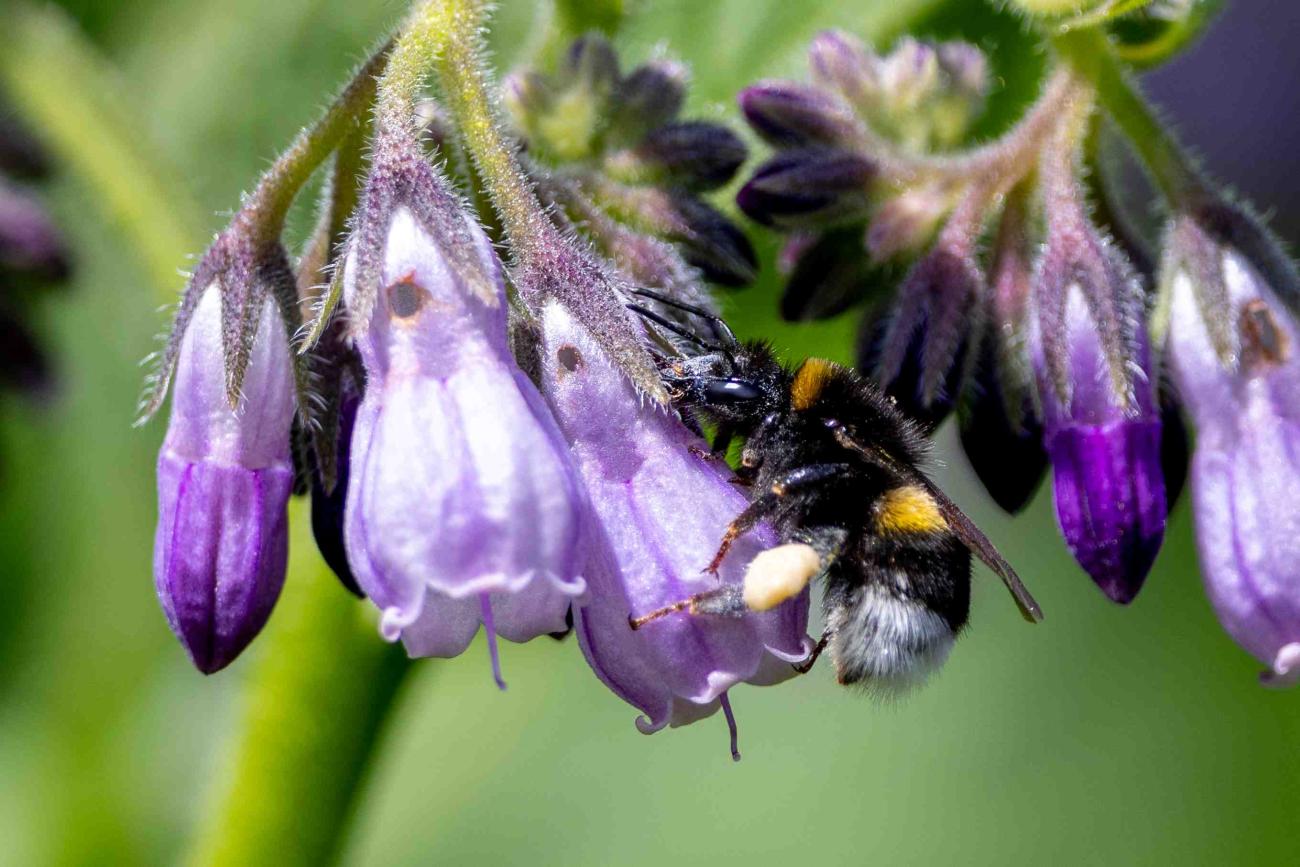
Arbeiterin beim Nektarraub an einer Blüte von Symphytum officinale (Ollon VD, Anfang Mai 2025). Foto © Sophie Giriens.
B. terrestris ist eine Hummel, die in der Lage ist, große Entfernungen zurückzulegen, um an Ressourcen zu gelangen: Arbeiterinnen wurden bei der Ernte mehr als 2 km von ihren Nestern entfernt gefunden. Die Art ist auch dafür bekannt, Nektar von langkronigen Blüten zu stehlen, indem sie mit ihren Mandibeln einen Einschnitt an der Basis der Blüte macht. (Walther-Hellwig & Frankl 2000, Goulson et al. 2002, Benton 2006).
Nistbiologie
B. terrestris baut normalerweise unterirdische Nester, meist in Höhlen von Kleinsäugern. Es können aber auch andere Strukturen, wie z. B. künstliche Hohlräume, verwendet werden. Die Koloniegröße ist oft groß, mit durchschnittlich etwa 160 Arbeiterinnen zu der Zeit, wenn die Kolonie am bevölkerungsreichsten ist, wobei einige Kolonien mehrere hundert Individuen erreichen. Sie ist ein pollen storer. (Goulson et al. 2002, Benton 2006).

Arbeiterin am Eingang zu ihrem Nest (Botanischer Garten Genf, Mitte April 2015). Foto © Sophie Giriens.
Parasiten
B. terrestris wird parasitiert von B. vestalis. Verschiedene andere Organismen, darunter Diptera, parasitieren auch B. terrestris. (Benton 2006, Martin et al. 2010).
Paarungsstrategie
Die Männchen von B. terrestris patrouillieren auf mit Pheromonen markierten Fährten. Goulson et al. (2011) haben ebenfalls eine Tendenz zum Hilltopping gezeigt.
Verbreitung
Lebenszyklus
Bombus terrestris ist eine der frühesten Hummelarten der Schweiz. Die überwinternden Königinnen schlüpfen bereits im März aus ihrer Diapause. Aufgrund von Identifikationsschwierigkeiten sind nur wenige Informationen über die Phänologie der Arbeiterinnen verfügbar. Die Männchen können in den wärmsten Regionen der Schweiz schon Anfang Mai erscheinen, sie fliegen aber meist von Ende Mai bis Ende September. Einige Beobachtungen von sehr frühen Männchen aus wärmeren Teilen der Schweiz, vor allem aus dem Tessin, werfen einige Fragen zur Phänologie der Art auf: Es ist noch unklar, ob es sich um Männchen handelt, die es geschafft haben, in besonders warmen Jahren zu überwintern, oder ob ganze Kolonien überwintern können, wie es bei B. terrestris und B. lucorum in Südengland der Fall zu sein scheint. (Neumeyer & Moretti 2005, Benton 2006).
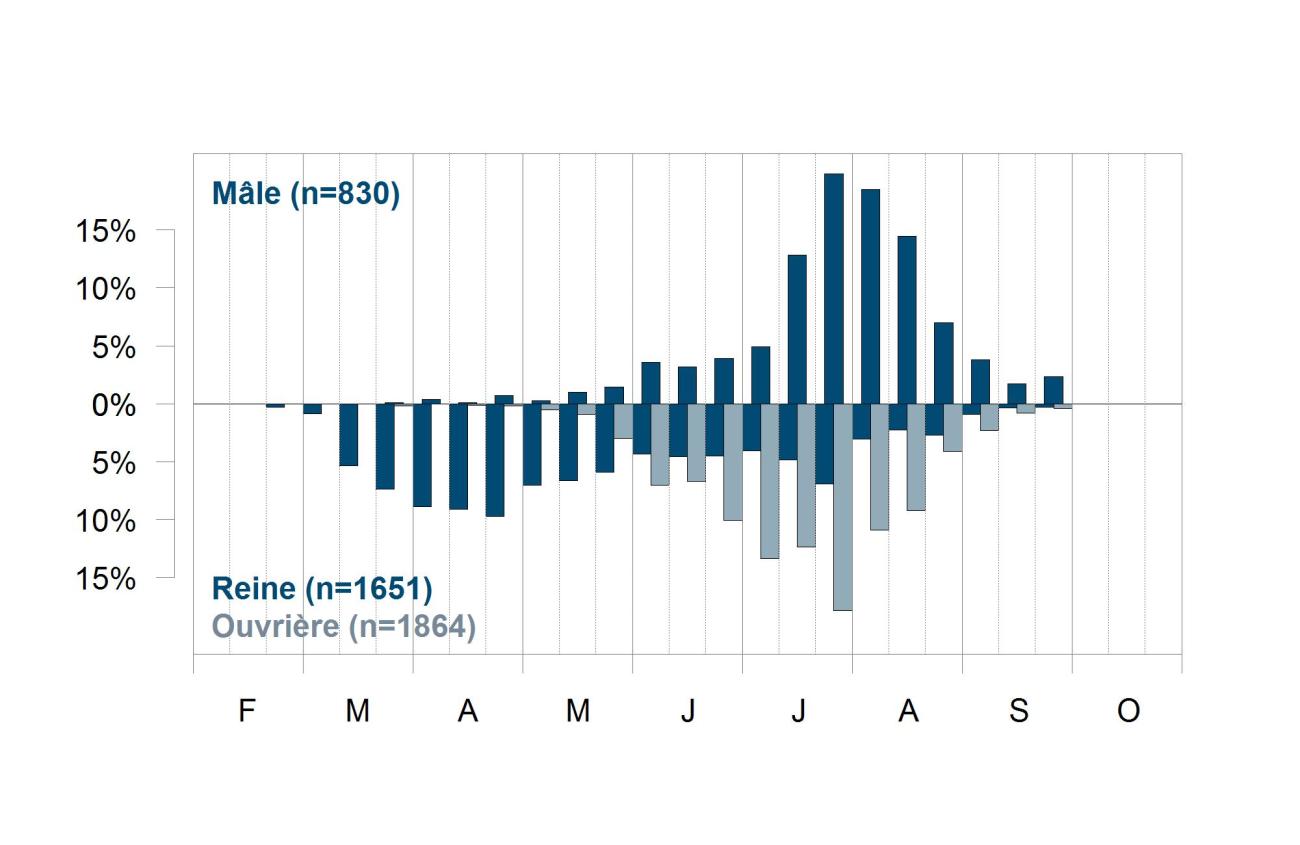
Phänologie von Bombus lucorum in der Schweiz.
Verbreitung
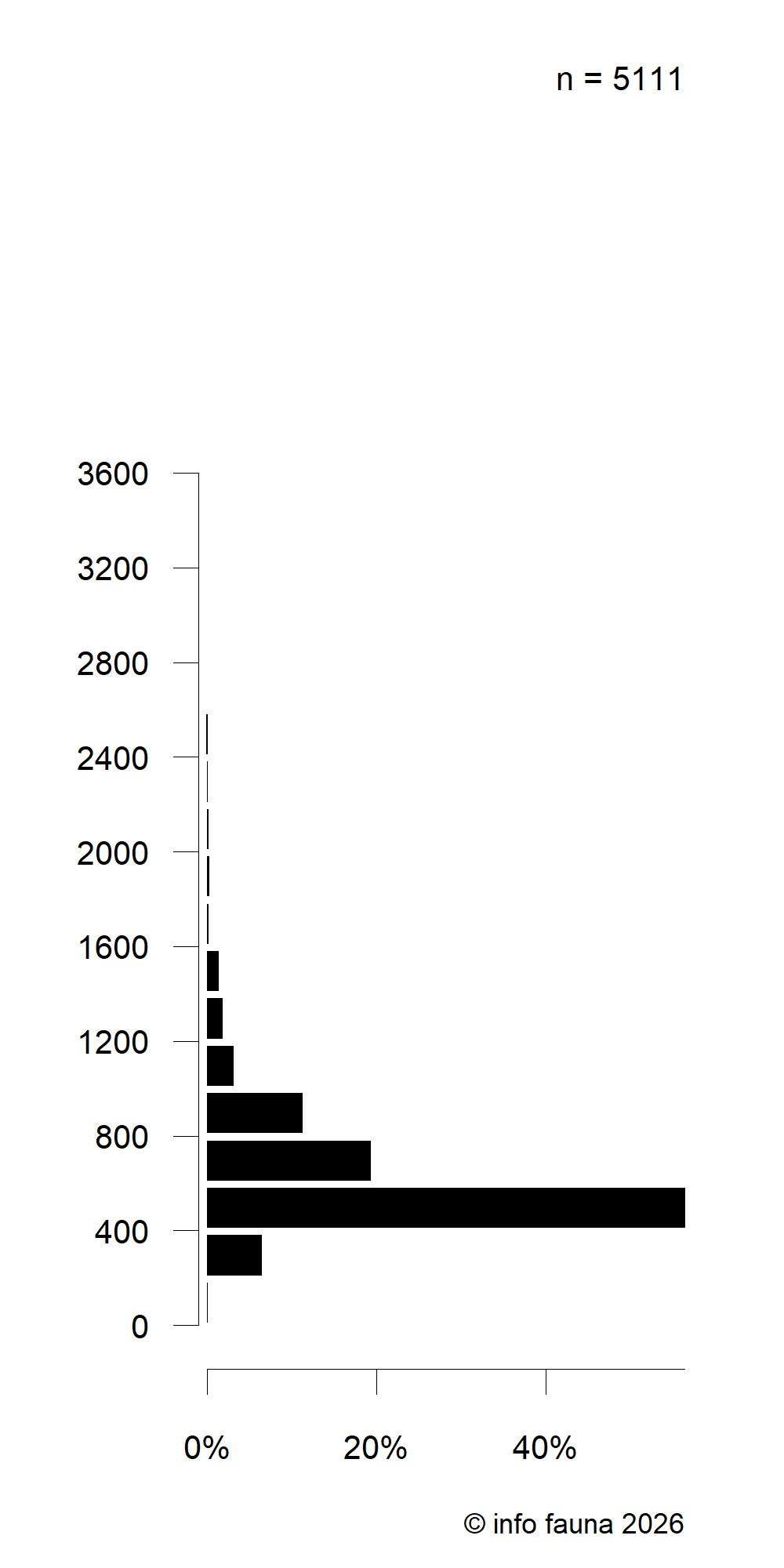
B. terrestris ist im ganzen Land weit verbreitet. Sie ist die am häufigsten vorkommende Art der B. terrestris Gruppe in niedrigen Höhenlagen.
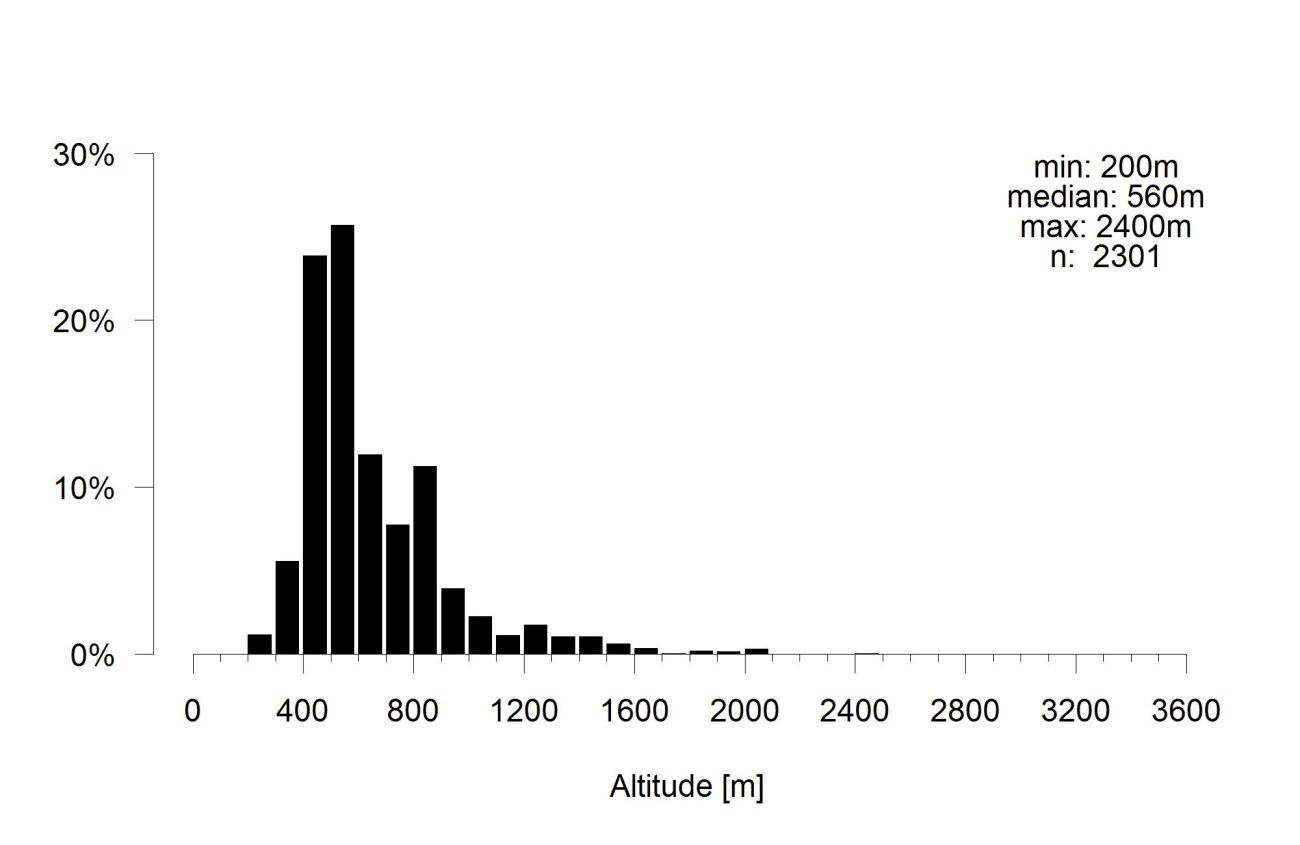
Höhenverteilung von Bombus terrestris in der Schweiz.
Schutz
Bedrohungsstatus
Bombus terrestris wird in der Roten Liste als nicht bedroht (LC) eingestuft (Müller & Praz 2024). Damit gehört sie nicht zu den gefährdeten Arten und ist keine Rote Liste Art. Es ist eine der häufigsten Arten in der Schweiz. Die Art ist nicht nur in Europa natürlich verbreitet, sondern wurde auch auf vielen anderen Kontinenten eingeführt, da sie seit mehreren Jahrzehnten zu Bestäubungszwecken gezüchtet und gehandelt wird. (Goulson 2003, Toretta et al. 2006).