
Type de présence en Suisse
Indigène (INN)
ⓘⓧ
Degré de menace
Selon les Catégories et Critères de la Liste rouge de l’UICN ou selon Duelli et al. 1994.
(exp = appréciation d'expert·e·s)
Statut de protection (CH)
Selon les lois et ordonnances nationales spécifiques.
Degré de menace (CH)
Non menacé (LC)
Statut de protection (CH)
ⓘⓧ
Selon les lois et ordonnances mentionnées
–
Lois et ordonnances
–
ⓘⓧ
Selon l’aide à l’exécution : Liste des espèces prioritaires au niveau national.
Priorité nationale
–
Niveau d’action
–
Indications sur le niveau d’action
–
Urgence des mesures (CH)
–
Protection d’occurrences individuelles
–
Surveillance des populations
–
ⓘⓧ
Domaine agricole (OEA/UZL)
Espèce cible/caractéristique selon : Objectifs environnementaux pour l’agriculture "Espèces et milieux naturels".
(* = appréciation d'expert·e·s)
Forêts
2 : Espèce cible forestière selon Biodiversité en forêt : objectifs et mesures. Aide à l’exécution pour la conservation de la diversité biologique dans la forêt suisse (Imesch et al. 2015).
1 : Espèce cible forestière complémentaire, définie dans le cadre de plans d'actions OFEV (p.ex. Plan d'action Forêts claires).
Domaine agricole (OEA/UZL)
–
Forêts
–
✓
Taxon bien étudié, graphique proche de la situation réelle plus d'info
Carte
Carte des observations de Bombus terrestris en Suisse (résolution 5x5 km).Voir la carte
Période
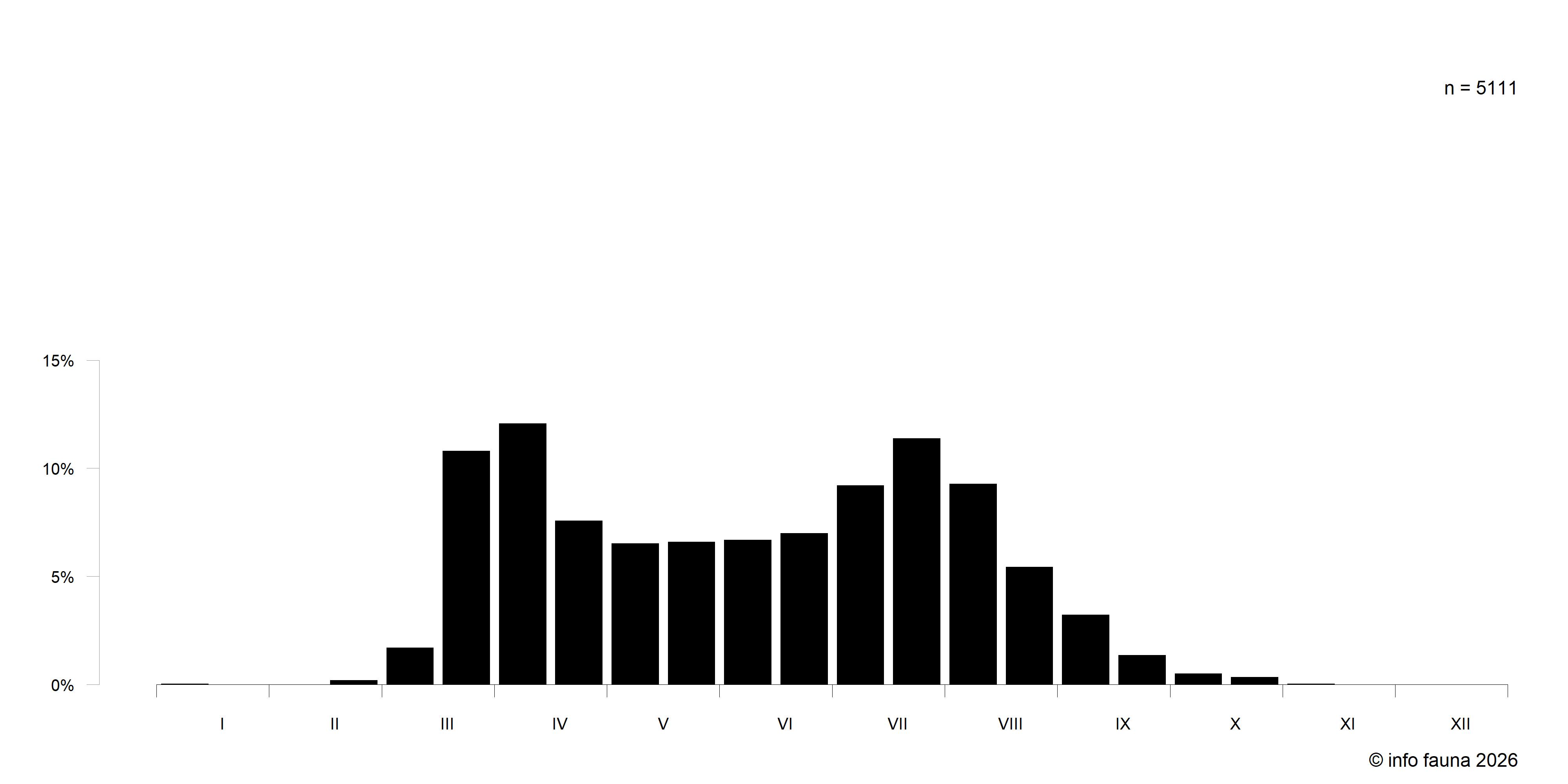
Période des observations de Bombus terrestris en Suisse. Le graphique montre la proportion de toutes les observations par quinzaine.
Classification
- Arthropoda (Phylum)
- Insecta (Classe)
- Hymenoptera (Ordre)
- Apidae (Famille)
- Bombus (Genre)
- Apidae (Famille)
- Hymenoptera (Ordre)
- Insecta (Classe)
Portrait de l'espèce
Auteur-e-s
Dimitri Bénon, Sophie Giriens, Christophe Praz
Portrait
Description et taxonomie
Bombus terrestris est une espèce de grande taille qui fait partie du sous-genre Bombus sensu stricto. Ce sous-genre comprend quatre espèces cryptiques en Suisse, regroupées ici sous le nom de "groupe B. terrestris". Ce groupe comprend B. terrestris, B. lucorum, B. cryptarum et B. magnus. Ces espèces sont caractérisées par le thorax à pilosité noire avec le collare jaune ; l'abdomen à pilosité noire sur les tergites 1 et 3, jaune sur le tergite 2 et blanche à l’extrémité. Contrairement à B. argillaceus, B. hortorum, B. jonellus et B. ruderatus, la pilosité du scutellum est noire.
Les femelles de B. terrestris ne peuvent pas être reconnues sur le terrain, à l'exception des reines possédant un collare fin et jaune très sombre. Les autres espèces ont généralement un collare plus large et/ou jaune-citron. Attention cependant, certaines reines de B. lucorum et B. cryptarum ont un collare sombre ou réduit. Une identification sûr nécessite donc toujours une observation sous la loupe binoculaire.

Reine sur Erica carnea. Cette forme au collare très fin peut être reconnue sur le terrain (Neuchâtel, fin mars 2018). Photo © Sophie Giriens.
Contrairement à B. lucorum et à B. magnus, les mâles de B. terrestris ont la pilosité du clypeus et du vertex entièrement sombre, un caractère partagé toutefois avec B. cryptarum. Les mâles de B. terrestris peuvent donc être identifiés sur le terrain en dehors de l'aire de distribution de B. cryptarum.

Mâle sur Centaurea jacea (France, département de l'Ain, fin septembre 2014). Photo © Sophie Giriens.
Le statut des espèces du groupe de B. terrestris est resté longtemps controversé. Plusieurs études récentes utilisant des méthodes moléculaires (barcoding et microsatellites) ou chimiques (électrophorèse enzymatique et analyse des sécrétions labiales des mâles) montrent cependant que les quatre espèces sont bel et bien distinctes. (Pamilo et al. 1984, Bertsch et al. 2005, Bertsch & Schweer 2012, Carolan et al. 2012, Williams et al. 2012a, Vesterlund et al. 2014, Giriens 2015, McKendrick et al. 2017).
Biologie et habitat
Habitat
Bombus terrestris est une espèce ubiquiste. On retrouve ce bourdon dans de nombreux habitats, principalement dans les milieux ouverts, y compris en zone urbaine.
Sources de pollen
B. terrestris a une langue de taille moyenne à courte. L'espèce est très généraliste et récolte le pollen de presque toutes les familles de plantes, sur les fleurs indigènes comme cultivées. Parmi ses plantes-hôtes régulières se trouvent les Fabaceae, les Rosaceae, les Lamiaceae et les Orobanchaceae. (Teper 2006, Kleijn & Raemakers 2008, Leonhardt & Blüthgen 2012).
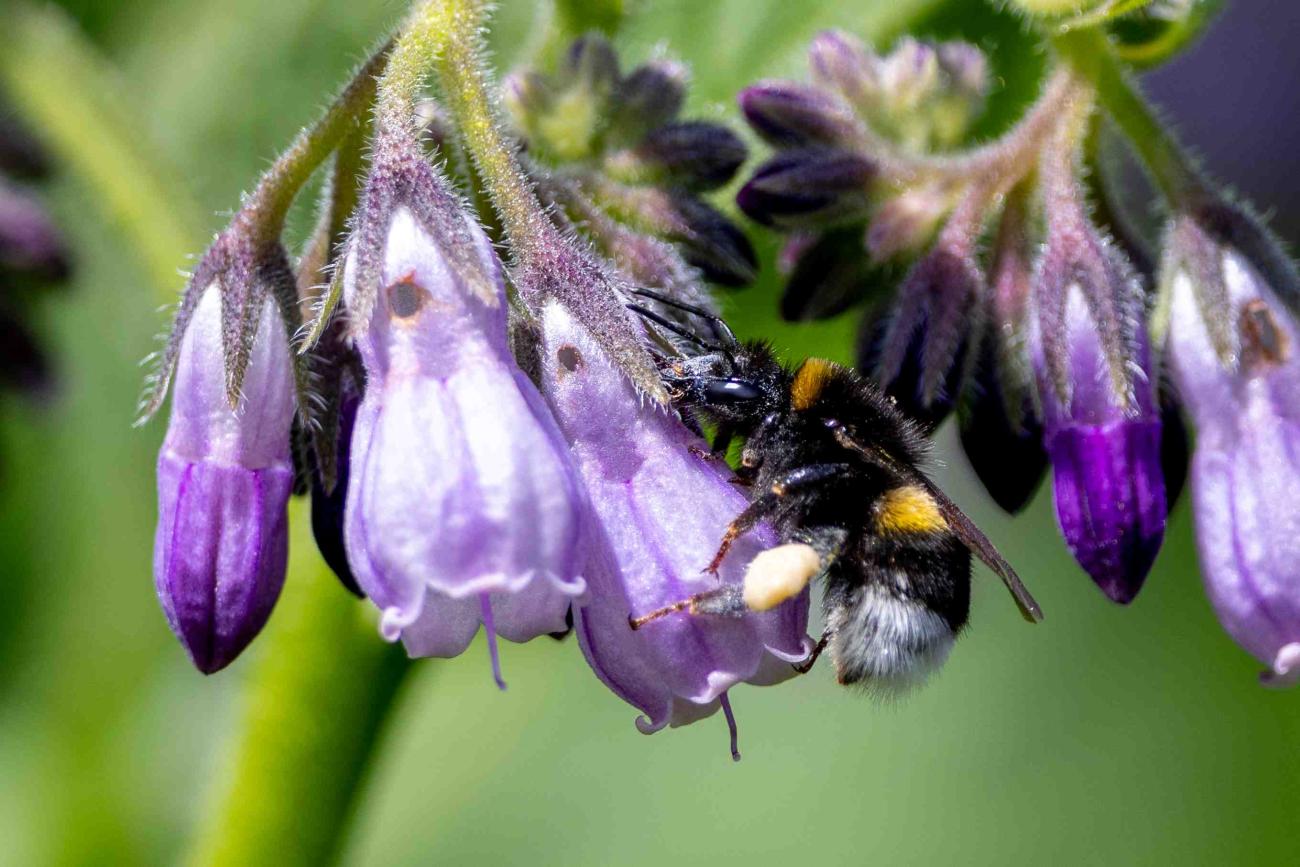
Ouvrière pratiquant un vol de nectar sur une fleur de Symphytum officinale (Ollon VD, début mai 2025). Photo © Sophie Giriens.
B. terrestris est un bourdon capable de parcourir des distances importantes pour obtenir des ressources: des ouvrières ont été retrouvées à plus de 2 km de leur nid en train de récolter. L'espèce est aussi connue pour voler le nectar des fleurs à longue corolle en faisant une incision à la base de la fleur à l’aide de ses mandibules. (Walther-Hellwig & Frankl 2000, Goulson et al. 2002, Benton 2006).
Nidification
B. terrestris construit généralement des nids souterrains, le plus souvent dans des terriers de petits mammifères. Il peut cependant aussi utiliser d'autres structures, notamment des cavités artificielles. La taille des colonies est souvent importante, avec en moyenne environ 160 ouvrières au moment où la colonie est la plus populeuse, certaines colonies atteignant plusieurs centaines d'individus. C’est un pollen storer. (Goulson et al. 2002, Benton 2006).

Ouvrière à l'entrée de son nid (Jardin botanique de Genève, mi-avril 2015). Photo © Sophie Giriens.
Espèces parasites
B. terrestris est parasité par B. vestalis. Différents autres organismes, notamment des diptères, parasitent aussi B. terrestris. (Benton 2006, Martin et al. 2010).
Comportement de reproduction
Les mâles de B. terrestris patrouillent le long de circuits marqués par des phéromones. Goulson et al. (2011) ont aussi montré qu’ils avaient tendance à faire du hilltopping.
Distribution
Cycle de vie
Bombus terrestris est l'une des espèces de bourdons les plus précoces de la faune suisse. Les reines hivernantes sortent déjà de leur diapause au mois de mars. On dispose de peu d'informations concernant la phénologie des ouvrières en raison des difficultés d'identification. Les mâles peuvent apparaître déjà début mai dans les régions les plus chaudes de Suisse, mais en général ils volent de fin mai à fin septembre. Certaines observations de mâles très précoces provenant d'endroits chauds de Suisse, notamment du Tessin, posent certaines questions sur la phénologie de l'espèce: on ne sait toujours pas exactement si ce sont des mâles qui ont réussi à passer l'hiver lors d'années particulièrement chaudes ou si des colonies entières sont capables de passer l'hiver, comme cela semble être le cas pour B. terrestris et B. lucorum au sud de l'Angleterre. (Neumeyer & Moretti 2005, Benton 2006).
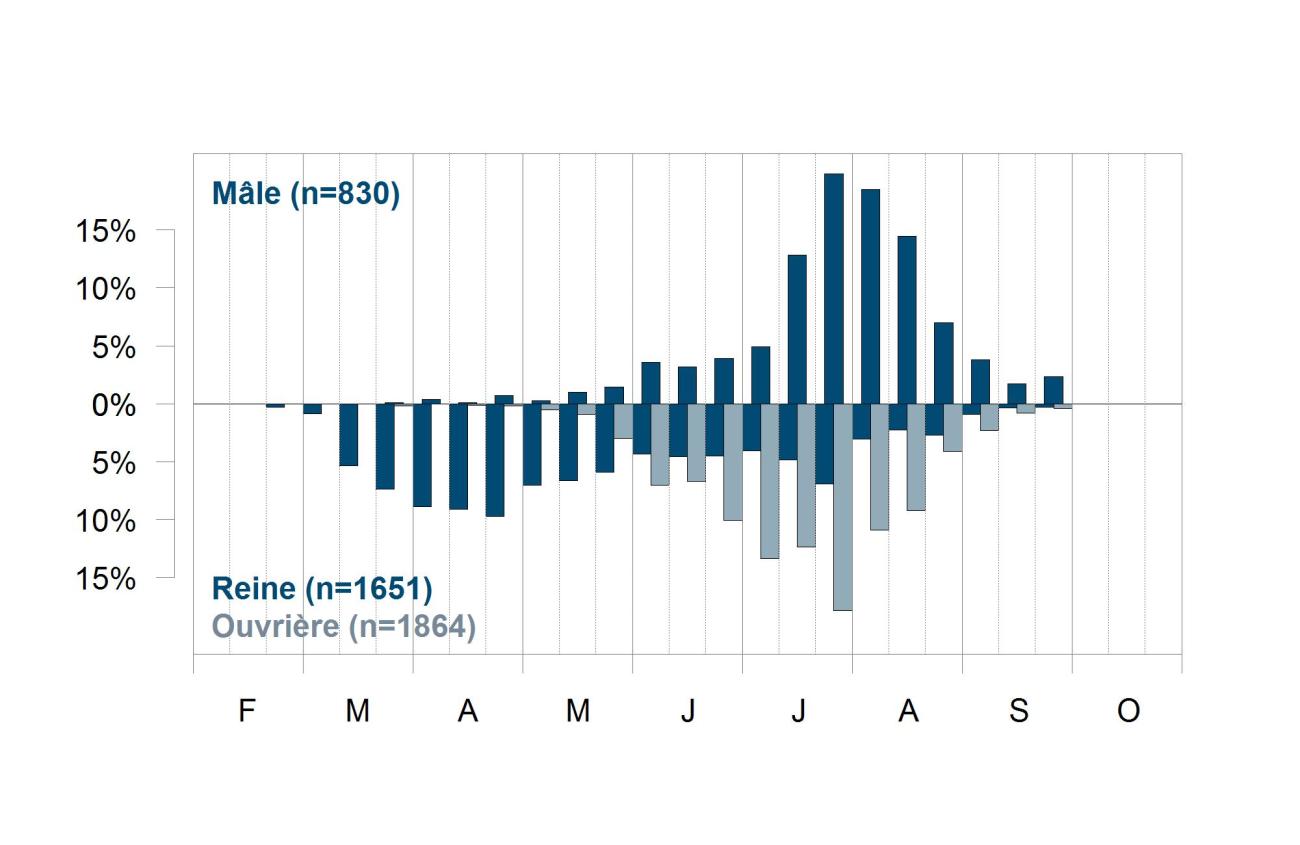
Phénologie de Bombus lucorum en Suisse.
Distribution
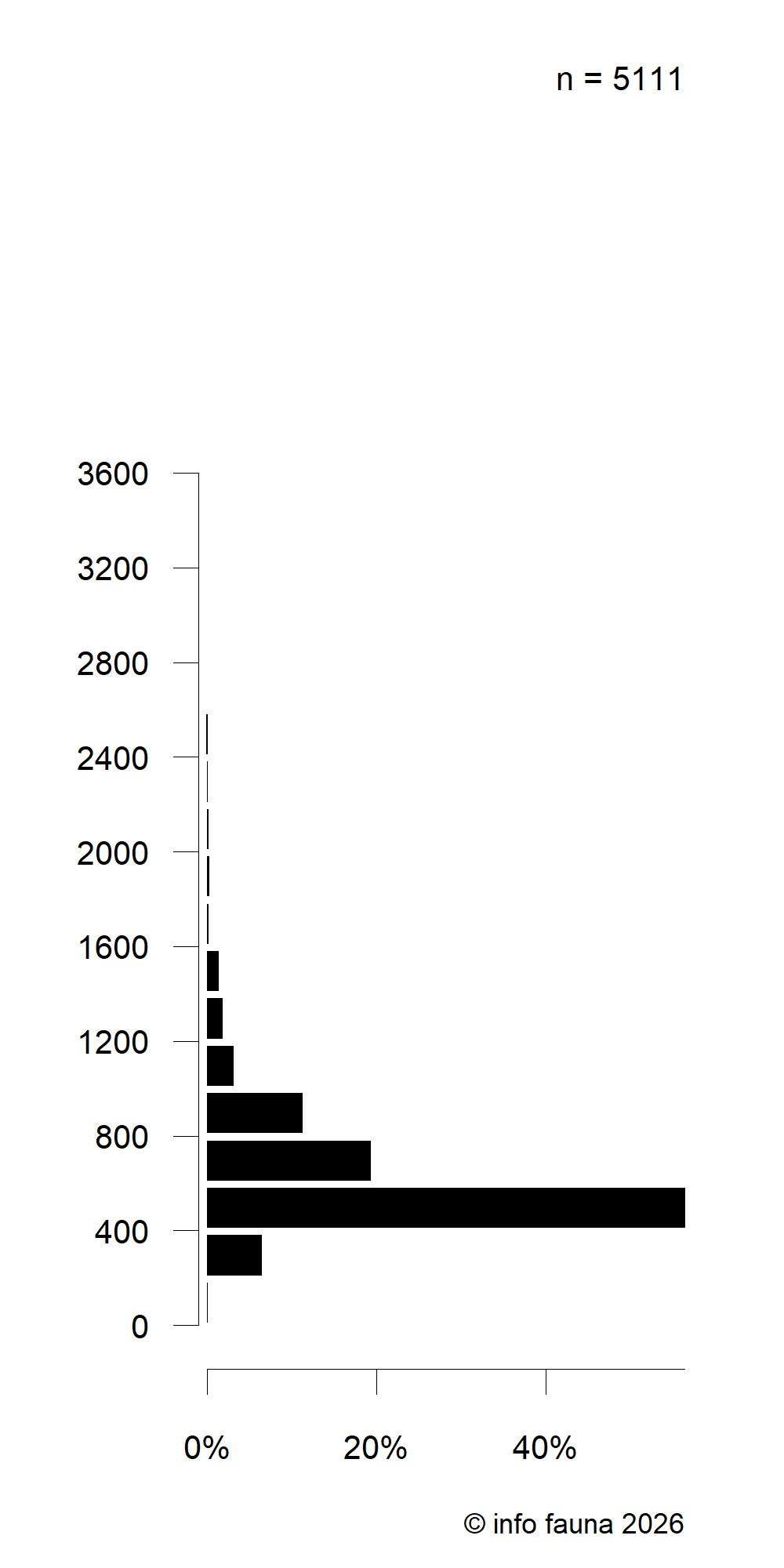
B. terrestris est largement distribué dans tout le pays. Il s'agit de l'espèce la plus abondante du groupe B. terrestris à basse altitude.
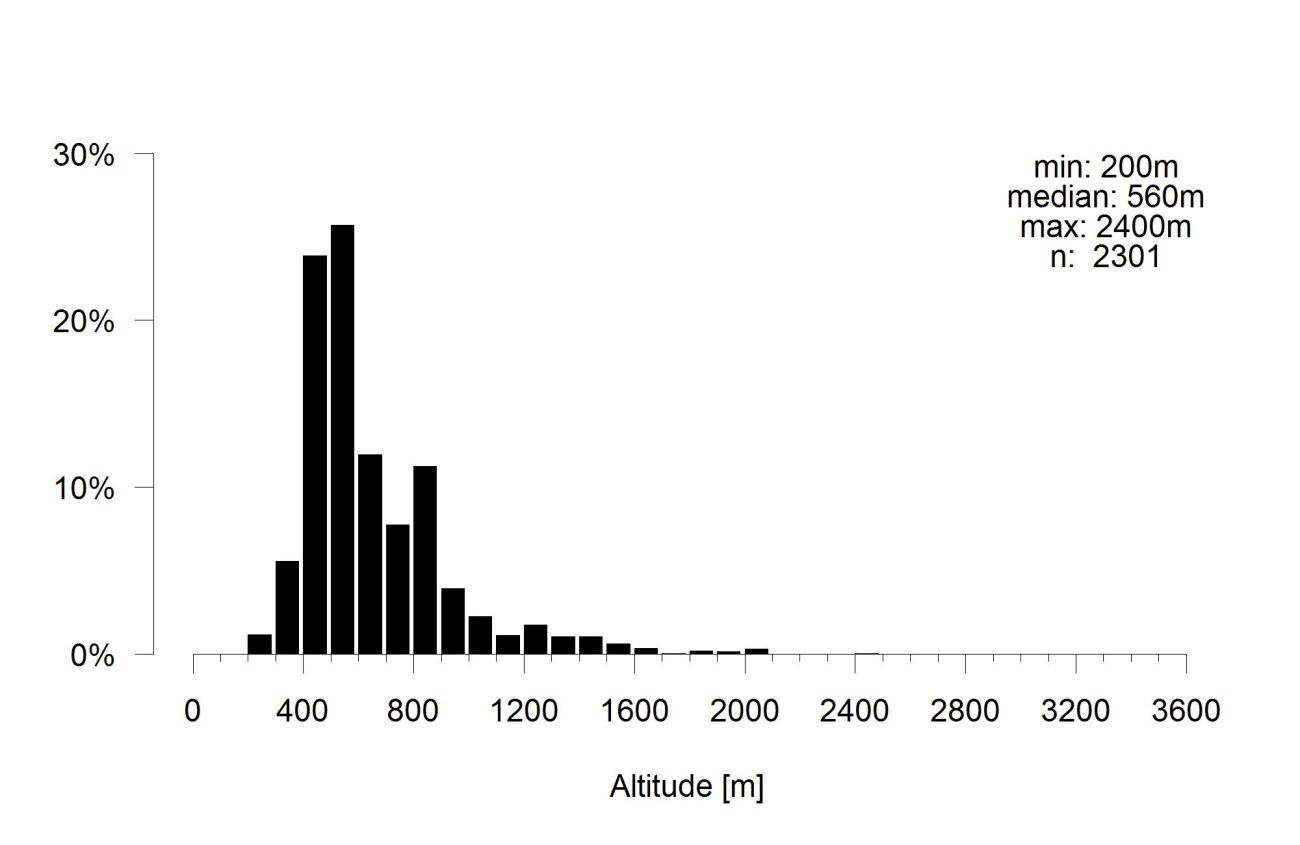
Distribution altitudinale de Bombus terrestris en Suisse.
Conservation
Cette page n'a malheureusement pas été traduite dans la langue sélectionnée. Elle s'affiche dans la langue de l'auteur.
Bedrohungsstatus
Bombus terrestris wird in der Roten Liste als nicht bedroht (LC) eingestuft (Müller & Praz 2024). Damit gehört sie nicht zu den gefährdeten Arten und ist keine Rote Liste Art. Es ist eine der häufigsten Arten in der Schweiz. Die Art ist nicht nur in Europa natürlich verbreitet, sondern wurde auch auf vielen anderen Kontinenten eingeführt, da sie seit mehreren Jahrzehnten zu Bestäubungszwecken gezüchtet und gehandelt wird. (Goulson 2003, Toretta et al. 2006).