Direkt zum Inhalt

Trachemys scripta elegans

(Wied, 1839)
Rotwangen-Schmuckschildkröte
Vorkommen in der Schweiz

Eingeführt, verboten nach Anhang 2 FrSV (NLV)

Gefährdung und Schutz ⓘⓧ

Gefährdungsgrad
Gemäss den Kategorien und Kriterien der Roten Liste der IUCN oder gemäss Duelli et al. 1994.
(exp = Einschätzung von Expert*innen)

Schutzstatus (CH)
Gemäss den entsprechenden nationalen Gesetzen und Verordnungen.

Gefährdungsgrad (CH)

Regional nicht beurteilt (NE)

Schutzstatus (CH) ⓘⓧ

Gemäss den aufgeführten Gesetzen und Verordnungen

–
Gesetze und Verordnungen
–
Förderung ⓘⓧ
Nationale Priorität
–
Handlungsebene
–
Hinweis zur Handlungsebene
–
Dringlichkeit (CH)
–
Sicherung Einzelvorkommen
–
Bestandsüberwachung
–
Massnahmen ⓘⓧ

Landwirtschaft (OEA/UZL)
Zielart/Leitart gemäss: Umweltziele Landwirtschaft „Arten und Lebensräume“.
(* = Einschätzung von Expert*innen)

Wälder
2: Waldzielart gemäss: Biodiversität und Wald: Ziele und Massnahmen. Vollzugshilfe zur Erhaltung und Förderung der biologischen Vielfalt im Schweizer Wald (Imesch et al. 2015).

1: Ergänzende Zielart im Wald, definiert im Rahmen von BAFU-Aktionsplänen (z. B. Aktionsplan Lichte Wälder).

Landwirtschaft (UZL)
–
Wald
–
    ✓

    Taxon gut untersucht, Karte nahe an der tatsächlichen Verbreitung Mehr Info

    Karte
    Trachemys scripta elegans
    Karte der Beobachtungen von Trachemys scripta elegans in der Schweiz (Auflösung 5 x 5 km).Karte anschauen
    Zeitraum der Beobachtungen von <em>Trachemys scripta elegans</em> in der Schweiz. Die Grafik zeigt den Anteil aller Beobachtungen pro zwei Wochen.
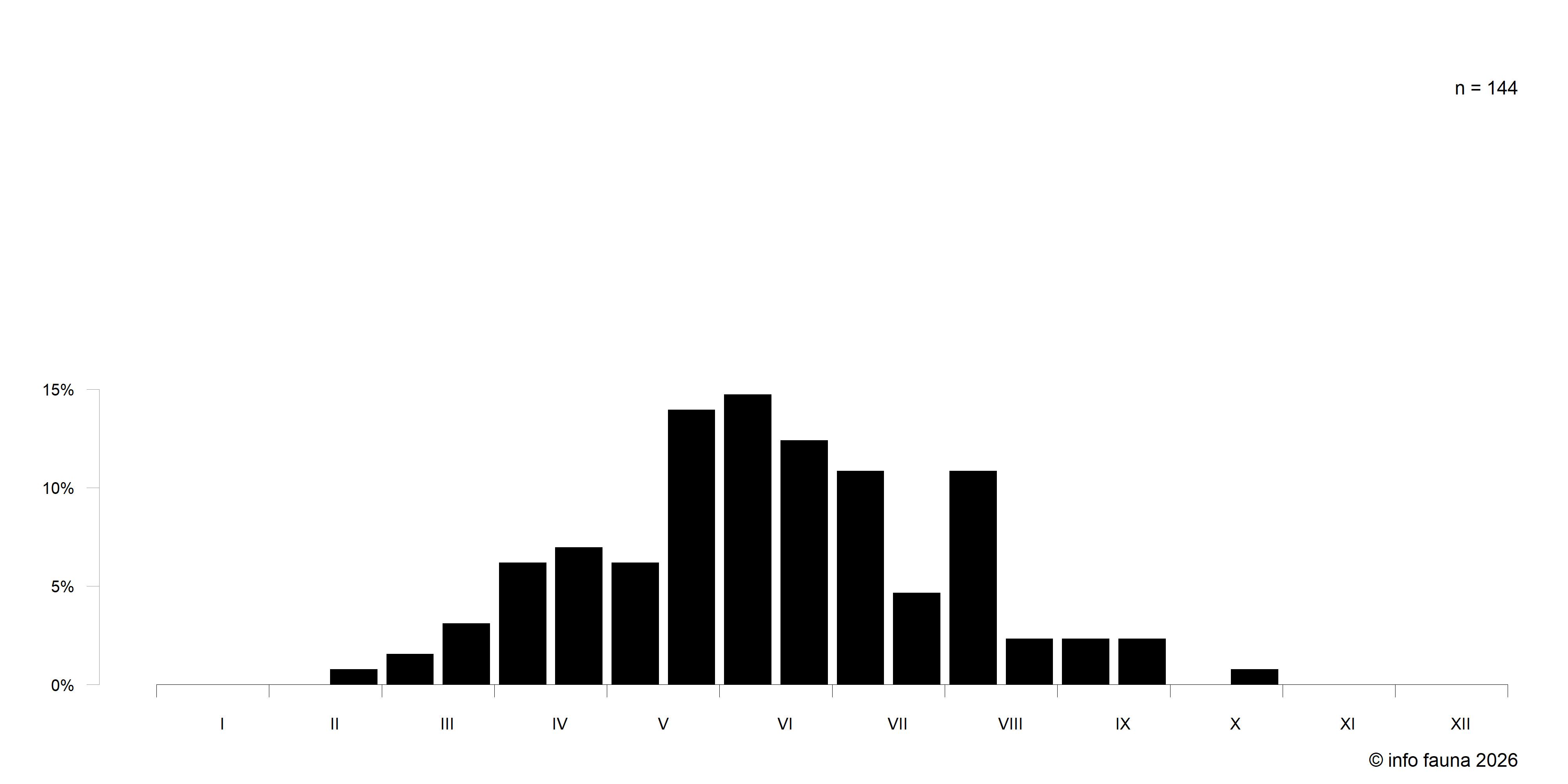
    Zeitraum der Beobachtungen von Trachemys scripta elegans in der Schweiz. Die Grafik zeigt den Anteil aller Beobachtungen pro zwei Wochen.
    Klassifikation

    • Chordata (Phylum)
      • Reptilia (Klasse)
        • Chelonii (Ordnung)
          • Emydidae (Familie)
            • Trachemys (Gattung)

    Literaturangaben

    Balzani, P., Vizzini, S., Santini, G., Masoni, A., Ciofi, C., Ricevuto, E., & Chelazzi, G. (2016). Stable isotope analysis of trophic niche in two co-occurring native and invasive terrapins, Emys orbicularis and Trachemys scripta elegans. Biological Invasions, 18.0(12), 3611-3621.
    Cadi, A., & Joly, P. (2003). Competition for basking places between the endangered European pond turtle ( Emys orbicularis galloitalica ) and the introduced red-eared slider ( Trachemys scripta elegans ). Canadian Journal of Zoology, 81.0(8), 1392-1398.
    Cadi, A., & Joly, P. (2004). Impact of the introduction of the red-eared slider (Trachemys scripta elegans) on survival rates of the European pond turtle (Emys orbicularis). Biodiversity and Conservation, 13.0(13), 2511-2518.
    Cagle, F. R. (1946). The growth of the slider turtle, Pseudemys scripta elegans. American Midland Naturalist, 36, 685-739.
    Costa, Z. J. (2014). Responses to predators differ between native and invasive freshwater turtles: environmental context and its implication for competition. Ethology, 120, 1-8.
    Demkowska-Kutrzepa, M., Studzinska, M., Roczen-Karczmarz, M., Tomczuk, K., Abbas, Z., & Rozanski, P. (2018). A review of the helminths co-introduced with Trachemys scripta elegans – a threat to European native turtle health. Amphibia-Reptilia, 39, 177-189.
    Héritier, L., Valdeón, A., Sadaoui, A., Gendre, T., Ficheux, S., Bouamer, S., ... & Verneau, O. (2017). Introduction and invasion of the red-eared slider and its parasites in freshwater ecosystems of Southern Europe: risk assessment for the European pond turtle in wild environments. Biodiversity and Conservation, 26.0(8), 1817-1843.
    Lever, C. (2003). Naturalized reptiles and amphibians of the world. Oxford University Press.
    Meyer, L., Du Preez, L., Bonneau, E., Héritier, L., Quintana, M., Valdeón, A., ... & Verneau, O. (2015). Parasite host-switching from the invasive American red-eared slider, Trachemys scripta elegans, to the native Mediterranean pond turtle, Mauremys leprosa, in natural environments. Aquatic Invasions, 10.0(1), 79-91.
    Prévot-Julliard, A., Gousset, E., Archinard, C., Cadi, A., & Girondot, M. (2007). Pets and invasion risks: is the Slider turtle strictly carnivorous?. Amphibia-Reptilia, 28.0(1), 139-143.