
Vorkommen in der Schweiz
Eingeführt, invasiv (NLS)
ⓘⓧ
Gefährdungsgrad
Gemäss den Kategorien und Kriterien der Roten Liste der IUCN oder gemäss Duelli et al. 1994.
(exp = Einschätzung von Expert*innen)
Schutzstatus (CH)
Gemäss den entsprechenden nationalen Gesetzen und Verordnungen.
Gefährdungsgrad (CH)
Regional nicht beurteilt (NE)
Schutzstatus (CH)
ⓘⓧ
Gemäss den aufgeführten Gesetzen und Verordnungen
–
Gesetze und Verordnungen
–
ⓘⓧ
Gemäss der Vollzugshilfe: Liste der national prioritären Arten der Schweiz.
Nationale Priorität
–
Handlungsebene
–
Hinweis zur Handlungsebene
–
Dringlichkeit (CH)
–
Sicherung Einzelvorkommen
–
Bestandsüberwachung
–
ⓘⓧ
Landwirtschaft (OEA/UZL)
Zielart/Leitart gemäss: Umweltziele Landwirtschaft „Arten und Lebensräume“.
(* = Einschätzung von Expert*innen)
Wälder
2: Waldzielart gemäss: Biodiversität und Wald: Ziele und Massnahmen. Vollzugshilfe zur Erhaltung und Förderung der biologischen Vielfalt im Schweizer Wald (Imesch et al. 2015).
1: Ergänzende Zielart im Wald, definiert im Rahmen von BAFU-Aktionsplänen (z. B. Aktionsplan Lichte Wälder).
Landwirtschaft (UZL)
–
Wald
–
✓
Taxon gut untersucht, Karte nahe an der tatsächlichen Verbreitung Mehr Info
Karte
Karte der Beobachtungen von Vespa velutina in der Schweiz (Auflösung 5 x 5 km).Karte anschauen
Zeitraum
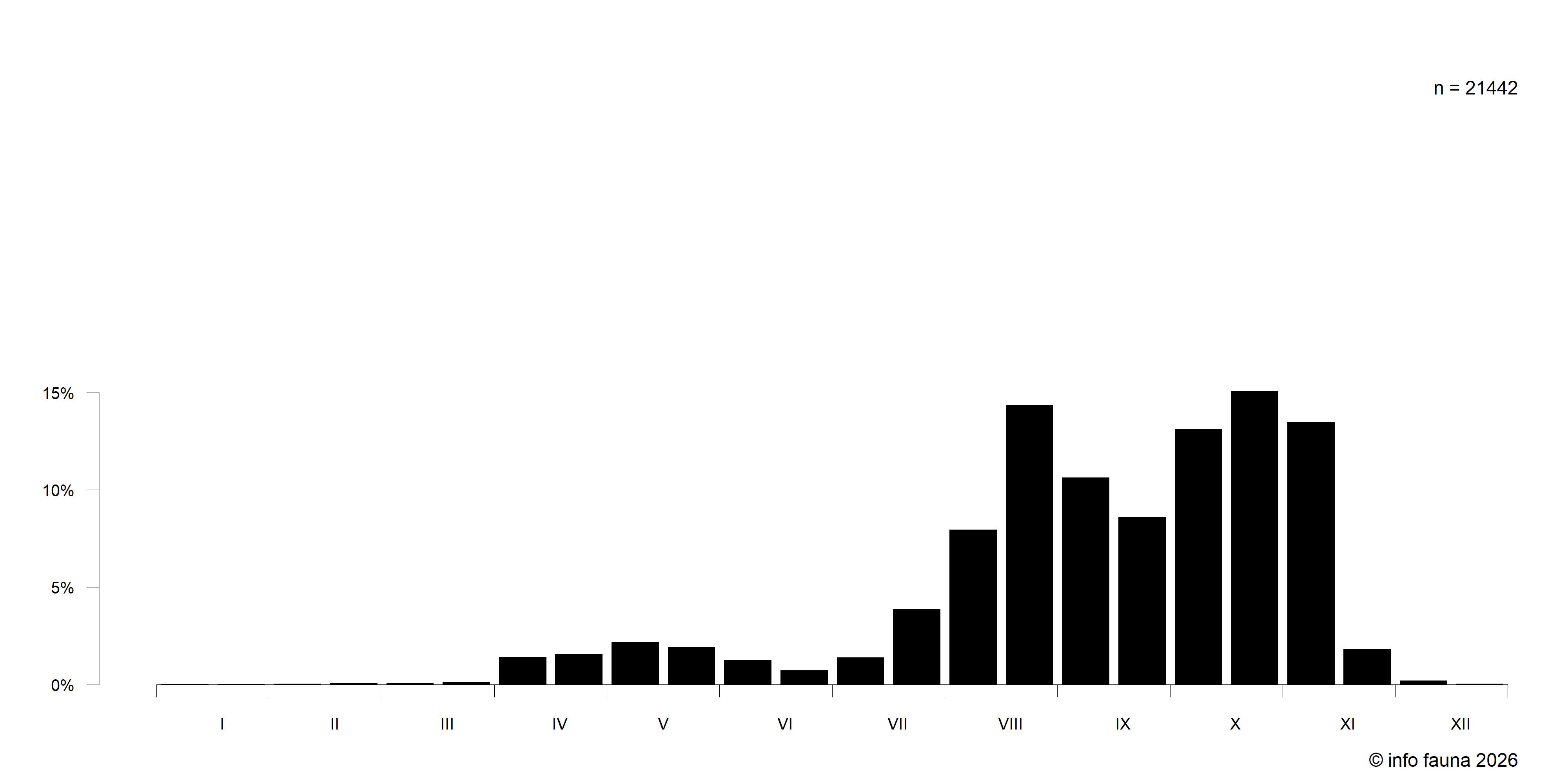
Zeitraum der Beobachtungen von Vespa velutina in der Schweiz. Die Grafik zeigt den Anteil aller Beobachtungen pro zwei Wochen.
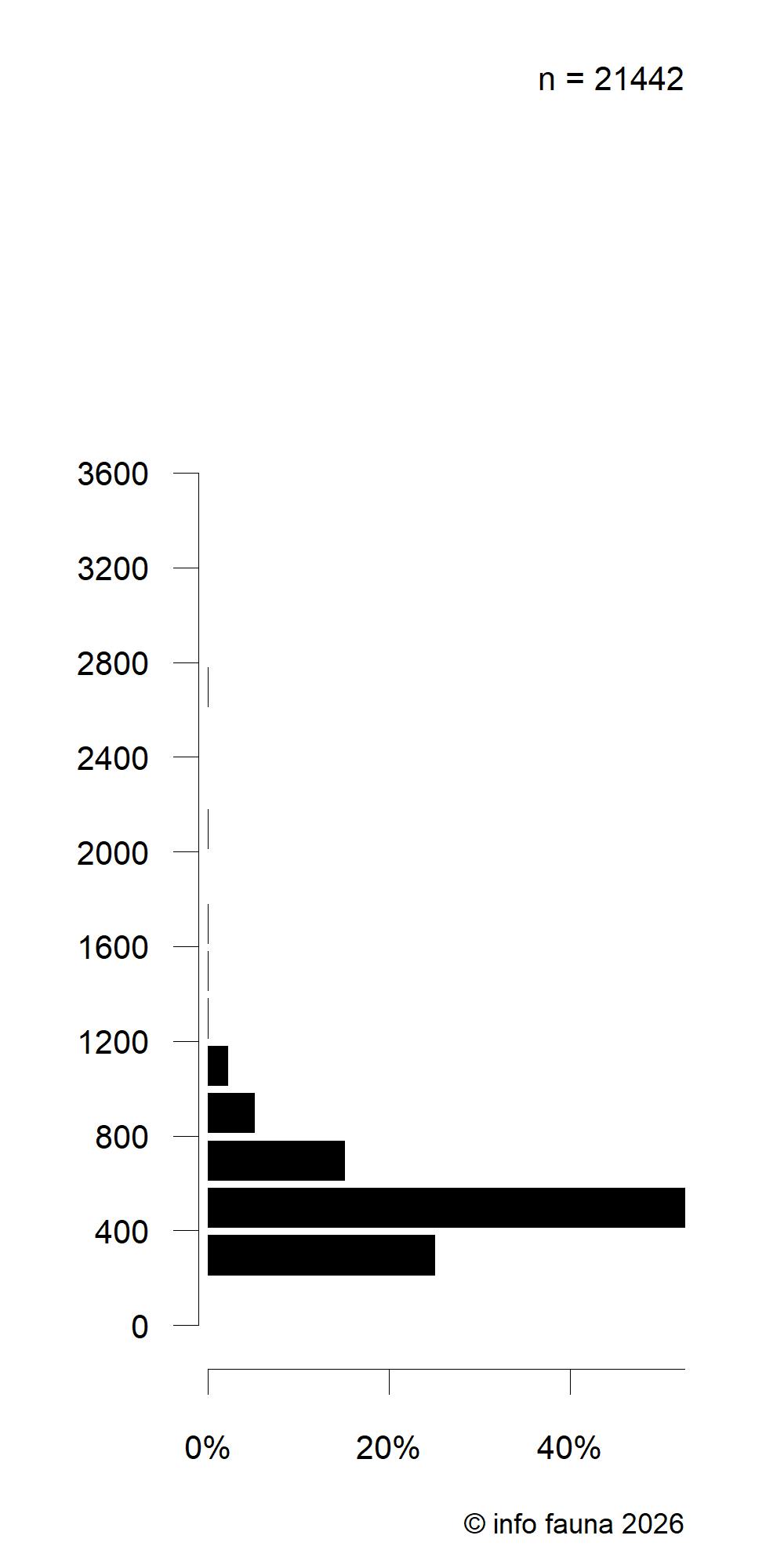
Klassifikation
- Arthropoda (Phylum)
- Insecta (Klasse)
- Hymenoptera (Ordnung)
- Vespidae (Familie)
- Vespa (Gattung)
- Vespidae (Familie)
- Hymenoptera (Ordnung)
- Insecta (Klasse)
Weitere Informationen
Artporträt
Autor-inn-en
Daniel CHERIX et Lukas SEEHAUSEN (1ère version) ; Charlotte DUCOTTERD
Porträt
Beschreibung
Die Asiatische Hornisse hat eine Grösse von 17 bis 32 mm. Typische Merkmale sind ein orangefarbenes Gesicht, ssein schmaler gelber Streifen auf dem ersten Hinterleibssegment und in der Mitte des Hinterleibs ein orangefarbener Streifen. Die Tarsen sind markant gelb.
Bestimmungsmerkmale
Neben der Farbe und ihrer Grösse kann man die Asiatische Hornisse auch daran erkennen, dass ihr Körper sehr dunkel ist und beim Fliegen den Eindruck erweckt, schwarz zu sein. Dies unterscheidet sie eindeutig von der Europäischen Hornisse, deren Färbung im Flug rehbraun bis rötlich erscheint.
Verwechslungsmöglichkeiten
Die Asiatische Hornisse kann mit mehreren Arten verwechselt werden, darunter die Europäische Hornisse (Vespa crabro), die Rote Wespe (Vespula rufa) oder die Mittlere Wespe (Dolichovespula media).
Hier vergleichen wir die Europäische Hornisse, die eine Grösse von 25 bis 35 mm hat und damit grösser als die Asiatische Hornisse ist. Ausserdem hat sie ein gelbes Gesicht, schwarze und braunrote Beine und einen überwiegend gelben Körper, was sie vor allem im Flug von der Asiatischen Hornisse unterscheidet.

Unterschied zwischen der Asiatischen Hornisse (Vespa veluntina) und der Europäischen Hornisse (Vespa crabro). Photo © Quentin Rome / MHHN, www.frelonasiatique.ch.
Biologie und Lebensraum
Lebensraum
In ihrem ursprünglichen Lebensraum lebt die Asiatische Hornisse hauptsächlich in Waldgebieten, aber mit der Ausbreitung der Urbanisierung auf Kosten der Wälder siedelt sie sich auch in stadtnahen Gebieten an (Sheng & Xing, 2005). In subtropischem Klima ist die Varietät nigrithorax auf die Bergregionen beschränkt (Van der Vecht, 1957). In Frankreich legt die Asiatische Hornisse ihr Nest bevorzugt in den hohen Ästen grosser Bäume an, sowohl in städtischen und landwirtschaftlichen Gebieten als auch in Waldgebieten (Rome et al., 2009; Rome et al., 2015). Sie scheint für die Ausbreitung von Flusstälern und Hauptverkehrsachsen zu profitieren.
Ernährung
Wie alle Hornissen ist auch die Asiatische Hornisse ein generalistischer Räuber und ernährt sich hauptsächlich von Insekten, manchmal auch von anderen Arthropoden (Rome et al., 2021). Sie jagt vor allem Hautflüglerdarunter auch Honigbienen, die ihren Bienenstock in der Nähe haben, aber manchmal auch Zweiflügler, Schmetterlingsraupen und Spinnen. Diese Insekten liefern Proteine und sind für die Ernährung der Larven bestimmt. Die Fütterung mit Honigtau, Nektar, Honig oder reifen Früchten ist wichtig für den Energiehaushalt der erwachsenen Tiere (Peré & Kenis, 2010). Forscher analysierten Beutekugeln von V. veluntina und fanden ein breites Beutespektrum, das je nach Nestumgebung variiert (Rome et al., 2021); städtische Kolonien jagen mehr Honigbienen und Waldvölker mehr soziale Wespen. Die Intensität der Futtersuche erreicht Anfang Oktober ihren Höhepunkt. Ein einzelnes Volk kann in einer Saison durchschnittlich 11,32 kg Insektenbiomasse verzehren (Rome et al., 2021).
Verhalten / Ökologie
Die Asiatische Hornisse ist eine überwiegend tagaktive Art. Im Gegensatz zur Europäischen Hornisse stellt sie alle Aktivitäten ausserhalb des Nestes ein, sobald die Nacht hereinbricht.
Fortpflanzung / Lebenszyklus
Die Asiatische Hornisse ist ein koloniebildendes Insekt. Je nach Region und aktuellem Klima erwacht die junge Königin zwischen März und April bei einer Temperatur von 12- 15 °C aus dem Winterschlaf und sucht sich einen Platz, um ein Primärnest zu bauen. Dazu nutzt sie eher geschützte Stellen, z.B. einen Dachvorsprung. Sie legt einige Eier und kümmert sich um die ersten Larven. Diese entwickeln sich je nach Temperatur in vier bis sechs Wochen zu erwachsenen Arbeiterinnen, die sich um den Nestbau und die Brutpflege kümmern. Ab diesem Zeitpunkt widmet sich die Königin ausschliesslich der Eiablage.
In etwa 70% der Fälle zieht die wachsende Kolonie um und baut ein Sekundärnest. Das Sekundärnest befindet sich in der Regel in einer Baumkrone, oft mehr als 10 m über dem Boden. Im Hochsommer, wenn die Kolonie sehr aktiv ist, entwickelt sich das Sekundärnest weiter. Es kann erheblich grösser werden als das Primärnest. Im Frühherbst entwickeln sich die Männchen und fruchtbaren Weibchen, die sich verpaaren. Im Oktober und November verlassen die befruchteten Jungköniginnen das Nest. Nur die Jungköniginnen überwintern, während die Männchen, die letzten Larven und die Arbeiterinnen sterben. Das Nest wird nur eine Saison lang genutzt. Jin jeder Saison kann ein Volk mehrere tausend Tiere hervorbringen, fast dreimal so viele wie die einheimische Hornisse (Vespa crabro). Die Flugzeit erstreckt sich von Mai bis Ende November.

Primärnest von V. velutina in einem Vogelnistkasten. Foto © www.frelonasiatique.ch

Untersuchung eines Sekundärnests von V. velutina. Foto © Daniel Cherix

Sekundärnest von V. velutina. Foto © Paula Jorge
Verbreitung
Ursprüngliche Verbreitung
Die Asiatische Hornisse stammt ursprünglich aus den Regionen zwischen Afghanistan und Ostchina, Indochina und Indonesien.
Situation weltweit und in Europa
Sie wurde 2004 in Südfrankreich, Departement Lot-et-Garonne, nach Europa eingeschleppt (Haxaire et al., 2006). Seit ihrem ersten Nachweis hat sich die Asiatische Hornisse in Spanien, Portugal, Italien, Deutschland, Belgien und anderen europäischen Ländern ausgebreitet.¨
Situation in der Schweiz
Die Art wurde 2017 zum ersten Mal im Kanton Jura beobachtet. Die Art ist aus den in Frankreich angesiedelten Populationen in die Schweiz gelangt. Ab 2019 in den Kantonen Genf, Waadt und Freiburg. Bis 2023 hat sie über Bern und Zürich die halbe Schweiz besiedelt. Der Ausbreitungstrend für diese Art ist sehr stark. In der Schweiz umfasst das Risikogebiet für die Ausbreitung das Mittelland, den Jurabogen und die Alpentäler.
Ausbreitung
Eintrittspforte: Einschleppung aus dem benachbarten Frankreich, hauptsächlich über die französisch-schweizerische Grenze (Genf, Jura)
Geschichte der Ausbreitung:
- April 2017: Erste bestätigte Beobachtung in der Schweiz - Fang einer Königin in Fregiécourt (Kanton Jura)
- 2019: Beginn der Ausbreitung in mehreren Kantonen
- 2023: Beschleunigte Expansion - 7 betroffene Kantone
- 2024: Fortgesetzte Expansion in den Kantonen BE, VD, GE, JU, NE, FR, SO und BL, wo die Art als etabliert gilt
- 2025: Ausbreitung im Wallis
Ausbreitungsmechanismen:
Menschliche Aktivitäten:
- Passive Verbreitung: Versehentlicher Transport in Fahrzeugen
- Waren Nähe zu Frankreich: Genf als Haupteinfallstor (mehr als 300 Nester im französischen Ain im Jahr 2023 gemeldet)
Natürliche Faktoren:
- Flug der Königinnen
- Bestätigte Ausbreitungsdistanz: Die Invasionsfront schreitet durchschnittlich 78 bis 80 km pro Jahr voran (Rome et al., 2015; Robinet et al., 2017)
- Schneller Fortpflanzungszyklus
Massnahmen
Schäden
Als Fressfeind kann die Asiatische Hornisse Honigbienenvölkern schwächen, die Honigproduktion beeinträchtigen und zu wirtschaftlichen Verlusten führen, was vor allem Imkern fürchten. Hinzu kommt die Gefahr durch die Jagd auf anderen nützlichen einheimischen Insekten. Da ihre Ökologie ähnlich ist, ist auch eine Konkurrenz mit den einheimischen Hornissen möglich (Péré & Kenis, 2010).
Rechtliche Grundlagen
Die Verantwortung für die Bekämpfung der Asiatischen Hornisse liegt bei den Kantonen (Art. 52 der Verordnung über den Umgang mit Organismen in der Umwelt FrSV). Falls erforderlich, übernimmt der Bund eine Koordinationsrolle.
(Schutz-) Massnahmen
Es ist wichtig, alle Verdachtsfälle der Asiatischen Hornisse so schnell wie möglich direkt auf der Website www.frelonasiatique.ch zu melden. Nur so können die Nester rechtzeitig gefunden und vor der Brutzeit zerstört werden.
Die Bekämpfung der Asiatischen Hornisse sollte nur von Spezialisten vorgenommen werden. In der Schweiz wird derzeit eine Task Force eingerichtet, mit dem Ziel, die Nester aufzuspüren. Die Nester lassen sich heute mit Hilfe von Funksendern, die an eingefangenen Arbeiterinnen befestigt werden, aufspüren. Anschliessend werden Spezialisten beauftragt, die Nester zu beseitigen, normalerweise in der Nacht, damit der grösste Teil der Kolonie zerstört werden kann. Um zu verhindern, dass neue Königinnen das Nest verlassen, sich paaren und im nächsten Jahr neue Kolonien gründen, sollten die Nester möglichst entfernt werden, bevor die begatteten Weibchen im Herbst das Nest verlassen.
Vom Aufstellen von Fallen ist aus mehreren Gründen abzuraten. Räuberische Hornissen suchen nach Proteinen, um ihre Larven zu ernähren. Die häufig in Fallen verwendeten zuckerbasierten Lockstoffe sind für sie daher nicht sehr attraktiv. Die meisten Arten von Fallen sind beim Fangen der Asiatischen Hornisse sehr ineffizient und daher nutzlos. Fast alle Fallen, insbesondere Fallen in Flaschen mit einem flüssigen Lockstoff, sind nicht selektiv und fangen auch viele andere Insektenarten. Dies richtet mehr Schaden an als es nützt. Ausserdem ist nicht erwiesen, dass das Aufstellen von Fallen am Bienenstand den Druck auf die Bienenvölker verringert. In einigen Kantonen ist das Fangen von Insekten grundsätzlich verboten und erfordert eine Sondergenehmigung.
Sollten sich die asiatischen Hornissen in der Region niedergelassen haben, können Imker ab August vergitterte Volieren vor ihren Bienenstöcken aufstellen, um die Auswirkungen auf die Honigbienen zu mindern (Cherix et al. 2021).
Fundorte melden
Um die Ausbreitung der Asiatischen Hornisse zu verfolgen, ist es wichtig, die Standorte, an denen sie beobachtet wurde, den zuständigen Behörden (Gemeinden, Kantone) zu melden. Dazu können Sie die Schweizer Meldeplattform für die Asiatische Hornisse verwenden: https://www.frelonasiatique.ch/de/
Weitere Informationen
- Asiatische Hornisse Empfehlungen 2024 (pdf) : Empfehlungen AH
- Informationsblatt CABI: Vespa velutina