
Tipo di presenza in Svizzera
Indigena (INN)
ⓘⓧ
Grado di minaccia
Secondo le Categorie e i criteri della Lista Rossa dell’UICN o secondo Duelli et al. 1994.
(exp = valutazione degli/delle esperti/e)
Status di protezione (CH)
Ai sensi delle leggi e alle ordinanze nazionali specifiche.
Grado di minaccia (CH)
Non minacciato (LC)
Status di protezione (CH)
ⓘⓧ
Ai sensi delle leggi e delle ordinanze citate
–
Leggi e Ordinanze
–
ⓘⓧ
Secondo l’aiuto all’esecuzione: Lista delle specie prioritarie a livello nazionale della Svizzera.
Priorità nazionale
–
Livelli operativi
–
Indicazioni sul livello operativo
–
Urgenza temporale con cui attuare (CH)
–
Protezione popolazioni isolate
–
Monitoraggio delle popolazioni
–
ⓘⓧ
Settore agricolo (OEA/UZL)
Specie bersaglio/caratteristiche secondo: Obiettivi ambientali per l’agricoltura “Specie e habitat”.
(* = valutazione degli/delle esperti/e)
Foreste
2: Specie forestale bersaglio secondo: Biodiversität und Wald: Ziele und Massnahmen. Vollzugshilfe zur Erhaltung und Förderung der biologischen Vielfalt im Schweizer Wald (Imesch et al. 2015).
1: Specie forestale bersaglio complementare, definita nell’ambito dei piani d’azione UFAM (ad es. Piano d’azione Boschi radi FR/DE)
Settore agricolo (OEA/UZL)
–
Foreste
–
✓
Taxon ben studiato, mappa vicina alla distribuzione reale Maggiori informazioni
Mappa
Mappa delle osservazioni di Bombus lucorum in Svizzera (risoluzione 5x5 km).Visualizza la mappa
Periodo

Periodo delle osservazioni di Bombus lucorum in Svizzera. Il grafico mostra la proporzione di tutte le osservazioni per quindicina.

Classificazione
- Arthropoda (Phylum)
- Insecta (Classe)
- Hymenoptera (Ordine)
- Apidae (Famiglia)
- Bombus (Genere)
- Apidae (Famiglia)
- Hymenoptera (Ordine)
- Insecta (Classe)
Ritratto della specie
Auteur-e-s
Dimitri Bénon, Sophie Giriens
Ritratto
Description et taxonomie

Reine sur Taraxacum officinale (La Sagne NE, fin avril 2017). Photo © Sophie Giriens.
Bombus lucorum est un bourdon de taille moyenne. Cette espèce fait partie du sous-genre Bombus sensu stricto, qui comprend quatre espèces cryptiques en Suisse, regroupées sous le nom de "groupe B. terrestris". Ce groupe comprend B. terrestris, B. lucorum, B. cryptarum et B. magnus. Ces espèces sont caractérisées par un thorax à pilosité noire avec le collare jaune et un abdomen à pilosité noire sur les tergites 1 et 3, jaune sur le tergite 2 et blanche à l’extrémité. Contrairement à B. argillaceus, B. hortorum, B. jonellus et B. ruderatus, la pilosité du scutellum est noire, à l'exception des formes claires de mâles de B. lucorum.

Ouvrière (Les Planchettes NE, mi juin 2018). Photo © Sophie Giriens.
L'identification des quatre espèces du groupe B. terrestris est difficile. Les reines de B. lucorum ne peuvent pas être reconnues sur le terrain, et même avec une loupe binoculaire, la séparation avec B. cryptarum est délicate. Les ouvrières ne sont pas toujours identifiables à l'aide de la morphologie. Les mâles sont en général reconnaissables sur le terrain. Les individus les plus clairs de B. lucorum se reconnaissent facilement grâce à la pilosité jaune des tergites 1 et 2 (parfois aussi du scutellum), ainsi qu'aux poils noirs à pointe grise sur le thorax et l'abdomen. Pour les individus plus foncé, la pilosité majoritairement claire de la face et du vertex permet de distinguer B. lucorum de B. terrestris, et dans la majorité des cas, de B. cryptarum. Cette dernière espèce a une pilosité généralement plus sombre, en particulier sur la face inférieure du thorax et sur les parties basales des pattes. B. magnus a aussi la pilosité de la face et du vertex qui est majoritairement claire, mais cette espèce est considérée comme éteinte en Suisse, l'unique mention datant de 1933.

Mâle de forme claire, reconnaissable sur le terrain (France, département de la Drôme, fin juillet 2011). Photo © David Genoud.
Le statut des espèces du groupe de B. terrestris est resté longtemps controversé. Plusieurs études récentes utilisant des méthodes moléculaires (barcoding et microsatellites) ou chimiques (électrophorèse enzymatique et analyse des sécrétions labiales des mâles) montrent cependant que les quatre espèces sont bel et bien distinctes. (Pamilo et al. 1984, Bertsch et al. 2005, Bertsch & Schweer 2012, Carolan et al. 2012, Williams et al. 2012a, Vesterlund et al. 2014, Giriens 2015, McKendrick et al. 2017).
Biologia e habitat
Habitat
Bombus lucorum est un bourdon ubiquiste, présent aussi bien dans les milieux ouverts de plaine que dans les milieux forestiers semi-ouverts et les pelouses alpines. L'espèce est moins thermophile que B. terrestris et se trouve souvent en sympatrie avec B. cryptarum dans les Alpes. Cependant, il semble qu'en altitude B. lucorum se trouve fréquemment dans les milieux forestiers alors que B. cryptarum y est presque totalement absent. Selon des mentions d'Allemagne et d'Angleterre, il semble que B. lucorum soit un peu plus thermophile que B. cryptarum et B. magnus. (Giriens 2015, Scriven et al. 2015, Bossert et al. 2016 ).

Zone de pâtures et de landes subalpines: un des milieux typiques de B. lucorum (Julierpass GR, fin août 2014) . Photo © Sophie Giriens.
Sources de pollen
B. lucorum a une langue courte. Son régime pollinique n’est pas bien connu, puisque la grande majorité des données proviennent d’observations de terrain ne faisant pour la plupart pas la distinction entre les visites à pollen et celles à nectar. Il semble cependant que ce soit une espèce largement polylectique. D’après Giriens (2015), B. lucorum peut être observé en Suisse sur de nombreuses familles de plantes : Fabaceae (31%), Orobanchaceae (15%), Asteraceae (14%, Lamiaceae (10%), Ericaceae (9%), Caprifoliaceae (5%), Onagraceae (4%) et Rosaceae (3%). Selon Scriven et al. (2015), les plantes les plus visitées au Royaume-Uni sont les Ericaceae (Erica , Rhododendron), Epilobium angustifolium, Trifolium pratense et des Rosaceae (Filipendula ulmaria, Rubus et Rosa).
L’espèce est une pilleuse de nectar. Elle perfore régulièrement la base des fleurs à longue corolle, notamment celle du genre Rhinanthus. (Bossert et al. 2016).
Nidification
B. lucorum niche dans le sol, presque toujours dans d’anciens nids de petits mammifères. Le nid est généralement constitué de feuilles, d’herbes et de mousse. L’espèce peut former des colonies de taille importante, comprenant jusqu'à 400 ouvrières. L’espèce est une pollen storer. (Løken 1973, Westrich 1989, Benton 2006).
Espèces parasites
B. lucorum est parasité par B. bohemicus. La fréquence des tentatives de parasitage peut être très élevée, atteignant près d’un nid sur trois. (Müller & Schmid-Hempel 1992).
Comportement de reproduction
Les mâles de B. lucorum sont connus depuis longtemps pour patrouiller le long de circuits marqués par des phéromones. Il a été montré récemment que le groupe d’espèces relié à B. lucorum faisait aussi du hilltopping. (Goulson et al. 2011).
Distribuzione
Cycle de vie
Bombus lucorum est une espèce précoce. Les reines hivernantes sortent déjà de leur diapause dans le courant du mois de mars. Les premières ouvrières émergent début mai pour voler jusqu’en septembre. Les mâles apparaissent rarement avant début juin et peuvent voler jusqu’à fin septembre.
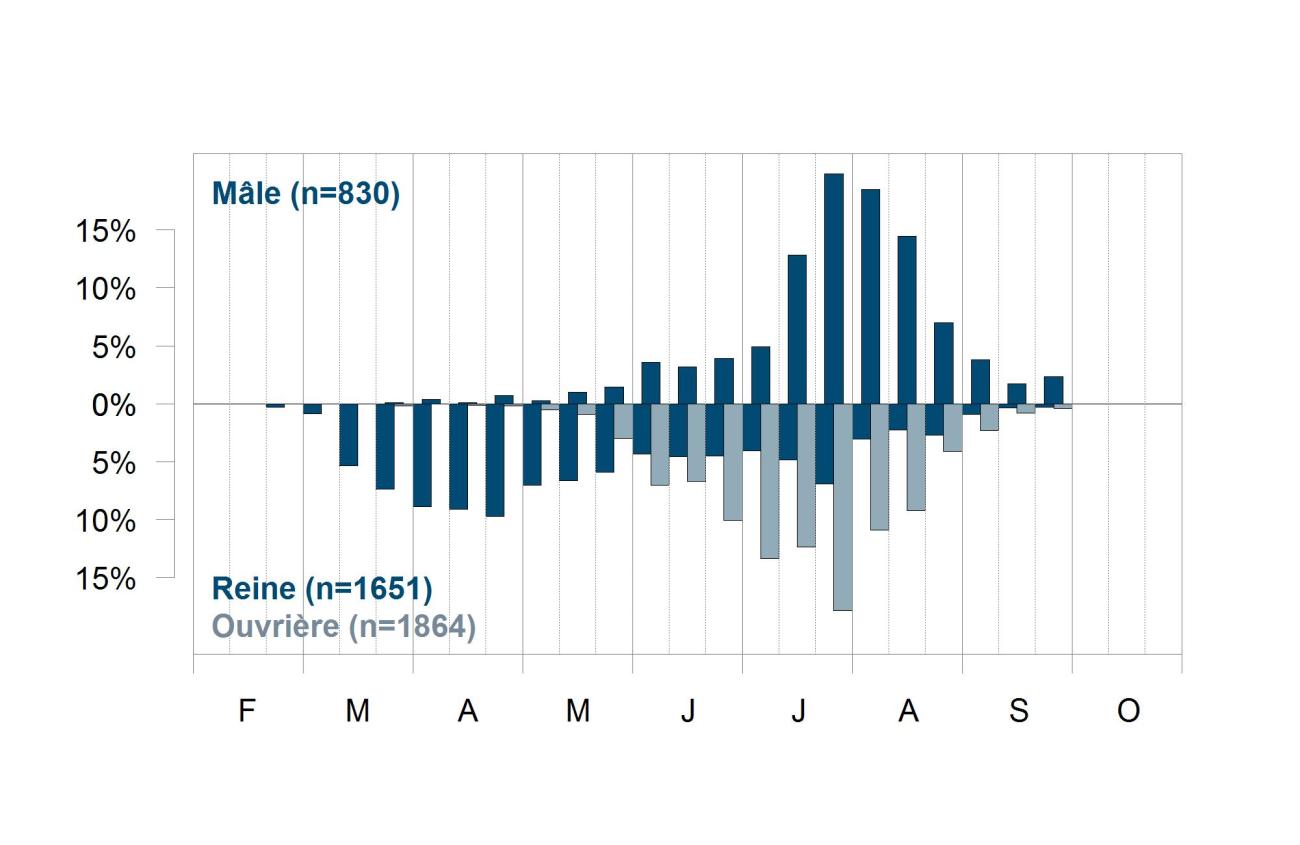
Phénologie de Bombus lucorum en Suisse.
Distribution
L’espèce est commune et se retrouve dans toute la Suisse, de 400 m jusqu'à plus de 2000 m d'altitude.

Distribution altitudinale de Bombus lucorum en Suisse.
Conservazione
Cette page n'a malheureusement pas été traduite dans la langue sélectionnée. Elle s'affiche dans la langue de l'auteur.
Bedrohungsstatus
Bombus lucorum wird in der Roten Liste als nicht bedroht (LC) eingestuft (Müller & Praz 2024). Damit gehört sie nicht zu den gefährdeten Arten und ist keine Rote Liste Art.