
Type de présence en Suisse
Indigène (INN)
ⓘⓧ
Degré de menace
Selon les Catégories et Critères de la Liste rouge de l’UICN ou selon Duelli et al. 1994.
(exp = appréciation d'expert·e·s)
Statut de protection (CH)
Selon les lois et ordonnances nationales spécifiques.
Degré de menace (CH)
Non menacé (LC)
Statut de protection (CH)
ⓘⓧ
Selon les lois et ordonnances mentionnées
–
Lois et ordonnances
–
ⓘⓧ
Selon l’aide à l’exécution : Liste des espèces prioritaires au niveau national.
Priorité nationale
–
Niveau d’action
–
Indications sur le niveau d’action
–
Urgence des mesures (CH)
–
Protection d’occurrences individuelles
–
Surveillance des populations
–
ⓘⓧ
Domaine agricole (OEA/UZL)
Espèce cible/caractéristique selon : Objectifs environnementaux pour l’agriculture "Espèces et milieux naturels".
(* = appréciation d'expert·e·s)
Forêts
2 : Espèce cible forestière selon Biodiversité en forêt : objectifs et mesures. Aide à l’exécution pour la conservation de la diversité biologique dans la forêt suisse (Imesch et al. 2015).
1 : Espèce cible forestière complémentaire, définie dans le cadre de plans d'actions OFEV (p.ex. Plan d'action Forêts claires).
Domaine agricole (OEA/UZL)
–
Forêts
–
✓
Taxon bien étudié, graphique proche de la situation réelle plus d'info
Carte
Carte des observations de Bombus cryptarum en Suisse (résolution 5x5 km).Voir la carte
Période
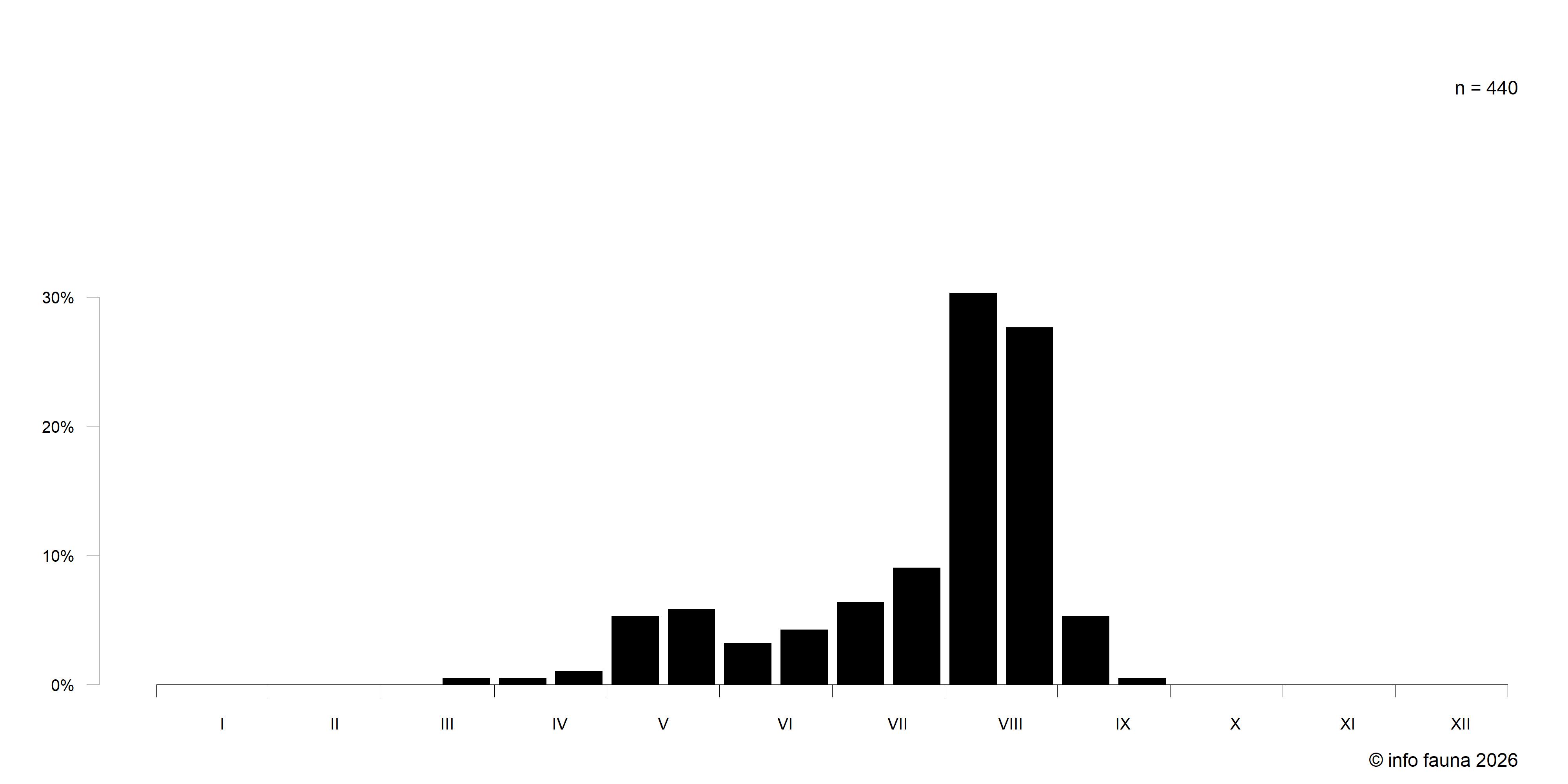
Période des observations de Bombus cryptarum en Suisse. Le graphique montre la proportion de toutes les observations par quinzaine.
Classification
- Arthropoda (Phylum)
- Insecta (Classe)
- Hymenoptera (Ordre)
- Apidae (Famille)
- Bombus (Genre)
- Apidae (Famille)
- Hymenoptera (Ordre)
- Insecta (Classe)
Portrait de l'espèce
Auteur-e-s
Dimitri Bénon, Sophie Giriens
Portrait
Description et taxonomie
Bombus cryptarum est un bourdon de taille moyenne. Cette espèce fait partie du sous-genre Bombus s. str., qui comprend quatre espèces cryptiques en Suisse, regroupées ici sous le nom de "groupe B. terrestris". Ce groupe comprend B. terrestris, B. lucorum, B. cryptarum et B. magnus. Ces espèces sont caractérisées par le thorax à pilosité noire avec le collare jaune ainsi qu'à l'abdomen à pilosité noire sur les tergites 1 et 3, jaune sur le tergite 2 et blanche à l’extrémité. Contrairement à B. argillaceus, B. hortorum, B. jonellus et B. ruderatus, la pilosité du scutellum est noire.

Reine typique du Jura avec une ligne sinueuse noire qui interrompt le collare jaune (La Côte-aux-Fées NE, fin avril 2018). Photo © Sophie Giriens.
Les espèces du groupe B. terrestris sont très difficiles à identifier morphologiquement, même à l'aide d'une loupe binoculaire. Une identification sur le terrain est donc exclue. Cependant, le long du Jura, si un reine du groupe B. terrestris possède une ligne noire bien marquée en forme de "S" qui interrompt le collare à l'avant de la tegula, il y a de bonnes chances que ce soit une reine de B. cryptarum. Cette ligne noire est parfois aussi présente chez les populations alpines de B. cryptarum, bien que moins visible. Cependant elle a aussi été trouvée chez de rares reines de B. lucorum et est fréquente chez B. terrestris sauf pour les populations jurassiennes. Ce critère doit être utilisé avec précaution. Les reines de B. terrestris sont plus grandes et le collare est souvent étroit et d'un jaune plus foncé que chez B. cryptarum, en tous cas au nord des Alpes. L'identification des ouvrières est fortement déconseillée, même avec une loupe binoculaire. Les mâles ne peuvent pas être différenciés de B. terrestris sur le terrain, toutefois ils se distinguent la plupart du temps de B. lucorum et B. magnus par la pilosité du clypeus qui est majoritairement noire et non jaune.
Le statut des espèces du groupe de B. terrestris est resté longtemps controversé. Plusieurs études récentes utilisant des méthodes moléculaires (barcoding et microsatellites) ou chimiques (électrophorèse enzymatique et analyse des sécrétions labiales des mâles) montrent cependant que les quatre espèces sont bel et bien distinctes. (Pamilo et al. 1984, Bertsch et al. 2005, Bertsch & Schweer 2012, Carolan et al. 2012, Williams et al. 2012a, Vesterlund et al. 2014, Giriens 2015, McKendrick et al. 2017).

Ouvrière sur Cirsium spinosissimum (Col du Saint-Gothard, mi-août 2020). Photo © Sophie Giriens.
Biologie et habitat
Habitat
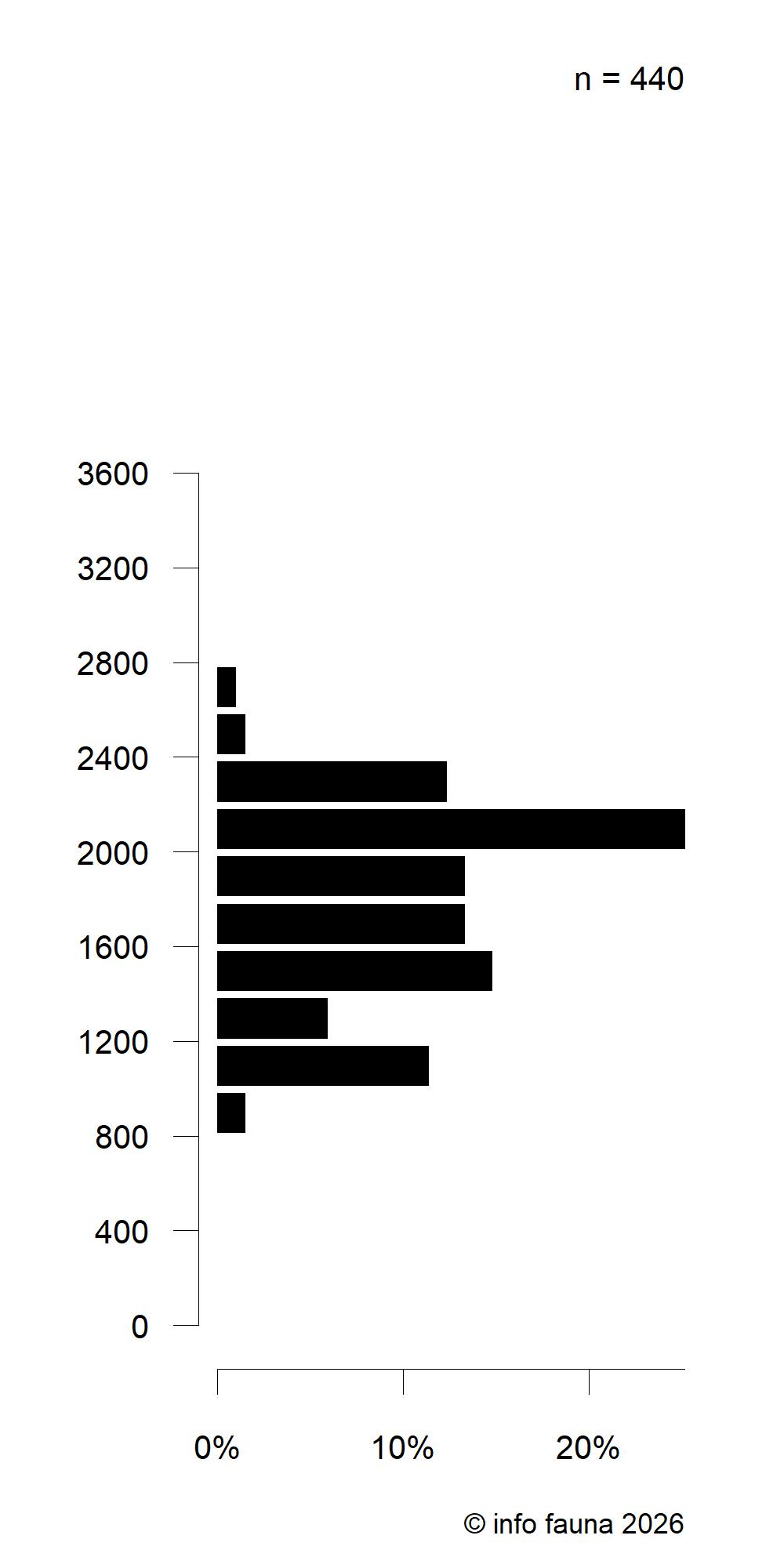
Peu de données sont disponibles sur la biologie et les habitats de cette espèce. En Suisse, Bombus cryptarum semble privilégier les milieux frais de l’étage montagnard et subalpin. Dans les Alpes notamment, beaucoup d’individus ont été observés dans les landes d'altitude à Ericaceae. C'est également le cas en Autriche, où l'espèce a surtout été récoltée sur Calluna vulgaris autour de 2000 m d'altitude. En Suisse et en Autriche, B. cryptarum se trouve presque toujours en sympatrie avec B. lucorum. Selon les données autrichiennes, l'espèce semble aussi apprécier les zones d'éboulis et mais ne se trouve presque jamais dans les milieux forestiers. Le long du Jura, B. cryptarum est surtout observé dans les pâturages d'altitude. (Gereben-Krenn et al. 2013, Giriens 2015, Bossert et al. 2016).
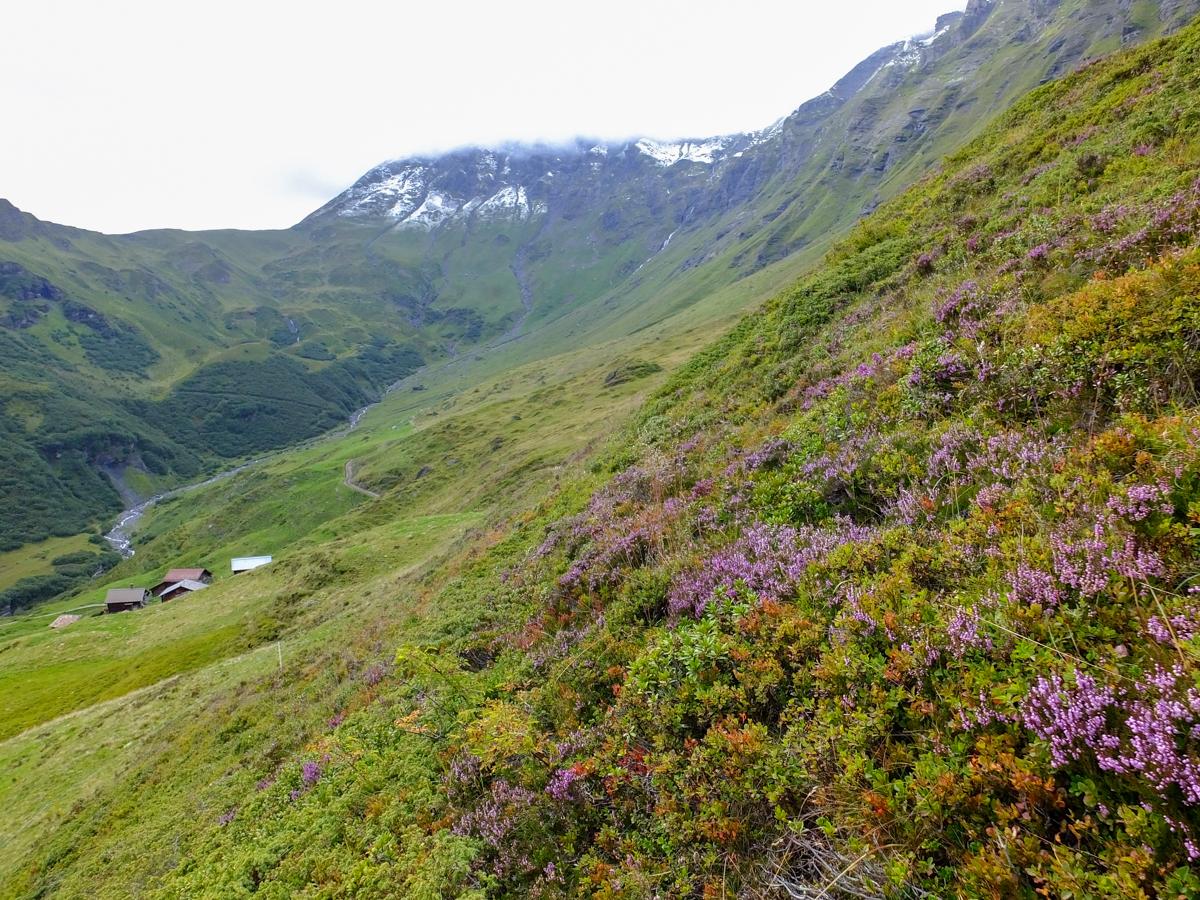
Habitat de Bombus cryptarum à 2000 m dans les Alpes bernoises (Lauterbrunnen BE, début septembre 2014). Photo © Sophie Giriens.
Sources de pollen
Comme les autres espèces du groupe de B. terrestris, B. cryptarum a une langue moyenne à courte. D’après nos analyses polliniques, cette espèce a une préférence marquée pour les Ericaceae et les Carduoideae. Ces résultats concordent avec nos données de terrain, B. cryptarum étant essentiellement observé sur Calluna vulgaris en fin de saison. En dehors des Ericaceae (45% des observations), Giriens a aussi observé l'espèce sur Epilobium angustifolium (21%), Fabaceae (14%), Orobanchaceae (10%), Lamiaceae (5%) et Caryophyllaceae (5%), sans pour autant faire de distinction entre les visites à pollen ou à nectar. En début de saison, le genre Salix est probablement une source de pollen importante pour les reines de cette espèce.
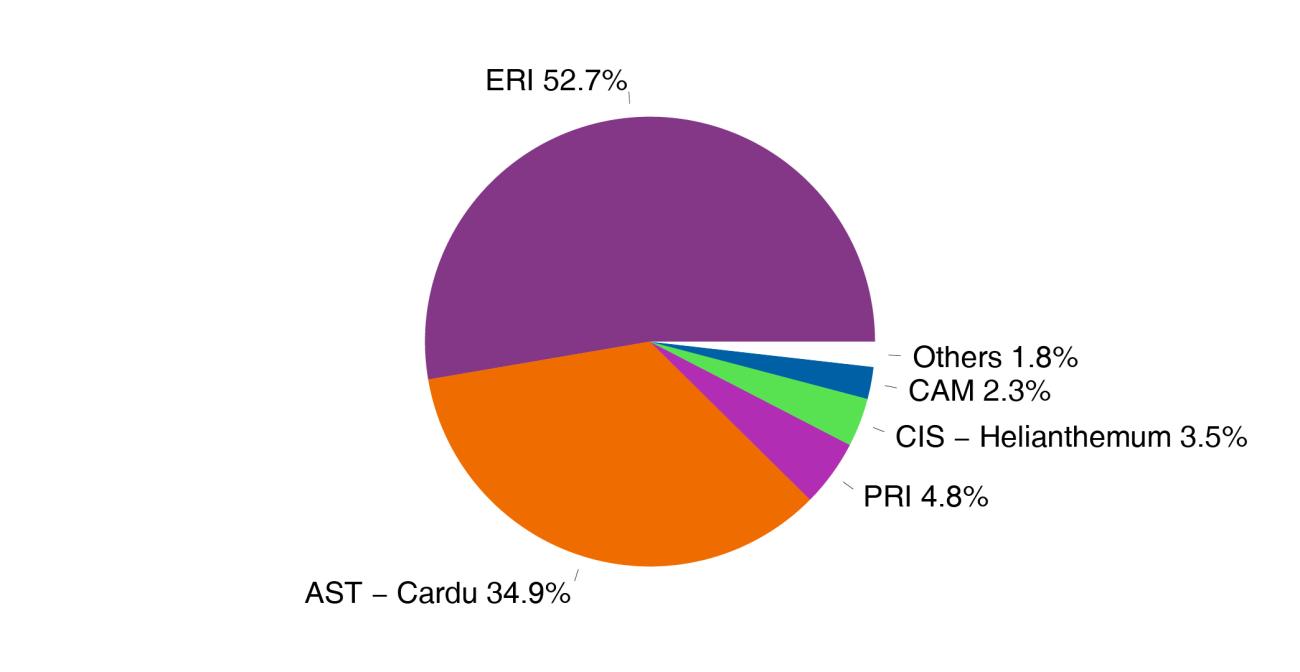
Préférences polliniques de Bombus cryptarum (n=7, N=7).

Ouvrière sur Calluna vulgaris (Val Müstair GR, mi-septembre 2019). Photo © Sophie Giriens.
Nidification
De par les difficultés d’identification, aucune information certifiée n’existe sur la biologie de nidification de B. cryptarum. Cependant, cette espèce construit probablement son nid dans des galeries de petits mammifères, tout comme B. lucorum et B. terrestris. Elle peut aussi probablement utiliser des anfractuosités dans des arbres ou des nichoirs à oiseaux. L’espèce est un pollen storer. On ne connaît pas la taille exacte de ses colonies. Probablement que comme pour B. lucorum, les colonies sont de tailles moyennes à grandes.
Espèces parasites
Bien qu’aucun nid parasité n’ait jamais été observé, il est possible que B. bohemicus, parasite avéré de B. lucorum, parasite aussi B. cryptarum.
Comportement de reproduction
À notre connaissance, le comportement reproducteur des mâles de B. cryptarum n’a jamais été étudié ni observé. Il est probable que l’espèce montre les mêmes comportements que son espèce sœur B. lucorum, les mâles de cette dernière étant connus pour patrouiller le long de circuits marqués et pour faire du hilltopping. (Goulson et al. 2011).
Distribution
Cycle de vie
Les reines hivernantes sortent de leur diapause un peu après celles de B. terrestris, entre mars et avril. En raison des problèmes d’identification, on ne dispose que de peu de données pour les ouvrières : celles déterminées au moyen de méthodes génétiques ou enzymatiques ont été capturées entre juillet et début septembre. Les mâles volent principalement de juillet à septembre.
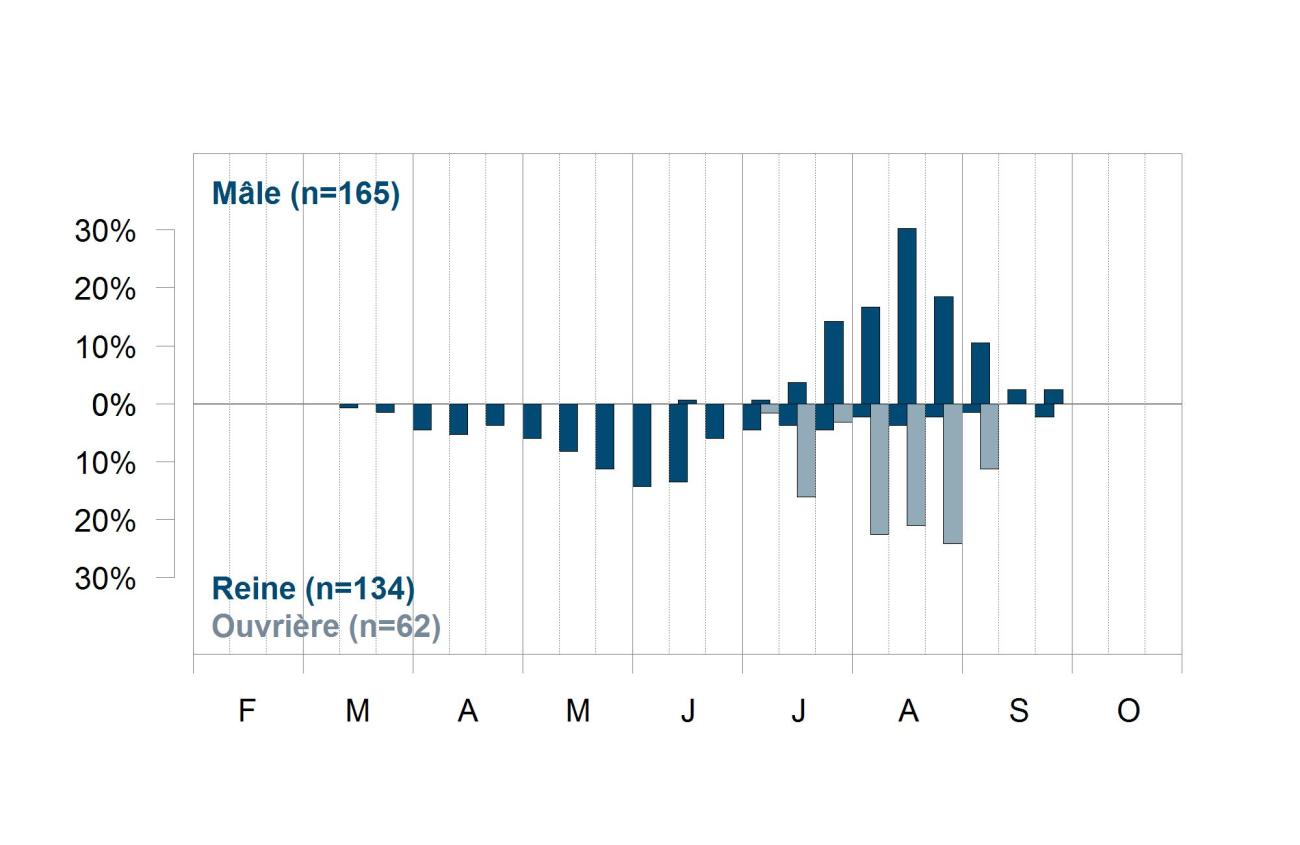
Phénologie de Bombus cryptarum en Suisse.
Distribution
Les difficultés de détermination limitent grandement le nombre de données disponibles sur la distribution de cette espèce. Seules les reines et les mâles typiques ont été pris en compte pour les cartes de distribution. Giriens (2015) a examiné la distribution de B. cryptarum sur la base de spécimens déterminés par analyse du gène mitochondrial. L’espèce est essentiellement présente dans les Alpes et sur la partie occidentale de la chaîne du Jura, de la Dôle jusqu'au canton de Neuchâtel. Dans les Alpes, l'espèce est bien répandue dans certaines régions (Valais, Oberland bernois, Grisons, nord du Tessin) mais semble manquer dans d'autres pour des raisons peu claires (par exemple le bas-Valais ou les Alpes vaudoises).

Distribution altitudinale de Bombus cryptarum en Suisse.
Conservation
Cette page n'a malheureusement pas été traduite dans la langue sélectionnée. Elle s'affiche dans la langue de l'auteur.
Bedrohungsstatus
B. cryptarum wird in der Roten Liste als nicht bedroht (LC) eingestuft (Müller & Praz 2024). Damit gehört sie nicht zu den gefährdeten Arten und ist keine Rote Liste Art. Die Populationen im Jura scheinen jedoch eher isoliert und zahlenmässig gering zu sein, so dass die Art besondere Aufmerksamkeit verdienen würde.