
Type de présence en Suisse
Indigène (INN)
ⓘⓧ
Degré de menace
Selon les Catégories et Critères de la Liste rouge de l’UICN ou selon Duelli et al. 1994.
(exp = appréciation d'expert·e·s)
Statut de protection (CH)
Selon les lois et ordonnances nationales spécifiques.
Degré de menace (CH)
Non menacé (LC)
Statut de protection (CH)
ⓘⓧ
Selon les lois et ordonnances mentionnées
–
Lois et ordonnances
–
ⓘⓧ
Selon l’aide à l’exécution : Liste des espèces prioritaires au niveau national.
Priorité nationale
–
Niveau d’action
–
Indications sur le niveau d’action
–
Urgence des mesures (CH)
–
Protection d’occurrences individuelles
–
Surveillance des populations
–
ⓘⓧ
Domaine agricole (OEA/UZL)
Espèce cible/caractéristique selon : Objectifs environnementaux pour l’agriculture "Espèces et milieux naturels".
(* = appréciation d'expert·e·s)
Forêts
2 : Espèce cible forestière selon Biodiversité en forêt : objectifs et mesures. Aide à l’exécution pour la conservation de la diversité biologique dans la forêt suisse (Imesch et al. 2015).
1 : Espèce cible forestière complémentaire, définie dans le cadre de plans d'actions OFEV (p.ex. Plan d'action Forêts claires).
Domaine agricole (OEA/UZL)
–
Forêts
–
✓
Taxon bien étudié, graphique proche de la situation réelle plus d'info
Carte
Carte des observations de Chelostoma rapunculi en Suisse (résolution 5x5 km).Voir la carte
Période
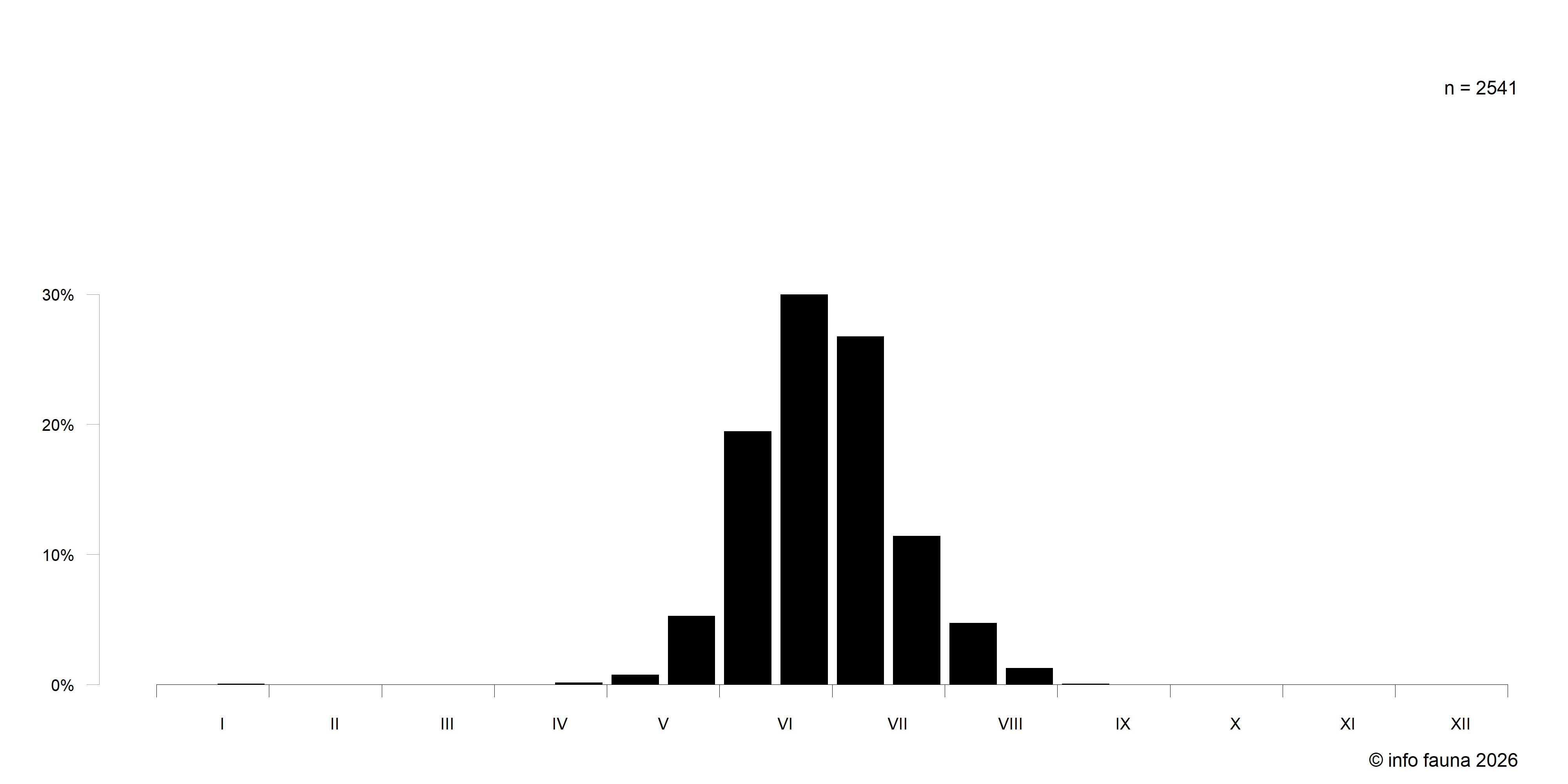
Période des observations de Chelostoma rapunculi en Suisse. Le graphique montre la proportion de toutes les observations par quinzaine.
Classification
- Arthropoda (Phylum)
- Insecta (Classe)
- Hymenoptera (Ordre)
- Apidae, Megachilinae (Famille)
- Chelostoma (Genre)
- Apidae, Megachilinae (Famille)
- Hymenoptera (Ordre)
- Insecta (Classe)
Portrait de l'espèce
Auteur-e-s
Andreas Müller
Portrait
Description et taxonomie

Femelle sur Campanula rapunculus (Agasul ZH, 1996) . Photo © Albert Krebs.
Chelostoma rapunculi est une abeille de taille moyenne (8-10 mm) dont les femelles peuvent être facilement distinguées des autres représentants indigènes de taille similaire du genre Chelostoma. En effet, la spécialisation sur les fleurs de Campanula ainsi que les mâchoires supérieures courtes et l'absence de lamelle céphalique sont des critères qui permettent d’identifier l’espèce.

Mâle accroché à un épi d'herbe pour dormir (Jeizinen, juin 1996). Photo © ; Andreas Müller.
Les mâles sont caractérisés par le tergite terminal de forme typique à l'espèce (incisé au milieu) et se termine par trois appendices tronqués larges et droits.
Biologie et habitat
Habitat
Chelostoma rapunculi se trouve partout où Campanula fleurit pendant la saison de vol et où des structures de bois mort appropriées sous forme d'arbres morts, de poteaux de clôture ou de bûchers sont présentes. Elle colonise ainsi les prairies riches en fleurs, les pâturages et jachères, les forêts, les clairières, les bordures de haies et de champs, les gravières et carrières, les zones rudérales et les jardins domestiques.
Sources de pollen
C. rapunculi est oligolectique sur Campanula (Campanulaceae) et les genres proches (par ex. Platycodon dans les jardins), visitant toutes les espèces de Campanula en fleurs pendant la saison de vol, compris les espèces exotiques dans les zones d'habitation. Il est possible que des genres de Campanulaceae moins proches, tels que Phyteuma, soient également utilisés occasionnellement, car le nom scientifique de l’espèce ("rapunculi") et français ("Hériade de la raiponce") choisi par le premier descripteur Lepeletier fait référence à ce genre de plantes. Cependant dans les expériences, le développement des larves sur du pollen étranger de Buphthalmum (Asteraceae), Ranunculus (Ranunculaceae), Echium (Boraginaceae) et Sinapis (Brassicaceae) s'est avéré impossible, ce qui indique une forte adaptation physiologique des larves pour digérer le pollen de Campanula. Pour l'approvisionnement d'une seule cellule à couvain, une moyenne de 19 vols de collecte est nécessaire. Cela nécessite le contenu pollinique complet de 22 fleurs de Campanula patula ou de 37 fleurs de C. rotundifolia. Dans de bonnes conditions, il faut environ six heures pour construire une cellule à couvain. Les femelles de C. rapunculi sont capables de collecter du pollen à une distance allant jusqu'à 1275 m du nid. Les distances entre le nid et les sources de pollen ont une influence considérable sur le succès de la reproduction : une augmentation de la distance de 500 m entraîne une diminution de 46% du nombre de cellules à couvain oviposées (Bonelli 1967d, Käpylä 1978, Westrich 1989, Müller et al. 2006, Praz et al. 2008b, Sedivy et al. 2008, Zurbuchen et al. 2010b & c, Müller 2015a).
Nidification
C. rapunculi construits ses nids dans des galeries linéaires existantes, de 3 à 5 mm de diamètre, telles que les galeries creusées par des insectes dans le bois mort (par ex. souches d'arbres, branches mortes, poteaux en bois, poutres de granges et de hangars) ou dans les tiges creuses de plantes sèches (par ex. les tiges de roseaux). Elle colonise aussi souvent les galeries pré-percées ou les tiges de bambou creuses dans les nichoirs artificiels. Les nids, séparés de l'intérieur par une première paroi, contiennent une à huit cellules à couvain disposées en ligne. Par rapport à Chelostoma florisomne, les cellules sont nettement moins souvent interrompues par des cellules vides. Le matériau de construction des parois cellulaires de 1 mm d'épaisseur et du bouchon de fermeture du nid de 2-6 mm, parfois jusqu'à 17 mm d'épaisseur, est de la terre et du sable qui sont mélangés à du nectar et éventuellement à des sécrétions des glandes salivaires comme liant. L'ajout du liant rend les parois dures comme de la pierre. De petites pierres ou d'autres particules sont incrustées dans le bouchon de fermeture à l'extérieur du nid. Une cavité, qui peut atteindre une longueur de 7 cm, est généralement formée entre la cellule à couvain la plus externe et l'extrémité du nid. Les larves éclosent de l'œuf après trois à cinq jours, consomment la nourriture à l'âge de 9-13 jours et terminent de filer le cocon à l'âge de 18-20 jours (Friese 1895, Stöckhert 1933, Bonelli 1967c, Käpylä 1978, Brechtel 1986, Westrich 1989, Ruszkowski et al. 1995, Banaszak & Romasenko 1998, Müller 2015a, Rozen & Praz 2016).
Espèces parasites
C. rapunculi est parasitée par l'abeille-coucou Stelis minuta, parfois aussi par Stelis minima. Les affirmations de la littérature selon lesquelles Stelis breviuscula parasite également C. rapunculi sont incorrectes. Les autres parasites alimentaires connus sont les hyménoptères Sapyga quinquepunctata et S. similis (Sapygidae). Des coléoptères du genre Trichodes (Cleridae) ont été identifiés comme parasitoïdes de l’espèce (Kornmilch 1995).
Comportement de reproduction
Les mâles éclosent quelques jours avant les femelles puis patrouillent les fleurs de Campanula en vol rapide à la recherche de femelles prêtes à s'accoupler. Les mâles dorment d’ailleurs aussi régulièrement dans les fleurs de Campanula. Ils sont les pollinisateurs principaux de la Céphalanthère rouge (Cephalanthera rubra), qu'ils approchent régulièrement lors de leurs vols de patrouille, bien que les fleurs de cette espèce d'orchidée ne contiennent pas de nectar. Les mâles confondent probablement les fleurs rouges de Cephalanthera avec les fleurs bleues de Campanula, puisque - comme l'a montré une étude - les fleurs, dont la couleur est si différente pour l'œil humain, sont de la même couleur pour l'œil de l'abeille. La même raison pourrait expliquer pourquoi les mâles patrouillent aussi régulièrement les fleurs de Géranium ou de Malva (Käpylä 1978, Nilsson 1983, Westrich 1989, Müller obs. pers.).
Distribution
Cycle de vie
Chelostoma rapunculi hiberne sous forme de larve au repos dans un cocon à l'intérieur de la cellule à couvain. L’espèce est univoltine. La période de vol principale des mâles s’étend de fin mai à début août, celle des femelles de début juin à fin août (Westrich 1989).

Phénologie de Chelostoma rapunculi en Suisse.
Distribution
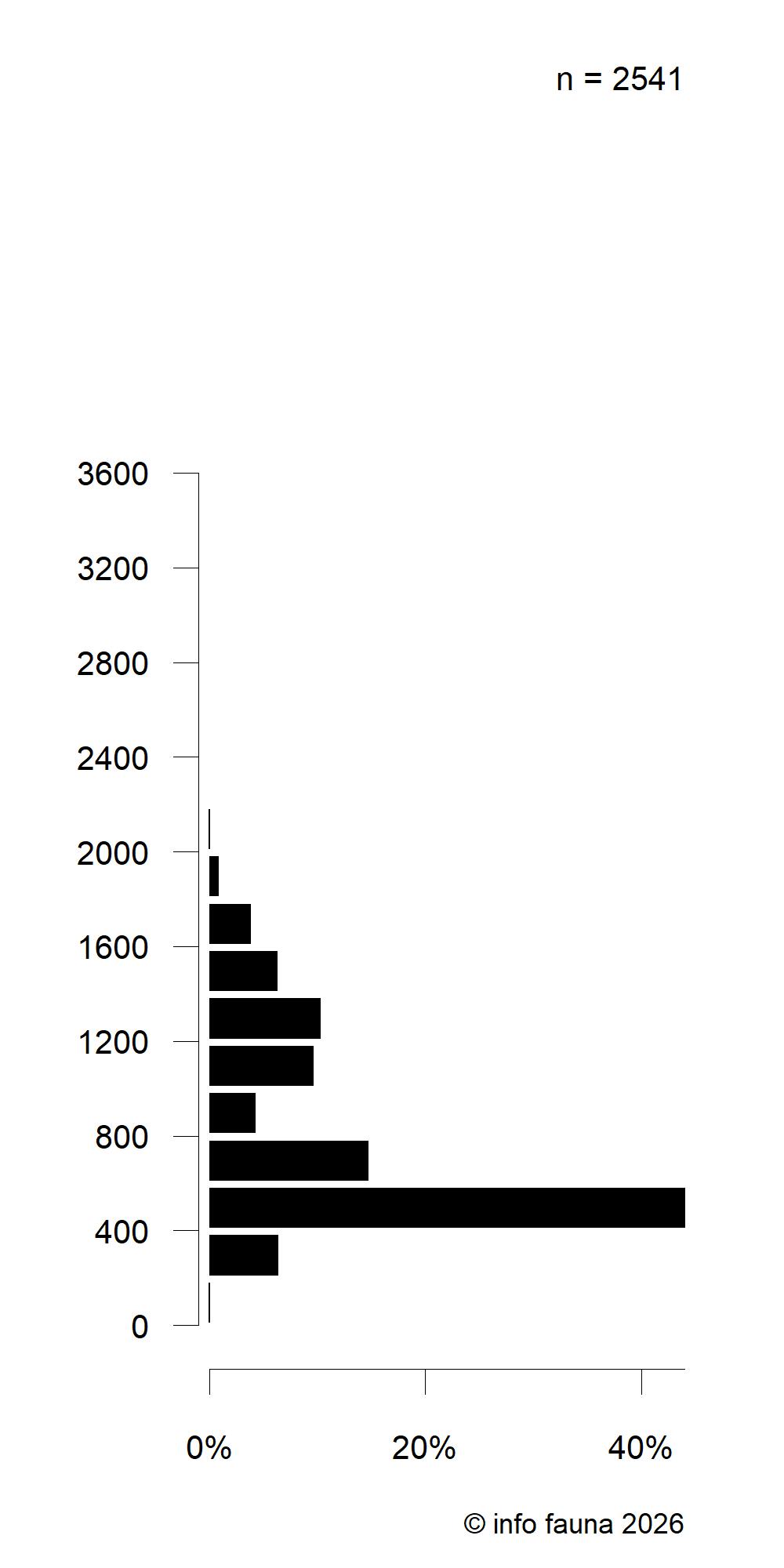
C. rapunculi est distribuée dans toute la Suisse jusqu'à 2000 m. Il s’agit d’une espèce commune, répandue sur le Plateau central.

Distribution altitudinale de Chelostoma rapunculi en Suisse.
Conservation
Cette page n'a malheureusement pas été traduite dans la langue sélectionnée. Elle s'affiche dans la langue de l'auteur.
Bedrohungsstatus
Chelostoma rapunculi wird in der Roten Liste als nicht bedroht (LC) eingestuft (Müller & Praz 2024). Damit gehört sie nicht zu den gefährdeten Arten und ist keine Rote Liste Art.