
Type de présence en Suisse
Indigène (INN)
ⓘⓧ
Degré de menace
Selon les Catégories et Critères de la Liste rouge de l’UICN ou selon Duelli et al. 1994.
(exp = appréciation d'expert·e·s)
Statut de protection (CH)
Selon les lois et ordonnances nationales spécifiques.
Degré de menace (CH)
Non menacé (LC)
Statut de protection (CH)
ⓘⓧ
Selon les lois et ordonnances mentionnées
–
Lois et ordonnances
–
ⓘⓧ
Selon l’aide à l’exécution : Liste des espèces prioritaires au niveau national.
Priorité nationale
–
Niveau d’action
–
Indications sur le niveau d’action
–
Urgence des mesures (CH)
–
Protection d’occurrences individuelles
–
Surveillance des populations
–
ⓘⓧ
Domaine agricole (OEA/UZL)
Espèce cible/caractéristique selon : Objectifs environnementaux pour l’agriculture "Espèces et milieux naturels".
(* = appréciation d'expert·e·s)
Forêts
2 : Espèce cible forestière selon Biodiversité en forêt : objectifs et mesures. Aide à l’exécution pour la conservation de la diversité biologique dans la forêt suisse (Imesch et al. 2015).
1 : Espèce cible forestière complémentaire, définie dans le cadre de plans d'actions OFEV (p.ex. Plan d'action Forêts claires).
Domaine agricole (OEA/UZL)
–
Forêts
–
✓
Taxon bien étudié, graphique proche de la situation réelle plus d'info
Carte
Carte des observations de Lasioglossum malachurum en Suisse (résolution 5x5 km).Voir la carte
Période
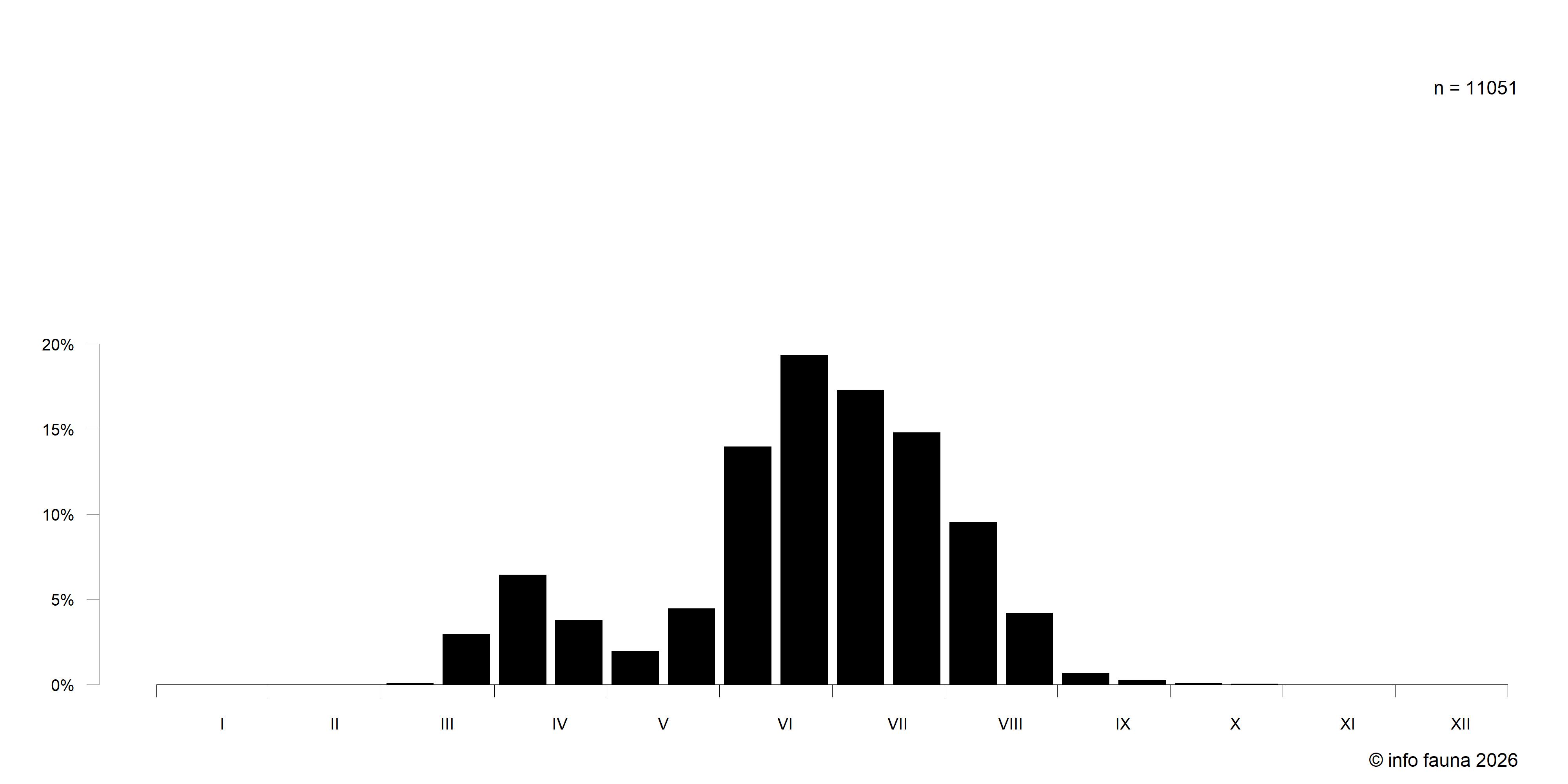
Période des observations de Lasioglossum malachurum en Suisse. Le graphique montre la proportion de toutes les observations par quinzaine.
Classification
- Arthropoda (Phylum)
- Insecta (Classe)
- Hymenoptera (Ordre)
- Apidae, Halictinae (Famille)
- Lasioglossum (Genre)
- Apidae, Halictinae (Famille)
- Hymenoptera (Ordre)
- Insecta (Classe)
Portrait de l'espèce
Auteur-e-s
Dimitri Bénon
Portrait
Description et taxonomie
Lasioglossum malachurum est une espèce de taille moyenne (8-9 mm) qui ne peut pas être identifiée sur le terrain. Elle ressemble notamment beaucoup à L. lineare. Les mâles ont souvent les premiers tergites en partie rouge. (Amiet et al. 2001).
C’est probablement l’espèce du genre Lasioglossum dont la biologie a été la plus étudiée du fait de son haut niveau de socialité.

Femelle au repos (La Neuveville BE, fin mai 2019). Photo © Dimitri Bénon.
Biologie et habitat
Habitat
Lasioglossum malachurum est une espèce thermophile présente dans tout type de milieux ouverts. Elle privilégie les sols limoneux et de loess, mais se retrouve aussi dans certains milieux sableux. Elle est bien présente dans les zones agricoles, les prairies et les pâturages, ainsi que dans les milieux urbains. (Westrich 2018).
Sources de pollen
L. malachurum est une espèce largement polylectique. Elle récolte le pollen d’au moins 12 familles de plantes, à savoir celui des Apiaceae, Asteraceae, Brassicaceae, Campanulaceae, Caryophyllaceae, Convolvulaceae, Fabaceae, Geraniacae, Lamiacae, Ranunculaceae, Rosaceae et Salicaceae. (Westrich 2018).

Les femelles récoltent aussi parfois le pollen de Plantaginaceae, comme ici sur Veronica (La Mauguettaz VD, fin mars 2017). Photo © Dimitri Bénon.
Nidification
L. malachurum est une abeille sociale qui niche de préférence dans les sols compacts limoneux ou de loess, où la végétation est absente ou clairsemée. Elle forme souvent de grandes agrégations comprenant plusieurs centaines voire milliers de nids. L’entrée des nids forme généralement un petit cône bien visible qui est marqué à l’aide de phéromones. Celles-ci permettent de retrouver le nid au sein de l’agrégation. Les sites privilégiés sont les bords de chemins et les places ouvertes où le sol est compacté par le passage de voitures ou de personnes. Les nids sont exclusivement monogynes. Au printemps, la jeune reine creuse une galerie verticale qui descend jusqu’à une profondeur de 20-25 cm. Les cellules à couvain sont ensuite excavées depuis la galerie principale, à une profondeur de 10-15 cm, de sorte à former un groupe compact de cellules adjacent à la galerie. Ces cellules sont généralement organisées en rayon et placées dans une chambre. Cependant, certains auteurs mentionnent avoir observé des nids où les cellules étaient simplement organisées en groupe autour de la galerie centrale, sans rayon et sans chambre. Les cellules sont toujours positionnées à l’horizontale, la paroi interne étant polie et recouverte d’une fine couche de sécrétion d’aspect brillant. La cellule est d’abord remplie avec le pollen, le nectar étant rajouté après coup par l’abeille pour former un pain de forme arrondi sur lequel sera déposé un œuf. Les cellules restent ouvertes pendant tous les stades larvaires et ne sont fermées qu’une fois que l’individu a atteint le stade de pré-pupe. Cette particularité, qui se retrouve seulement chez quelques espèces du genre Lasioglossum, permet à la reine (et plus tard les ouvrières) de: 1) limiter la propagation de maladies en intervenant rapidement lorsqu'une larve meurt (la larve morte est alors sortie du nid ou la cellule entière est bouchée avec du sol) et 2) nourrir les larves au fur et à mesure (par trophallaxie). Une fois toutes les cellules construites et approvisionnées (généralement 6-8 cellules pour la première génération), le nid est fermé de l’intérieur jusqu’à l’émergence des premières ouvrières. Au cours de cette première phase solitaire, les nids ne sont pas gardés et il arrive que des reines tentent de s’approprier un nid qui n’est pas le leur s'il est laissé sans défense. Au retour de l’occupante, des combats peuvent avoir lieu entre les deux reines. Bien que la plupart du temps il ne s’agisse que d’intimidation, les combats peuvent être violents et les individus peuvent être blessés et parfois mourir.

Ouvrière montant la garde (Osterfingen SH, 1996). Photo © Albert Krebs.
Une fois les ouvrières émergées, la phase sociale de la colonie commence. La galerie principale du nid est prolongée, les anciennes cellules remplies avec de la terre et de nouvelles sont creusées plus en profondeur, entre 25-30 cm. Une division du travail se met en place, la reine ne s’occupant plus que de la ponte, les ouvrières se chargeant de la construction du nid et des cellules, de la récolte et de la garde du nid. Elles s’occupent aussi de vider les excréments produits par les larves. À ce stade, une cinquantaine de cellules sont construites, alignées sur un ou deux rangs le long de la galerie principale. Une fois cette seconde génération d’ouvrières arrivée à maturité, une troisième génération, contenant les sexués et parfois quelques ouvrières, sera formée. La galerie principale est alors prolongée de plusieurs ramifications le long desquelles seront creusées les nouvelles cellules. Plus de 100 nouvelles cellules peuvent être ainsi creusées, à une profondeur de 50-70 cm. Lors de cette dernière phase, une partie importante des œufs mâles peut être pondus par les ouvrières. En Grèce, il a même été démontré que presque la moitié des colonies ne contenaient plus de reine à la fin de l’été, la génération de sexués étant entièrement produite par des ouvrières fécondées. Le pourcentage d’ouvrières fécondées augmente à chaque génération : ainsi il est quasiment nul pour la première, mais peut dépasser les 10% à la troisième génération. Ces ouvrières fécondées jouent donc un rôle important uniquement là où les colonies peuvent produire trois générations d’ouvrières, ce qui n’est pas le cas en Suisse. L’importance du rôle joué par les ouvrières dans la ponte d’œufs fécondés (produisant donc des reines) dépend aussi fortement de l’affiliation des ouvrières à la reine : en effet, il est fréquent de rencontrer au sein d’une colonie des individus génétiquement différents de la reine (probablement dans les cas de nids usurpés). Ces ouvrières « étrangères » sont plus enclines à posséder des ovaires développés et, en cas de fécondation, peuvent participer à la production de nouvelles reines. (Noll 1931, Bonelli 1948, Knerer 1969b, Smith & Weller 1989, Ayasse 1990, Pesenko et al. 2000, Richards 2000, Paxton et al. 2002, Wyman & Richards 2003, Soro et al. 2009, Westrich 2018).

Petite agrégation de nids, ceux-ci étant bien visible grâce au tumulus de terre brun clair qui les entoure (Osterfingen SH, 1996). Photo © Albert Krebs.
De nombreuses études se sont intéressées à l’organisation des colonies de L. malachurum dans le but de mieux comprendre les facteurs influençant divers comportements, comme l’usurpation de nid, la fermeture précoce des nids pendant le développement du couvain, la présence d’individus étrangers au sein d’une colonie, la ponte des ouvrières, etc. Une synthèse complète de ces recherches aborderait des notions trop spécifiques sortant du cadre de notre projet. En cas d’intérêt, de nombreuses informations complémentaires peuvent être trouvées dans les articles suivants. (Smith & Weller 1989, Ayasse et al. 1999, Richards 2000, Paxton et al. 2002, Wyman & Richards 2003, Zobel & Paxton 2007).

Coupe verticale de la chambre à couvain. On peut voir au centre le "rayon" de cellules vides contenu dans la chambre (Allemagne, Konstanz, juin 1996). Photo © Andreas Müller.
Espèces parasites
L. malachurum est parasitée par Sphecodes monilicornis. (Amiet et al. 2001, Pesenko et al. 2000, Bogush & Straka 2012, Westrich 2018).
Comportement de reproduction
Les jeunes reines sont généralement fécondées en dehors du nid maternel, mais un accouplement a aussi été observé dans un nid lors de son excavation. Les reines s’accouplent en général une seule fois, rarement jusqu’à 4 reprises. Les mâles patrouillent le plus souvent autour des sites de nidifications. Ils meurent rapidement après l’accouplement. Des études ont montré qu’ils étaient capables, sur la base de différences olfactives, de faire la distinction entre des femelles provenant du même nid qu'eux ou non, ainsi qu’entre des femelles déjà fécondées ou non. Ainsi, les mâles montrent une préférence pour les femelles non fécondées provenant d’un autre nid. Les femelles fécondées hivernent dans le nid maternel ou dans de petites galeries creusées à proximité. (Smith & Ayasse 1987, Ayasse et al. 1999, Pesenko et al. 2000, Paxton et al. 2002, Soro et al. 2009).
Distribution
Cycle de vie
Lasioglossum malachurum est une espèce sociale. Il s’agit même, avec L. pauxillum, de l’espèce démontrant le plus haut niveau de socialité chez les Halictines. Le nombre de générations d’ouvrières varie selon la région géographique. Au nord, l’espèce ne produit qu’une seule génération d’ouvrières, au sud jusqu’à trois. En Suisse, L. malachurum semble former en général une seule génération d’ouvrières. Les jeunes reines sortent de leur diapause au mois de mars. Elles produisent alors une première génération (juin), composée uniquement d’ouvrières. La génération de sexués est produite dès le mois de juillet et vole jusqu'en automne. Chez les colonies à deux générations d'ouvrières, la phénologie est légèrement décalée avec une première génération fin mai début juin, suivie d'une seconde génération en juillet et d'une troisième (sexués) en août. Seules les jeunes reines fécondées passent l’hiver. (Pesenko et al. 2000).
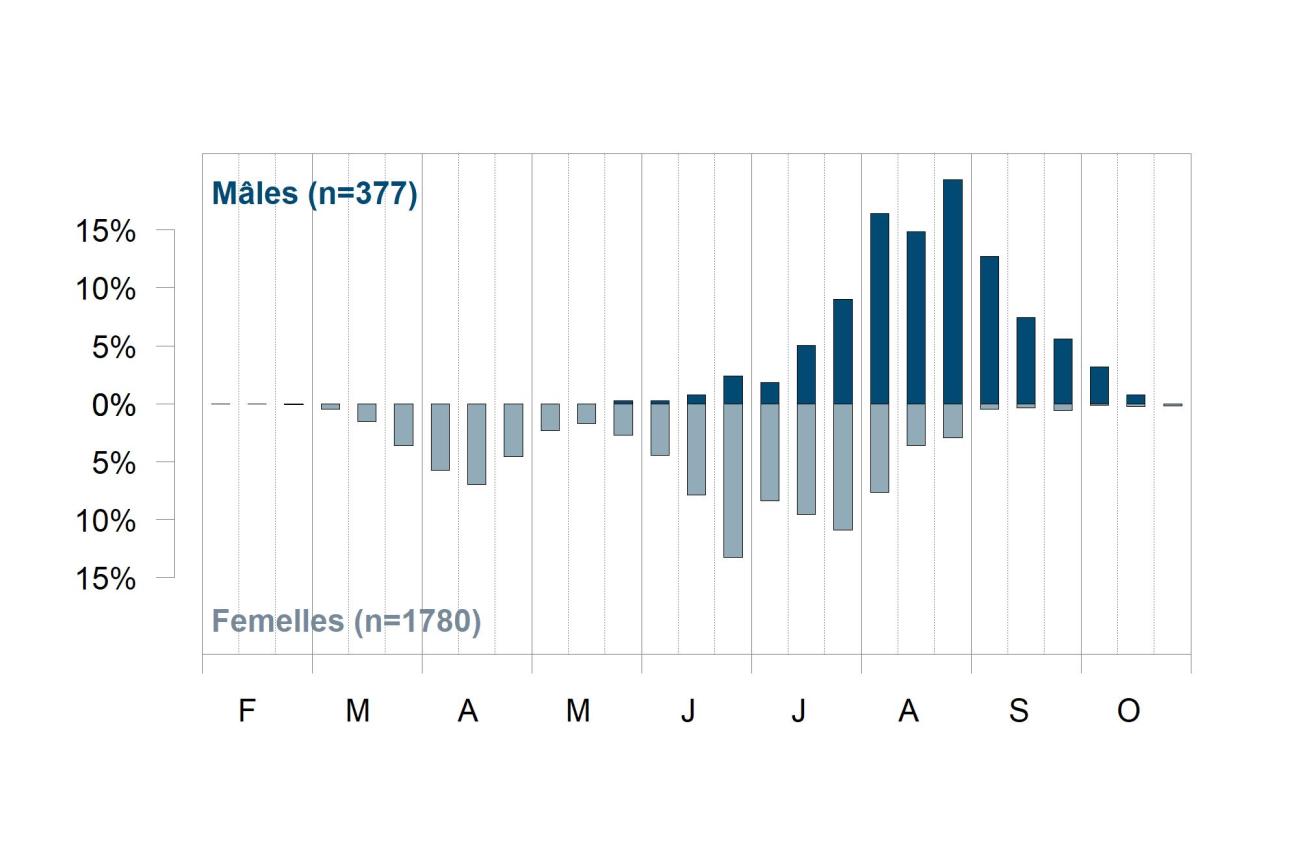
Phénologie de Lasioglossum malachurum en Suisse.
Distribution
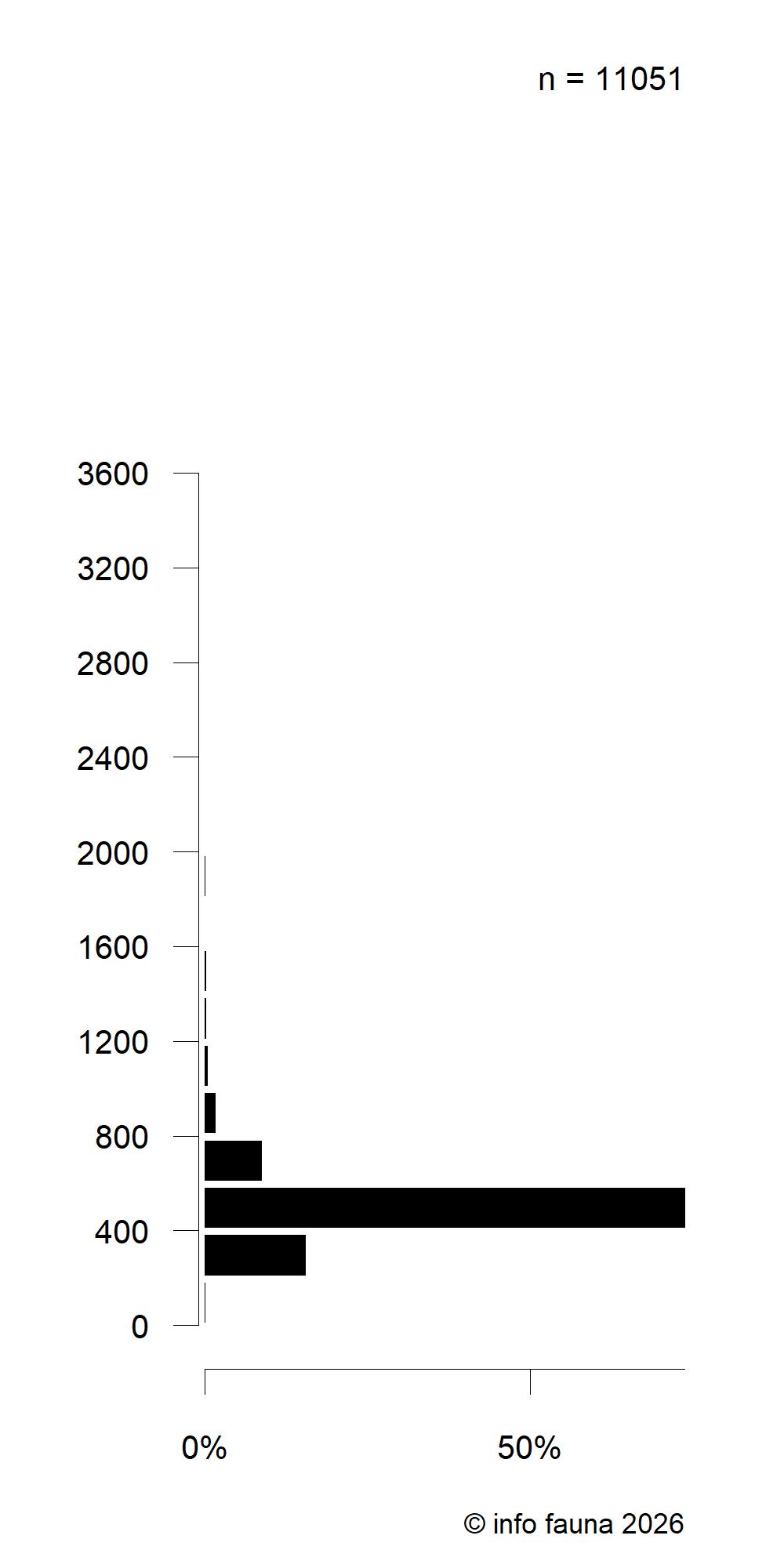
L. malachurum est l'une des espèces les plus communes au nord des Alpes. C’est une espèce de basse altitude qui se retrouve majoritairement sur le Plateau et le Jura ainsi de manière plus localisée en Valais, aux Grisons et au Tessin. Elle se rencontre entre 300 et 800 m.
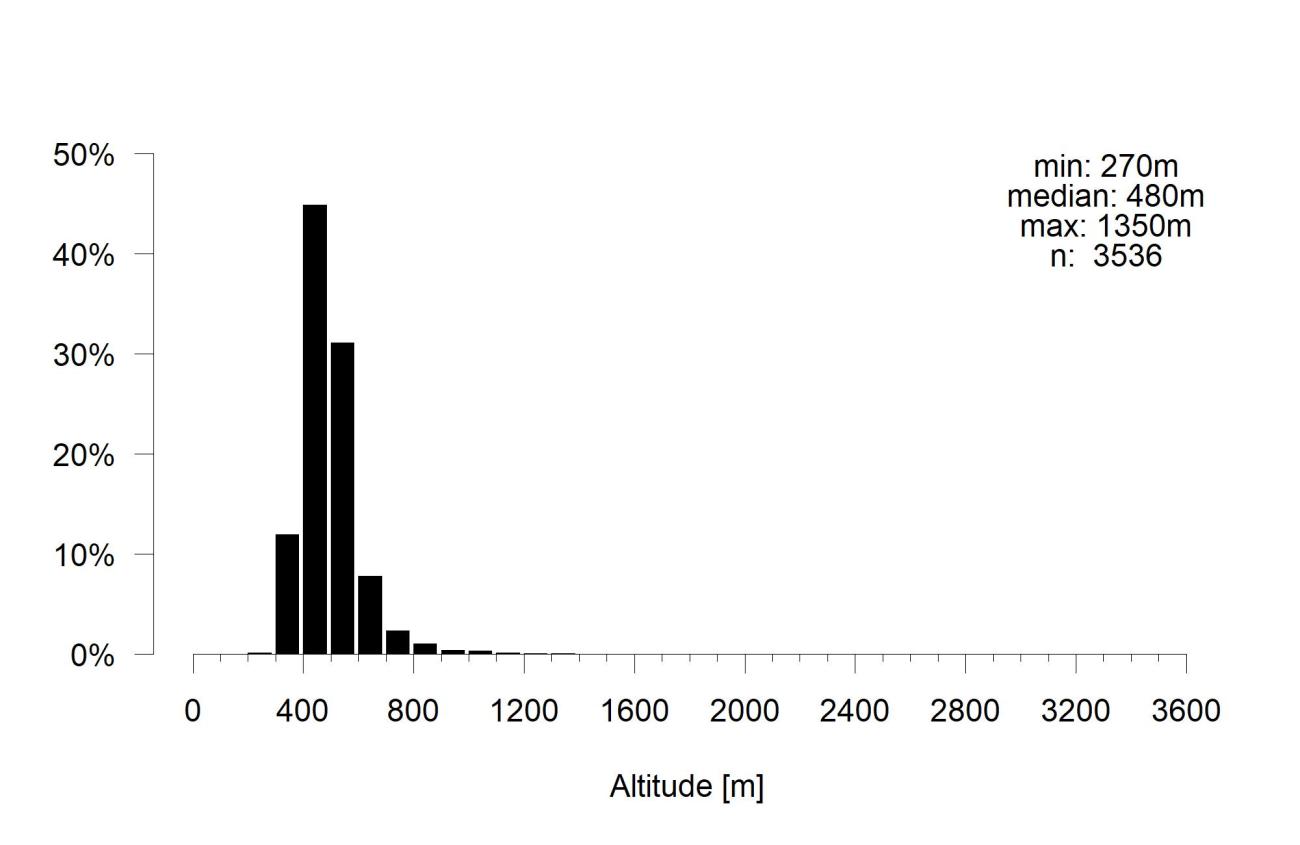
Distribution altitudinale de Lasioglossum malachurum en Suisse.
Conservation
Cette page n'a malheureusement pas été traduite dans la langue sélectionnée. Elle s'affiche dans la langue de l'auteur.
Gefährdungsstatus
Lasioglossum malachurum wird in der Roten Liste als nicht bedroht (LC) eingestuft (Müller & Praz 2024). Damit gehört sie nicht zu den gefährdeten Arten und ist keine Rote Liste Art.