
Tipo di presenza in Svizzera
Indigena (INN)
ⓘⓧ
Grado di minaccia
Secondo le Categorie e i criteri della Lista Rossa dell’UICN o secondo Duelli et al. 1994.
(exp = valutazione degli/delle esperti/e)
Status di protezione (CH)
Ai sensi delle leggi e alle ordinanze nazionali specifiche.
Grado di minaccia (CH)
Non minacciato (LC)
Status di protezione (CH)
ⓘⓧ
Ai sensi delle leggi e delle ordinanze citate
–
Leggi e Ordinanze
–
ⓘⓧ
Secondo l’aiuto all’esecuzione: Lista delle specie prioritarie a livello nazionale della Svizzera.
Priorità nazionale
–
Livelli operativi
–
Indicazioni sul livello operativo
–
Urgenza temporale con cui attuare (CH)
–
Protezione popolazioni isolate
–
Monitoraggio delle popolazioni
–
ⓘⓧ
Settore agricolo (OEA/UZL)
Specie bersaglio/caratteristiche secondo: Obiettivi ambientali per l’agricoltura “Specie e habitat”.
(* = valutazione degli/delle esperti/e)
Foreste
2: Specie forestale bersaglio secondo: Biodiversität und Wald: Ziele und Massnahmen. Vollzugshilfe zur Erhaltung und Förderung der biologischen Vielfalt im Schweizer Wald (Imesch et al. 2015).
1: Specie forestale bersaglio complementare, definita nell’ambito dei piani d’azione UFAM (ad es. Piano d’azione Boschi radi FR/DE)
Settore agricolo (OEA/UZL)
–
Foreste
–
✓
Taxon ben studiato, mappa vicina alla distribuzione reale Maggiori informazioni
Mappa
Mappa delle osservazioni di Nebria brevicollis in Svizzera (risoluzione 5x5 km).Visualizza la mappa
Periodo
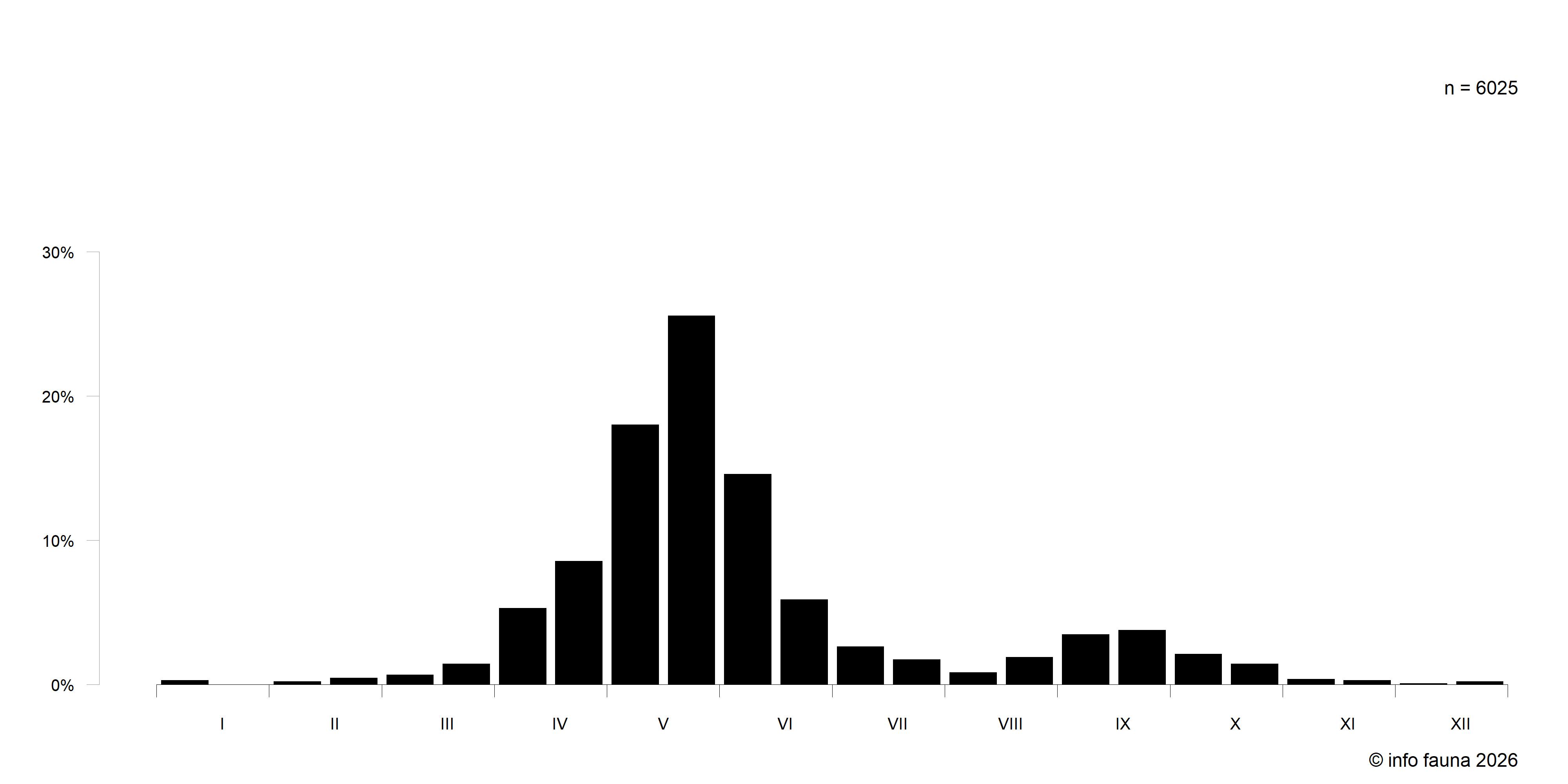
Periodo delle osservazioni di Nebria brevicollis in Svizzera. Il grafico mostra la proporzione di tutte le osservazioni per quindicina.
Classificazione
- Arthropoda (Phylum)
- Insecta (Classe)
- Coleoptera (Ordine)
- Carabidae (Famiglia)
- Nebria (Genere)
- Carabidae (Famiglia)
- Coleoptera (Ordine)
- Insecta (Classe)
Ritratto della specie
Auteur-e-s
Florian Walter, René Hoess
Ritratto
Description
Les critères les plus importants pour cette espèce de 10-14 mm de long sont, d’après Huber (2006):
- côtés du pronotum fortement arqués, légèrement sinués avant les angles postérieurs, pronotum cordiforme
- 3ème interstrie des élytres avec des soies discales
- face supérieure des tarses pourvue de courtes soies (en plus des soies apicales), lorsque les tarses sont usés et les soies perdues, les points d’insertion de celles-ci sont encore visibles
- palpes maxillaires entièrement brun-rouge, rarement plus ou moins assombries
- microsculpture élytrale faite de mailles fortement transverses
- face dorsale brun-noir, côtés du pronotum et élytres rougeâtres, extrémités brun-rouge, fémurs et tibias sombres
N. salina, très semblable a les métatarses glabres sur le dessus (hormis les soies apicales normales), la microsculpture élytrale faite de mailles isodiamétriques et l’article basal des palpes maxillaires presque toujours sombre.

Nebria brevicollis, Neuchatel 2010. Photo © Laurie Magnin MZL
Biologia e habitat
Habitat
Espèce plutôt hygrophile et eurytope qui se trouve principalement dans des forêt de feuillus et des sites frais à humides en milieu ouvert mais également dans d’autres milieux (Marggi 1992, Luka et al. 2009, Trautner & Rietze 2017). Selon Müller-Kroehling (2015), elle a une affinité pour les forêts alluviales ou inondables. En Bade-Wurtemberg, elle a été trouvée le plus souvent dans des cultures fraiches et des zones herbacées mais également dans des forêts humides et même dans des pelouses mi-sèches (Trautner & Rietze 2017). Cette espèce est nocturne (Thiele 1977). On la trouve régulièrement rassemblée en grand nombre, par exemple au pied d’arbres et sous des tas de pierres (comm. pers. René Hoess). L’hivernation se passe en bord de champs (Holland & Luff 2000). Les imagos peuvent être actifs en hiver (Renken 1956). N. brevicollis est partiellement capable de voler et vient régulièrement au piège lumineux (Nelemans 1983, données du CSCF). Les femelles portant des oeufs mâtures ont souvent la musculature alaire atrophiée (Desender 2000).
Régime alimentaire
Espèce principalement prédatrice qui a un large spectre de proies. Elle peut s’attaquer à des Myriapoda de 2 cm de long (Loreau 1983).
Phénologie
L’accouplement et la ponte ont principalement lieu en été et en automne, le développement des larves en été et en automne (Holland & Luff 2000, Trautner & Rietze 2017). Ainsi bien les larves que les adultes hivernent et peuvent être actifs en hiver (Renken 1956, Greenslade 1965, Murdoch 1967, Evans 1969, Flatz & Thaler 1980, Traugott 1998, Jaskuła & Soszyńska-Maj 2011, données du CSCF). Les imagos ont été trouvés toute l’année, avec un maximum en mai.

Phénologie de Nebria brevicollis. Le graphique montre le pourcentage de toutes les observations par mois. Lorsqu'il y a au moins 60 observations avec une date complète (jour et mois), leur répartition par semaine est indiquée. Données 2022 © info fauna.
Distribuzione
Globale
Cette espèce est présente dans toute l’Europe jusqu’au sud de l’Europe septentrionale. Au sud-est elle atteint l’Asie Mineure et le Caucase. En Europe centrale, elle est commune et présente dans tous les pays limitrophes de la Suisse. (Huber 2006)
En Suisse
Cette espèce est distribuée dans toute la Suisse mais manque dans les régions de haute altitude des Alpes et de quelques vallées alpines.
Altitudinale
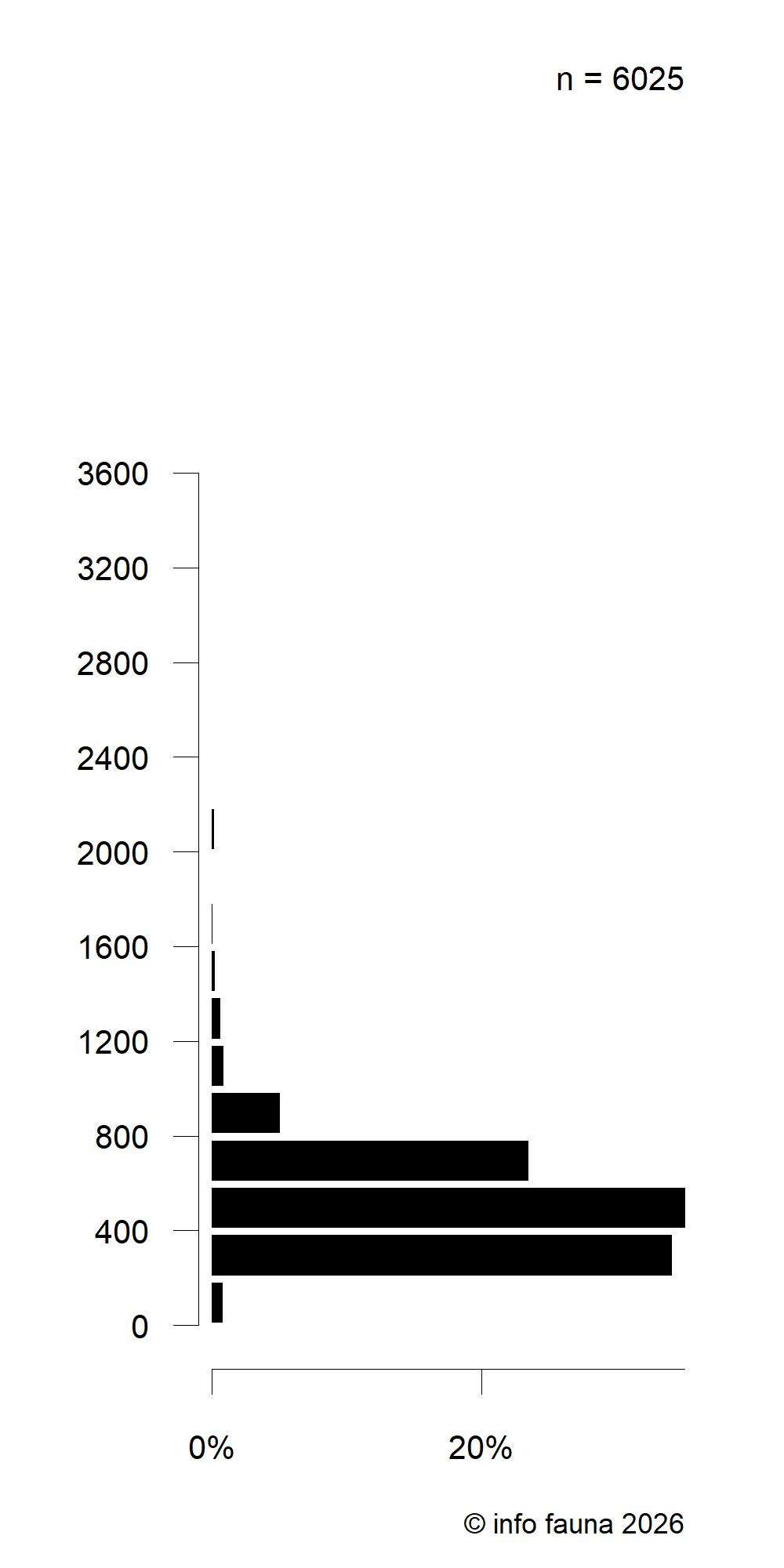
Collinéenne-montagnarde (principalement jusqu’à 1200 mètres d’altitude, quelques captures dans les étages subalpin et alpin jusque vers 3250 m.)

Répartition altitudinale de Nebria brevicollis. Le graphique montre le pourcentage de toutes les observations par classe d'altitude. Données 2022 © info fauna
Conservazione
Niveau de menace
Cette espèce est largement distribuée et commune dans les forêts et les milieux ouverts humides Elle n’est donc pas menacée. Koivula & Vermeulen (2005) ont montré qu’elle ne traversait pas les grandes routes. L’impact potentiel qu’aura la fragmentation de son habitat sur cette espèce sera visible dans les prochaines décennies.
Riferimenti bibliografici
Untersuchungen über Winterlager der Insekten
Renken, W. (1956). Untersuchungen über Winterlager der Insekten. Zeitschrift für Morphologie und Ökologie der Tiere, 45, 34-106.
On the ecology of some British carabid beetles with special reference to life histories
Greenslade, P. J. M. (1965). On the ecology of some British carabid beetles with special reference to life histories. Transactions of the Society of British Entomology, 16, 149-179.
The surface activity of beetles in a northern English wood
Evans, M. (1969). The surface activity of beetles in a northern English wood. Transactions of the Society for British Entomology, 18, 247-262.
Flight-muscle development of the carabid beetle Nebria brevicollis (F.)
Nelemans, M. N. E. (1983). Flight-muscle development of the carabid beetle Nebria brevicollis (F.). In The synthesis of field study and laboratory experiment. Report 4th Symp. Carabidol. (pp. 45-51). 81 Pudoc Wageningen.
Le régime alimentaire de huit carabides (Coleoptera) communs en milieu forestier
Loreau, M. (1983). Le régime alimentaire de huit carabides (Coleoptera) communs en milieu forestier. Acta Oecologia, 4, 331-343.
Winteraktivität epigäischer Aranei und Carabidae des Innsbrucker Mittelgebirges (900 m NN, Tirol, Österreich)
Flatz, S., & Thaler, K. (1980). Winteraktivität epigäischer Aranei und Carabidae des Innsbrucker Mittelgebirges (900 m NN, Tirol, Österreich). Anzeiger für Schädlingskunde, Pflanzenschutz, Umweltschutz volume, 53, 40-45.
Carabid Beetles in Their Environments. A Study on Habitat Selection by Adaptations in Physiology and Behaviour
Thiele, H. (1977). Carabid Beetles in Their Environments. A Study on Habitat Selection by Adaptations in Physiology and Behaviour. Zoophysiology and Ecology, 10.
Faunistik der Sandlaufkäfer und Laufkäfer der Schweiz (Cicindelidae & Carabidae) Coleoptera Teil 1 / Text
Marggi, W. (1992). Faunistik der Sandlaufkäfer und Laufkäfer der Schweiz (Cicindelidae & Carabidae) Coleoptera Teil 1 / Text. Dokumenta Faunistica 13.
Coleoptera, Carabidae. Ecology-Atlas
Luka, H., Marggi, W., Huber, C., Gonseth, Y., & Nagel, P. (2009). Coleoptera, Carabidae. Ecology-Atlas. Fauna Helvetica 24.
Tribus Bembidiini
Trautner, J., Bräunicke, M., & Fritze, M. (2017). Tribus Bembidiini. In Trautner, J., Die Laufkäfer Baden-Württembergs (pp. 201-310). Stuttgart: Eugen-Ulmer.
Nebria & Oreonebria
Huber, C. (2006). Nebria & Oreonebria. In Freude H., Harde K. W., Lohse G. A. & Klausnitzer B. (Eds.), Die Käfer Mitteleuropas. Band 2. Adephaga 1: Carabidae (Laufkäfer), 2. Auflage (pp. 71-82). Heidelberg / Berlin: Spektrum-Verlag.
What do we know about winter active ground beetles (Coleoptera, Carabidae) in Central and Northern Europe?
Jaskuła, R., & Soszyńska-Maj, A. (2011). What do we know about winter active ground beetles (Coleoptera, Carabidae) in Central and Northern Europe?. ZooKeys, 100, 517-532.
Laufkäfer als charakteristische Arten in Bayerns Wäldern - eine methodenkritische Auseinandersetzung mit Definition und Verfahren zur Herleitung charakteristischer Arten und zur Frage von Artengemeinschaften, unter besonderer Berücksichtigung der nac
Müller-Kroehling, S. (2015). Laufkäfer als charakteristische Arten in Bayerns Wäldern - eine methodenkritische Auseinandersetzung mit Definition und Verfahren zur Herleitung charakteristischer Arten und zur Frage von Artengemeinschaften, unter besonderer Berücksichtigung der nach §30 BNatschG geschützten Waldgesellschaften und der Wald-Lebensraumtypen des Anhanges I der FFH-Richtlinie und vergleichenden Einbeziehung natürlicherweise waldfreier Sonderstandorte im Wald. Technischen Universität München.
Highways and Forest Fragmentation – Effects on Carabid Beetles (Coleoptera, Carabidae)
Koivula, M. J., & Vermeulen, H. J. W. (2005). Highways and Forest Fragmentation – Effects on Carabid Beetles (Coleoptera, Carabidae). Landscape Ecology, 20(8), 911-926.
Larval and adult species composition, phenology and life cycles of carabid beetles (Coleoptera: Carabidae) in an organic potato field
Traugott, M. (1999). Larval and adult species composition, phenology and life cycles of carabid beetles (Coleoptera: Carabidae) in an organic potato field. European Journal of Soil Biology, 34(4), 189-197.
Life history patterns of some British Carabidae and their ecological significance
Murdoch, W. W. (1967). Life history patterns of some British Carabidae and their ecological significance. Oikos, 18(25-32).
The effects of agricultural practices on Carabidae in temperate ecosystems. Integr
Holland, J. M., & Luff, M. L. (2000). The effects of agricultural practices on Carabidae in temperate ecosystems. Integr. Pest Manag., 5, 109-129.
Flight muscle development and dispersal in the life cycle of carabid beetles: patterns and processes
Desender, K. (2000). Flight muscle development and dispersal in the life cycle of carabid beetles: patterns and processes. Bulletin de l'Institut Royal des Sciences Naturelles de Belgique - Bulletin van het Koninklijk Belgisch Instituut voor Natuurwetenschappen, 70, 13-31.