
Type de présence en Suisse
Indigène (INN)
ⓘⓧ
Degré de menace
Selon les Catégories et Critères de la Liste rouge de l’UICN ou selon Duelli et al. 1994.
(exp = appréciation d'expert·e·s)
Statut de protection (CH)
Selon les lois et ordonnances nationales spécifiques.
Degré de menace (CH)
Non menacé (LC)
Statut de protection (CH)
ⓘⓧ
Selon les lois et ordonnances mentionnées
–
Lois et ordonnances
–
ⓘⓧ
Selon l’aide à l’exécution : Liste des espèces prioritaires au niveau national.
Priorité nationale
–
Niveau d’action
–
Indications sur le niveau d’action
–
Urgence des mesures (CH)
–
Protection d’occurrences individuelles
–
Surveillance des populations
–
ⓘⓧ
Domaine agricole (OEA/UZL)
Espèce cible/caractéristique selon : Objectifs environnementaux pour l’agriculture "Espèces et milieux naturels".
(* = appréciation d'expert·e·s)
Forêts
2 : Espèce cible forestière selon Biodiversité en forêt : objectifs et mesures. Aide à l’exécution pour la conservation de la diversité biologique dans la forêt suisse (Imesch et al. 2015).
1 : Espèce cible forestière complémentaire, définie dans le cadre de plans d'actions OFEV (p.ex. Plan d'action Forêts claires).
Domaine agricole (OEA/UZL)
–
Forêts
–
✓
Taxon bien étudié, graphique proche de la situation réelle plus d'info
Carte
Carte des observations de Nebria brevicollis en Suisse (résolution 5x5 km).Voir la carte
Période
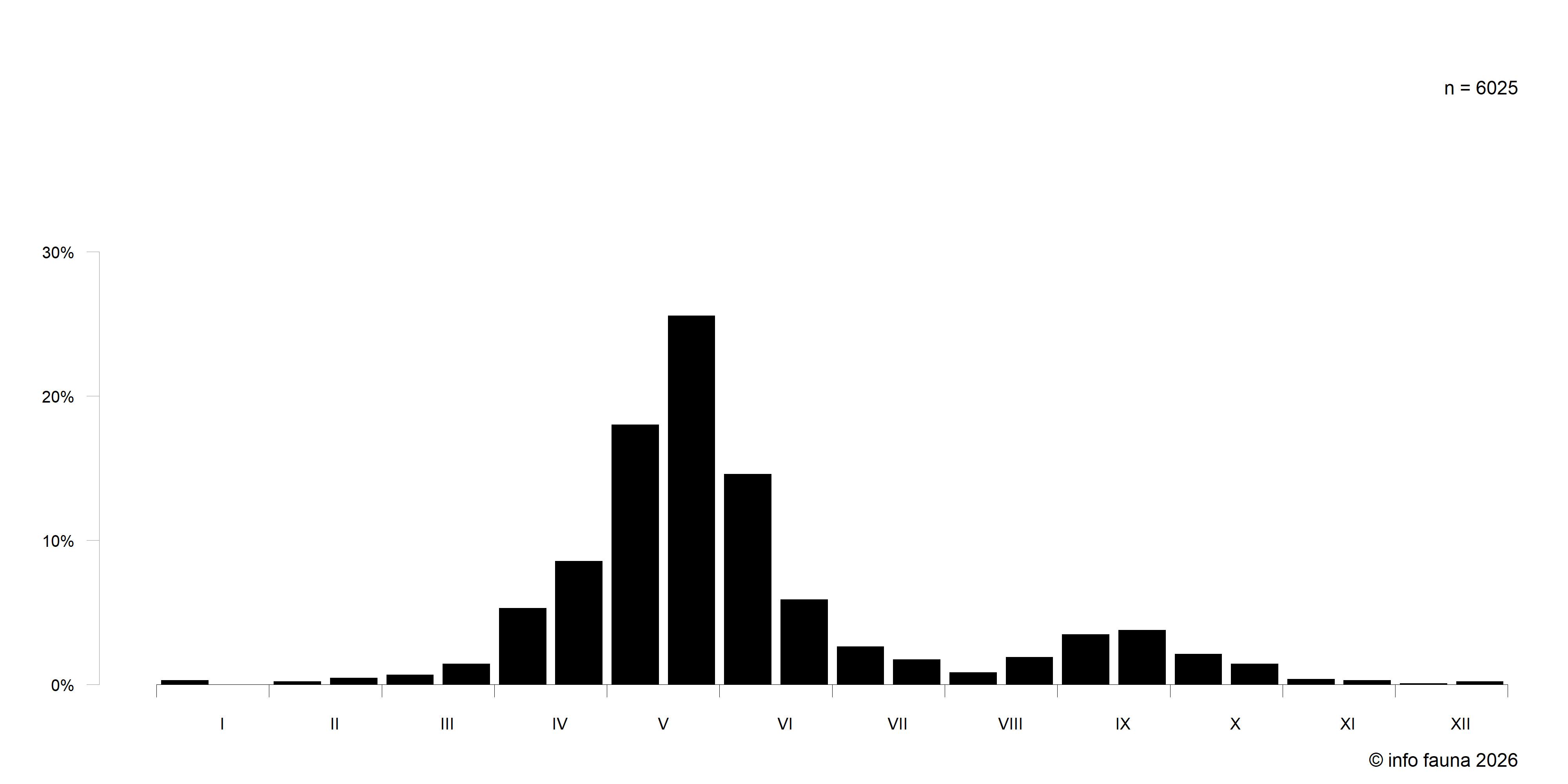
Période des observations de Nebria brevicollis en Suisse. Le graphique montre la proportion de toutes les observations par quinzaine.
Classification
- Arthropoda (Phylum)
- Insecta (Classe)
- Coleoptera (Ordre)
- Carabidae (Famille)
- Nebria (Genre)
- Carabidae (Famille)
- Coleoptera (Ordre)
- Insecta (Classe)
Plus d'informations
Portrait de l'espèce
Auteur-e-s
Florian Walter, René Hoess
Portrait
Description
Les critères les plus importants pour cette espèce de 10-14 mm de long sont, d’après Huber (2006):
- côtés du pronotum fortement arqués, légèrement sinués avant les angles postérieurs, pronotum cordiforme
- 3ème interstrie des élytres avec des soies discales
- face supérieure des tarses pourvue de courtes soies (en plus des soies apicales), lorsque les tarses sont usés et les soies perdues, les points d’insertion de celles-ci sont encore visibles
- palpes maxillaires entièrement brun-rouge, rarement plus ou moins assombries
- microsculpture élytrale faite de mailles fortement transverses
- face dorsale brun-noir, côtés du pronotum et élytres rougeâtres, extrémités brun-rouge, fémurs et tibias sombres
N. salina, très semblable a les métatarses glabres sur le dessus (hormis les soies apicales normales), la microsculpture élytrale faite de mailles isodiamétriques et l’article basal des palpes maxillaires presque toujours sombre.

Nebria brevicollis, Neuchatel 2010. Photo © Laurie Magnin MZL
Biologie et habitat
Habitat
Espèce plutôt hygrophile et eurytope qui se trouve principalement dans des forêt de feuillus et des sites frais à humides en milieu ouvert mais également dans d’autres milieux (Marggi 1992, Luka et al. 2009, Trautner & Rietze 2017). Selon Müller-Kroehling (2015), elle a une affinité pour les forêts alluviales ou inondables. En Bade-Wurtemberg, elle a été trouvée le plus souvent dans des cultures fraiches et des zones herbacées mais également dans des forêts humides et même dans des pelouses mi-sèches (Trautner & Rietze 2017). Cette espèce est nocturne (Thiele 1977). On la trouve régulièrement rassemblée en grand nombre, par exemple au pied d’arbres et sous des tas de pierres (comm. pers. René Hoess). L’hivernation se passe en bord de champs (Holland & Luff 2000). Les imagos peuvent être actifs en hiver (Renken 1956). N. brevicollis est partiellement capable de voler et vient régulièrement au piège lumineux (Nelemans 1983, données du CSCF). Les femelles portant des oeufs mâtures ont souvent la musculature alaire atrophiée (Desender 2000).
Régime alimentaire
Espèce principalement prédatrice qui a un large spectre de proies. Elle peut s’attaquer à des Myriapoda de 2 cm de long (Loreau 1983).
Phénologie
L’accouplement et la ponte ont principalement lieu en été et en automne, le développement des larves en été et en automne (Holland & Luff 2000, Trautner & Rietze 2017). Ainsi bien les larves que les adultes hivernent et peuvent être actifs en hiver (Renken 1956, Greenslade 1965, Murdoch 1967, Evans 1969, Flatz & Thaler 1980, Traugott 1998, Jaskuła & Soszyńska-Maj 2011, données du CSCF). Les imagos ont été trouvés toute l’année, avec un maximum en mai.

Phénologie de Nebria brevicollis. Le graphique montre le pourcentage de toutes les observations par mois. Lorsqu'il y a au moins 60 observations avec une date complète (jour et mois), leur répartition par semaine est indiquée. Données 2022 © info fauna.
Distribution
Globale
Cette espèce est présente dans toute l’Europe jusqu’au sud de l’Europe septentrionale. Au sud-est elle atteint l’Asie Mineure et le Caucase. En Europe centrale, elle est commune et présente dans tous les pays limitrophes de la Suisse. (Huber 2006)
En Suisse
Cette espèce est distribuée dans toute la Suisse mais manque dans les régions de haute altitude des Alpes et de quelques vallées alpines.
Altitudinale
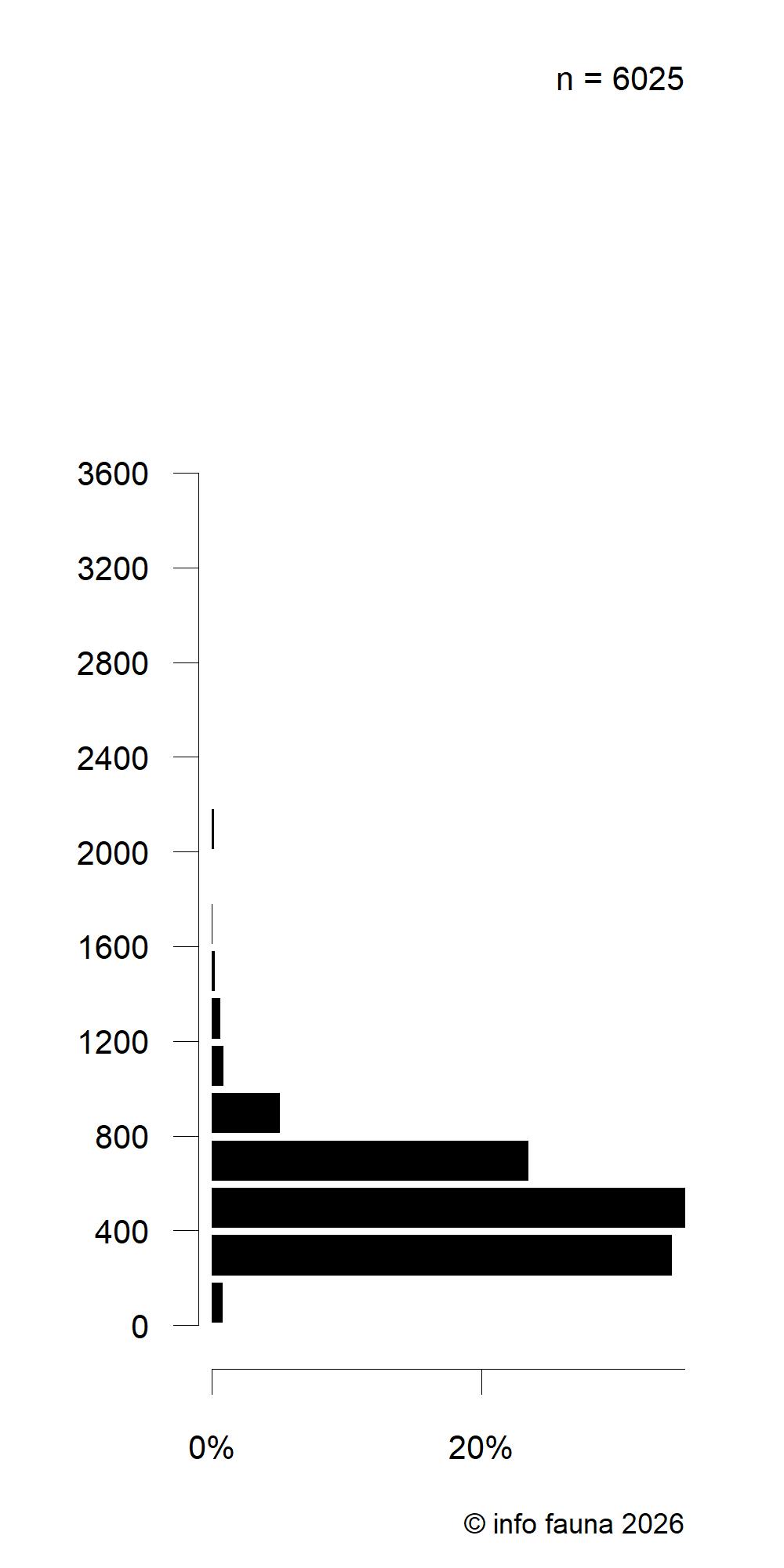
Collinéenne-montagnarde (principalement jusqu’à 1200 mètres d’altitude, quelques captures dans les étages subalpin et alpin jusque vers 3250 m.)

Répartition altitudinale de Nebria brevicollis. Le graphique montre le pourcentage de toutes les observations par classe d'altitude. Données 2022 © info fauna
Conservation
Niveau de menace
Cette espèce est largement distribuée et commune dans les forêts et les milieux ouverts humides Elle n’est donc pas menacée. Koivula & Vermeulen (2005) ont montré qu’elle ne traversait pas les grandes routes. L’impact potentiel qu’aura la fragmentation de son habitat sur cette espèce sera visible dans les prochaines décennies.