
Type de présence en Suisse
Introduite, invasive (NLS)
ⓘⓧ
Degré de menace
Selon les Catégories et Critères de la Liste rouge de l’UICN ou selon Duelli et al. 1994.
(exp = appréciation d'expert·e·s)
Statut de protection (CH)
Selon les lois et ordonnances nationales spécifiques.
Degré de menace (CH)
Non applicable au niveau régional (NA)
Statut de protection (CH)
ⓘⓧ
Selon les lois et ordonnances mentionnées
–
Lois et ordonnances
–
ⓘⓧ
Selon l’aide à l’exécution : Liste des espèces prioritaires au niveau national.
Priorité nationale
–
Niveau d’action
–
Indications sur le niveau d’action
–
Urgence des mesures (CH)
–
Protection d’occurrences individuelles
–
Surveillance des populations
–
ⓘⓧ
Domaine agricole (OEA/UZL)
Espèce cible/caractéristique selon : Objectifs environnementaux pour l’agriculture "Espèces et milieux naturels".
(* = appréciation d'expert·e·s)
Forêts
2 : Espèce cible forestière selon Biodiversité en forêt : objectifs et mesures. Aide à l’exécution pour la conservation de la diversité biologique dans la forêt suisse (Imesch et al. 2015).
1 : Espèce cible forestière complémentaire, définie dans le cadre de plans d'actions OFEV (p.ex. Plan d'action Forêts claires).
Domaine agricole (OEA/UZL)
–
Forêts
–
✓
Taxon bien étudié, graphique proche de la situation réelle plus d'info
Carte
Carte des observations de Myocastor coypus en Suisse (résolution 5x5 km).Voir la carte
Période
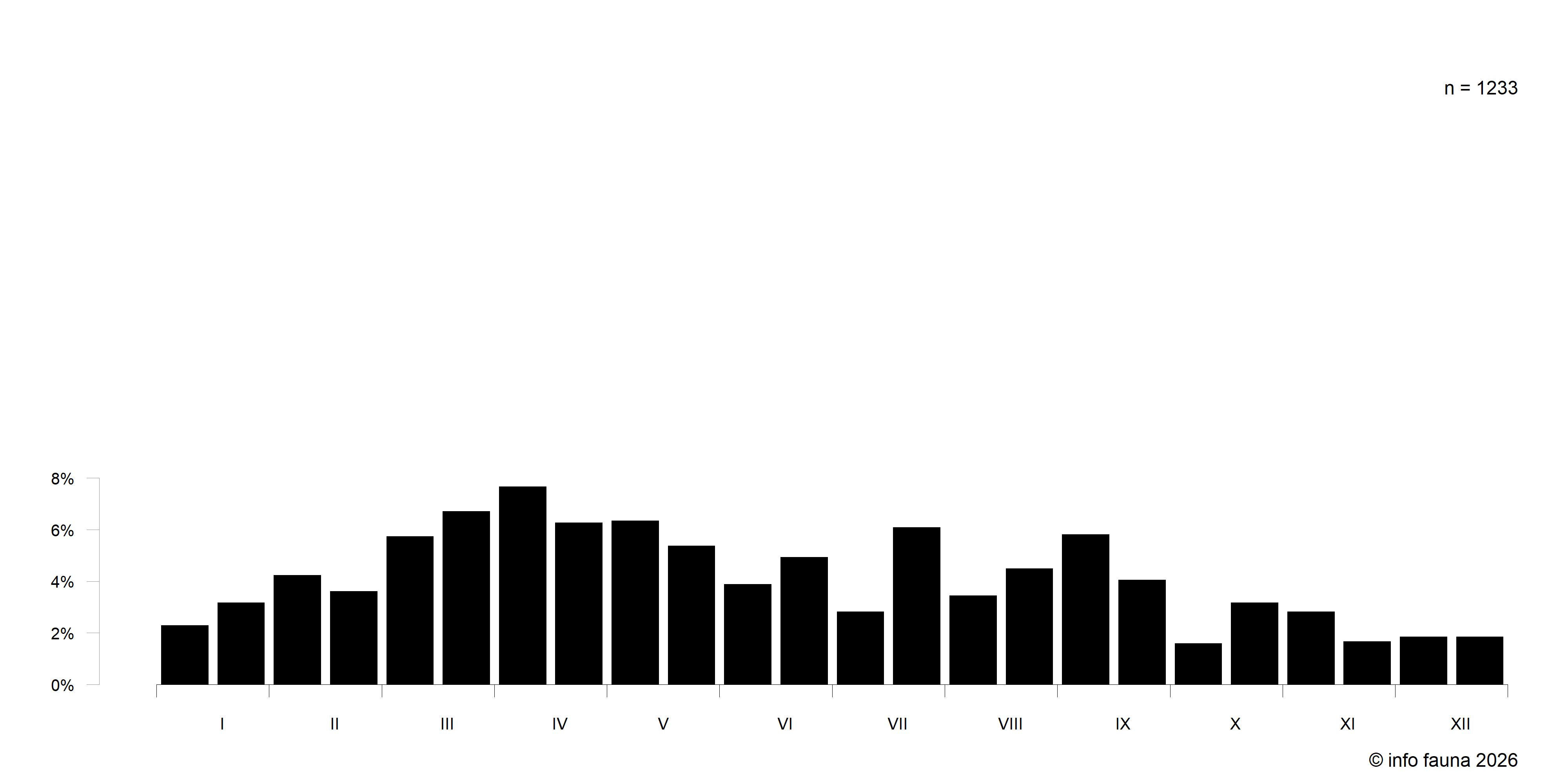
Période des observations de Myocastor coypus en Suisse. Le graphique montre la proportion de toutes les observations par quinzaine.
Classification
- Chordata (Phylum)
- Mammalia (Classe)
- Rodentia (Ordre)
- Echimyidae (Famille)
- Myocastor (Genre)
- Echimyidae (Famille)
- Rodentia (Ordre)
- Mammalia (Classe)
Portrait de l'espèce
Auteur-e-s
Sarah Hummel
Portrait
Description
Le ragondin, appelé parfois castor des marais, est un rongeur aquatique d’apparence trapue. Avec sa longueur de corps de 45 à 65 cm, le ragondin est nettement plus petit que le castor (Castor fiber), mais sensiblement plus grand que le rat musqué (Ondatra zibethicus). Son museau est plat, donnant au crâne une forme «carrée». La lèvre supérieure est profondément fendue, révélant les impressionnantes incisives orange, dont la coloration est due à des dépôts de fer. La queue du ragondin est cylindrique et constitue l’élément distinctif le plus marquant par rapport à la queue largement aplatie (palette) du castor. Comme chez le rat musqué, une grande partie du dos du ragondin dépasse de l’eau lorsqu’il nage. La posture de la tête est marquante: les ragondins tiennent leur nez au-dessus de la surface de l’eau, de sorte que leur tête pointe en diagonale vers le haut, rendant visibles leurs longues et épaisses vibrisses de couleur gris-blanc brillante ainsi que ses lèvres et joues blanchâtres. Les oreilles dépassent nettement du pelage. Les ragondins européens proviennent de fermes à fourrure, la couleur de leur pelage est ainsi extrêmement variable en raison de l’élevage sélectif. Elle peut varier du blanc au noir, mais la plupart des animaux sont de couleur brun rougeâtre, avec un aspect général hirsute. Ses grandes pattes postérieures palmées et équipées de poils natatoires ainsi que son pelage capturant l’air font de lui un bon nageur. Les longues griffes des pattes antérieures et la forte musculature des pattes et des épaules sont des adaptations à sa capacité à creuser la terre.

La posture du ragondin (Myocastor coypus) dans l’eau est un signe distinctif. En effet, sa tête pointe en diagonale, le «castor des marais» tenant son nez hors de l’eau. Photo © Samuel Betschart.

La queue du ragondin (Myocastor coypus) permet de le distinguer facilement du castor (Castor fiber). En effet, elle est cylindrique chez le premier, tandis qu’elle est aplatie (palette) chez le deuxième. Photo © Maryse Neukomm.
Biologie et habitat
Habitat
Dans son aire de distribution d’origine, l’Amérique du Sud, le ragondin peuple la côte pacifique chilienne ainsi que les eaux peu profondes et lacustres des basses terres des grands fleuves Rio Negro, Rio Colorado et Rio Paraná. En Europe, on le trouve dans les marais, les étangs, les canaux ou les petits cours d’eau à la végétation aquatique luxuriante, dans les massifs de joncs, les roselières ou dans les terres agricoles adjacentes. Les hivers enneigés et les longues périodes de gel entraînent une forte mortalité et empêchent la propagation de l’espèce en altitude.

Le ragondin (Myocastor coypus) apprécie les zones humides comme les marais, les étangs ou encore les roselières. Ce type de milieux fournit abri et nourriture au rongeur. Photo © Orlando Ostinelli.
Régime alimentaire
Les ragondins se nourrissent principalement des fruits, des feuilles et des tiges de plantes aquatiques. Pendant la saison hivernale, ils se rabattent sur leurs racines et rhizomes, mais épluchent aussi les branches et les tiges de diverses plantes ligneuses. Selon les disponibilités, ils complètent leur alimentation avec des plantes cultivées, des moules et des escargots, de manière similaire au rat musqué.
Comportement
Les ragondins creusent des terriers dans les zones littorales, qui consistent en un simple système de galeries et un ou plusieurs espaces d’habitation. Contrairement au castor et au rat musqué, ils placent leurs entrées et sorties au-dessus de la surface de l’eau. Pendant la journée, ils utilisent aussi des trous, des buissons denses ou des petites îles comme lieux de repos. Dans les étangs et les lacs sans rives escarpées, ils construisent des huttes faites de matière végétale, tout comme les rats musqués.
Selon l’intensité de la perturbation de leur habitat, les ragondins sont actifs de jour comme de nuit.
Ils ne sont pas territoriaux et fréquentent des zones d’itinérance d’un rayon d’environ 200 m. Au sein de leur colonie, ils vivent généralement en couples.
Reproduction
Les ragondins peuvent se reproduire toute l’année. Après une période de gestation de 110 à 150 jours, 3 à 5 jeunes en moyenne (au maximum jusqu’à 11) naissent et sont allaités pendant 8 semaines. Jusqu’à 3 portées par an sont possibles. Les jeunes sont capables d’accompagner leur mère dans sa recherche de nourriture dès la naissance et complètent leur alimentation avec des aliments végétaux après seulement quelques jours (nidifuges). À l’âge d’environ six mois, ils atteignent la maturité sexuelle, mais la reproduction n’a généralement lieu qu’à partir de leur deuxième année.
Distribution
Situation mondiale et en Europe
Les ragondins sont originaires d’Amérique du Sud. En 1880, les premiers animaux se sont échappés des fermes à fourrure en France. Avec la création de fermes en Allemagne à partir de 1926, de plus en plus d’animaux se sont échappés et les premières populations sauvages d’Europe se sont établies à différents endroits dans les deux pays. L’Amérique du Nord, le Japon, le Kenya et l’Australie occidentale sont également peuplés de ragondins aujourd’hui. Ces populations peuvent être retracées jusqu’à des lâchers délibérés ou des évasions d’animaux d’élevages. En fonction des conditions climatiques, les ragondins se reproduisent à des rythmes différents selon les pays. Les hivers rigoureux avec des températures basses ne sont que très peu tolérés, ce qui, en Europe centrale, entraîne des effondrements sévères et répétés des populations, voire localement l’extinction de certaines populations, tandis que les températures hivernales douces de la région méditerranéenne, par exemple dans le nord de l’Italie ou le sud de la France, entraînent une croissance démographique constante, qui s’accompagne de dommages considérables aux installations hydrauliques et aux cultures.
Comme les populations de ragondins en Europe sont basées sur des introductions artificielles, l’espèce est considérée comme exotique (néozoaire). En 2016, elle a été inscrite sur la liste des espèces exotiques envahissantes préoccupantes pour l’Union européenne (liste noire), raison pour laquelle aucun statut de menace (NA) n’a été défini.
Situation en Suisse
En Suisse, le premier ragondin a été aperçu en 1948 dans la commune de Glattfelden (ZH), près du Rhin, probablement en provenance d’Allemagne. Aujourd’hui, les ragondins se sont principalement établis en Ajoie et le long du Rhin entre Bâle et Schaffhouse. Des populations isolées existent également à Genève et dans la plaine de Magadino près de Locarno et près de Chiasso.
En raison de son historique de propagation, le ragondin est considéré comme un néozoaire envahissant, c’est pourquoi aucun statut de menace (NA) n’a été défini. Toutefois, à l’heure actuelle on suppose que les périodes de froid empêchent le ragondin de se répandre largement en Suisse et de ce fait on ne s’attend pas à des dommages environnementaux majeurs de la part de ce nouveau rongeur. Pour obtenir des prévisions fiables, il faudra cependant observer l’évolution de la situation.
Mesures
Les effets potentiellement négatifs des ragondins sont presque identiques à ceux du rat musqué, bien que légèrement inférieurs au niveau global.
Comme le rat musqué, le ragondin creuse des galeries dans les berges des cours d’eau et peut ainsi altérer l’hydrologie, déstabiliser les renforcements des berges et causer des dommages aux digues et aux barrages, coûtant des millions d’euros, surtout dans les pays méditerranéens. Contrairement aux régions côtières, cette influence est probablement d’une importance mineure en Suisse.
Les ragondins peuvent parcourir de longues distances sur terre, et peuvent donc endommager les cultures agricoles même dans des zones plus éloignées de l’eau. Leur fort besoin en aliments végétaux et leur activité d’alimentation sélective peuvent modifier la composition des communautés végétales. En hiver surtout, lorsqu’ils se nourrissent principalement de racines et de rhizomes, la pression sur certaines espèces végétales peut devenir trop importante, par exemple pour les espèces de massettes comme Typha angustifolia ou T. latifolia, mais aussi pour des espèces végétales plus rares comme le nénuphar (Nuphar lutea) ou l’iris des marais (Iris pseudacorus), jusqu’à faire disparaître ces plantes localement. Les dégâts de broutage aux plantes ligneuses à proximité de la rive peuvent également être considérables.
La pression de prédation sur les populations résiduelles locales de moules de rivière et d’étang (Unionidae), très menacées, pourrait également augmenter puisque les ragondins complètent leur régime alimentaire avec ces dernières, en particulier pendant les pénuries de nourriture en hiver. Contrairement au rat musqué, leur influence n’est pas encore bien documentée, mais les premières études de cas en Allemagne suggèrent une influence tout aussi importante.
Les ragondins et les rats musqués ont un régime alimentaire similaire. En hiver surtout, les deux espèces se disputent les maigres ressources alimentaires de plantes aquatiques. Il y a donc des indications que les ragondins pourraient déplacer les rats musqués. Une éventuelle concurrence avec les castors est en cours de discussion, mais il n’existe pas encore d’études fiables sur l’interaction des rongeurs aquatiques.
En raison de la mortalité hivernale relativement élevée pendant les périodes prolongées de froid, on considère jusqu’à présent qu’il est peu probable que le ragondin s’établisse à long terme en Suisse avec des populations importantes et cause des dommages à l’environnement. Les ragondins observés en Suisse sont aussitôt éliminés par les autorités cantonales de la chasse, ce qui a jusqu’à présent empêché qu’ils se répandent sur de grandes surfaces. Cependant, les premières adaptations au nouvel habitat sont déjà visibles. En Europe centrale par exemple, les ragondins semblent commencer à creuser des terriers plus nombreux et plus profonds pour se protéger des intempéries. Il n’est donc pas exclu que, contrairement aux attentes, l’espèce s’installe durablement et s’étende, du moins dans les basses altitudes de la Suisse. Si cela devait se produire, une intensification des mesures devrait être discutée, en tout cas dans les zones sensibles.