
Type de présence en Suisse
Indigène (INN)
ⓘⓧ
Degré de menace
Selon les Catégories et Critères de la Liste rouge de l’UICN ou selon Duelli et al. 1994.
(exp = appréciation d'expert·e·s)
Statut de protection (CH)
Selon les lois et ordonnances nationales spécifiques.
Degré de menace (CH)
En danger (EN)
Statut de protection (CH)
ⓘⓧ
Selon les lois et ordonnances mentionnées
–
Lois et ordonnances
–
ⓘⓧ
Selon l’aide à l’exécution : Liste des espèces prioritaires au niveau national.
Priorité nationale
Oui
Niveau d’action
AF(+LF+GL) : Conservation ciblée des espèces
Indications sur le niveau d’action
–
Urgence des mesures (CH)
1 : urgent
Protection d’occurrences individuelles
–
Surveillance des populations
1 : insuffisant
ⓘⓧ
Domaine agricole (OEA/UZL)
Espèce cible/caractéristique selon : Objectifs environnementaux pour l’agriculture "Espèces et milieux naturels".
(* = appréciation d'expert·e·s)
Forêts
2 : Espèce cible forestière selon Biodiversité en forêt : objectifs et mesures. Aide à l’exécution pour la conservation de la diversité biologique dans la forêt suisse (Imesch et al. 2015).
1 : Espèce cible forestière complémentaire, définie dans le cadre de plans d'actions OFEV (p.ex. Plan d'action Forêts claires).
Domaine agricole (OEA/UZL)
Z : Espèce cible
Forêts
–
✓
Taxon bien étudié, graphique proche de la situation réelle plus d'info
Carte
Carte des observations de Anthophora plagiata en Suisse (résolution 5x5 km).Voir la carte
Période
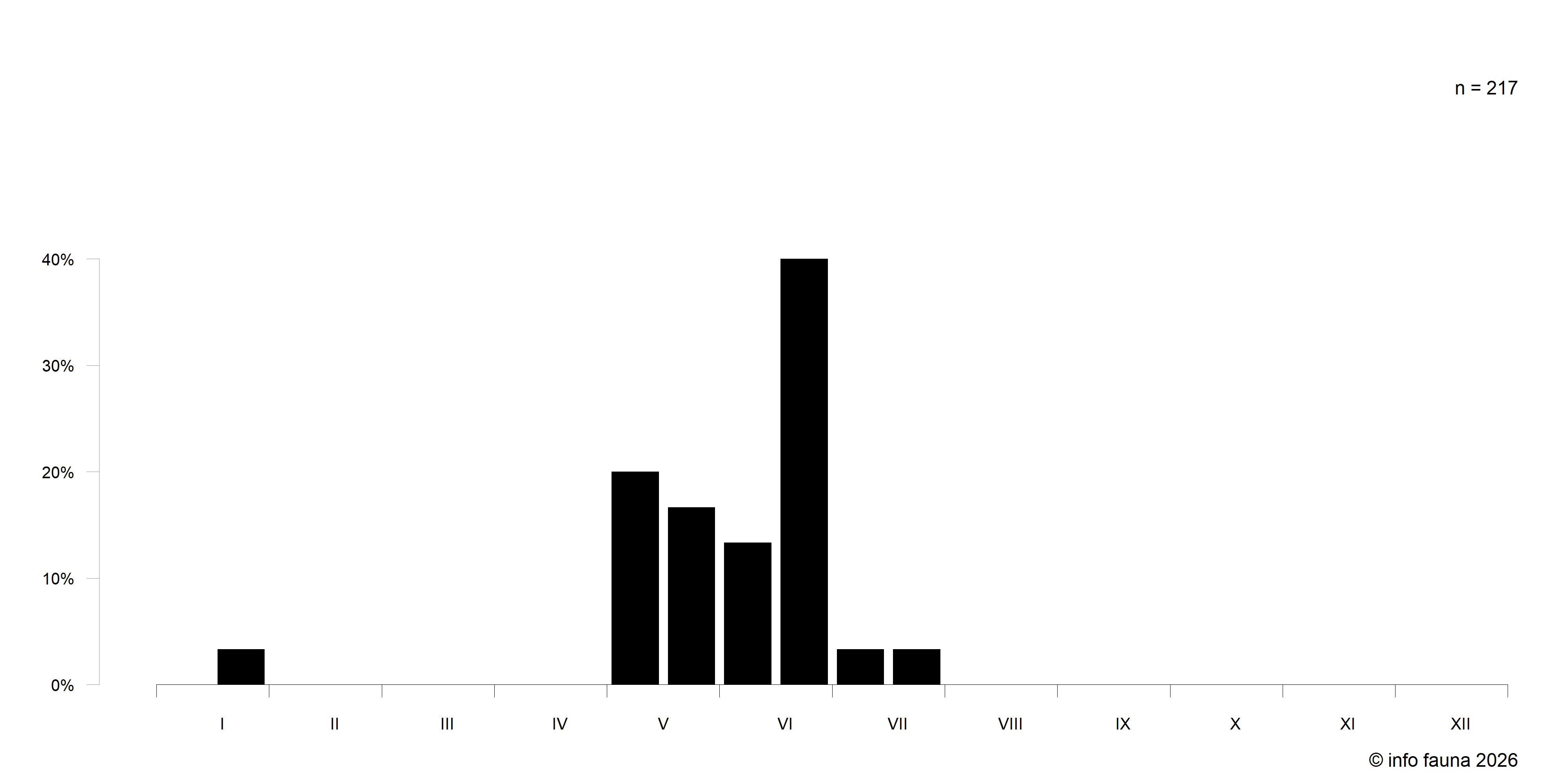
Période des observations de Anthophora plagiata en Suisse. Le graphique montre la proportion de toutes les observations par quinzaine.
Classification
- Arthropoda (Phylum)
- Insecta (Classe)
- Hymenoptera (Ordre)
- Apidae, Anthophorinae (Famille)
- Anthophora (Genre)
- Apidae, Anthophorinae (Famille)
- Hymenoptera (Ordre)
- Insecta (Classe)
Portrait de l'espèce
Auteur-e-s
Dimitri Bénon
Portrait
Description et taxonomie
Anthophora plagiata est une espèce de taille moyenne à grande (13-14 mm) qu’il est généralement possible d’identifier sur le terrain avec l’abeille en main et une bonne connaissance du genre Anthophora. Chez les femelles, on rencontre, souvent dans les mêmes populations, deux formes très différentes. La forme claire a la pilosité blanchâtre sur la face, brun-orange sur le thorax et les tergites (parfois noire sur le tergite 5). La brosse tibiale est blanchâtre. La pilosité nettement brunâtre du thorax et de l’abdomen, souvent avec des teintes orangées, permet en général de séparer facilement A. plagiata des autres espèces du genre Anthophora. Chez la forme sombre, la femelle a une pilosité caractéristique, noire sur la tête, le thorax et les deux premiers tergites, contrastant fortement avec la pilosité orange des tergites suivants. La brosse tibiale des pattes arrières est aussi entièrement noire.

Femelle de la forme claire d'Anthophora plagiata (St-Luc VS, 1975). Photo © Albert Krebs.
Le mâle fait partie des espèces sans franges de poils noirs sur les pattes médianes. Sa pilosité est majoritairement brun-jaune, noire sur les tergites 4-7. Il se reconnait à sa face teintée de blanc; uniquement le clypeus, le labre et les mandibules sont blancs. Chez le mâle d'A. furcata la coloration est jaune et dépasse le clypeus pour atteindre le bord des yeux. Le mâle d'A. balneorum est très semblable mais chez cette espèce la coloration blanche ne recouvre pas l’ensemble du clypeus et les mandibules sont entièrement sombres.

Femelle de la forme sombre récoltant sur Fabaceae (Tomils GR, 1999). Photo © Albert Krebs.
Biologie et habitat
Habitat
Anthophora plagiata est intimement liée aux milieux très structurés et richement fleuris où l’on trouve des parois et talus morainiques ou de Loess. Pour sa nidification, l’espèce a besoin d’un accès rapide à une source d’eau, souvent des petits cours d’eau ou des zones de suintements.
Sources de pollen
A. plagiata est une espèce polylectique. En Europe centrale, l’espèce récolte le pollen d’au moins quatre familles de plantes, à savoir celui de Boraginaceae (Echium), Cistaceae (Helianthemum), Fabaceae (Lotus, Ononis, Trifolium, Vicia) et Lamiaceae (Lamium). Plus au nord, l’espèce a aussi été observée en train de récolter du pollen de Papaveraceae (Papaver), Rosaceae (Rosa) et Brassicaceae (Brassica). (Cederberg 2015, Westrich 2018).
Les femelles montrent une nette séparation entre la récolte de pollen et de nectar. Ainsi, tôt dans la matinée, les femelles récoltent essentiellement du pollen, puis, dans un deuxième temps, elles ne récoltent plus que du nectar. (Westrich 2018).
Nidification
La nidification d’A. plagiata a été largement étudiée et des nombreuses observations sont disponibles dans la littérature. La femelle creuse elle-même son nid dans le sol, en général dans des parois et des talus verticaux limoneux, de moraines ou de Loess. Plus rarement, les nids peuvent aussi être creusés à plat, dans des sols protégés de la pluie. L’espèce creuse aussi régulièrement ces nids dans le mortier de certains murs : au nord de l’Europe (notamment en Suède, au Danemark ou encore en Pologne), les façades des habitations traditionnelles sont même les sites de nidifications privilégiés d’A. plagiata. L'espèce forme souvent de petites agrégations, certaines pouvant contenir jusqu’à 100 individus lorsque les conditions sont réunies.
Les nids d’A. plagiata se reconnaissent le plus souvent à la longue cheminée coudée qui en prolonge l’entrée. Cette cheminée est composée de petits blocs de terre accolés ensemble et atteint environ 3.5 cm de long. Elle est nettement coudée vers le bas et possède souvent une longue fissure linéaire sur sa face supérieure. C’est une construction très fragile, lisse à l’intérieur et rugueuse à l’extérieur, qui se casse régulièrement au fil du temps. Une fois cette cheminée passée, le nid se prolonge dans le sol en une courte galerie coudée, s’enfonçant le plus souvent à la verticale, au bout de laquelle sont construites les cellules à couvain. La galerie principale est souvent ramifiée, le nid contenant alors 2-3 galeries. Chaque galerie contient 1-4 cellules à couvain. Les cellules à couvain sont placées directement l’une derrière l’autre, le bouchon de terre qui ferme la première cellule servant de paroi à la suivante. Comme chez la grande majorité des espèces du genre Anthophora, la paroi interne de la cellule est entièrement recouverte d’une couche cireuse blanchâtre. Le remplissage de la cellule à couvain suit un procédé particulier : la femelle récolte en effet d’abord le pollen, qu’elle dépose au fond de la cellule, puis le nectar, avec lequel elle remplit une grande partie de la cellule de sorte que la masse de pollen est complètement immergée. Il est très probable que la femelle ajoute au nectar des sécrétions provenant notamment de la glande Dufour, la provision dégageant rapidement une odeur âcre typique du genre Anthophora. L’œuf est alors déposé sur cette réserve de nourriture liquide, seules les deux extrémités touchant la surface de la provision. Le forage d’une nouvelle galerie représentant un travail considérable, une femelle ne produit que peu de cellules à couvain au cours de sa vie. Les anciens nids sont cependant souvent réutilisés d’une saison à l’autre. (Malyshev 1925d, Grosdanic & Vasic 1965, Banaszak 1971, Steinmann 1985, Cederberg 2015, Westrich 2018).

Site de nidification d'Anthophora plagiata, avec les cheminées coudées, caractéristiques de l'espèce, visibles devant l'entrée de certains nids. Photo © Albert Krebs.
Comme les nids sont généralement construits dans du sol très dur, la femelle utilise une grande quantité d’eau pour ramollir la terre et lui permettre ainsi de creuser son nid avec ses mandibules. C’est pourquoi les sites de nidifications se trouvent en général à proximité immédiate (souvent seulement quelques dizaines de mètres) d’une source d’eau. Durant les belles journées ensoleillées, il est ainsi possible de voir des rassemblements de plusieurs dizaines de femelles à un même point d’eau. (Steinmann 1985, Westrich 2018).
Le rôle exact de la longue cheminée présente à l’entrée des nids d’A. plagiata est encore en partie inconnu. Plusieurs hypothèses ont été proposées, notamment qu’il s’agirait d’une protection contre les parasites ou les fortes pluies, ou d’un moyen de reconnaissance des nids. Norden (1984) a étudié le comportement d’A. abrupta, une espèce nord-américaine qui montre une biologie de nidification relativement proche de celle d’A. plagiata. Selon cet auteur, la cheminée aurait avant tout un rôle de chauffage : cette structure permet en effet d’augmenter plus rapidement la température à l’intérieur du nid, la femelle pouvant alors s’activer plus tôt dans la matinée.
Espèces parasites
A. plagiata est parasitée par plusieurs espèces d’abeilles-coucous: Coelioxys rufescens et Coelioxys conicus, Melecta albifrons et M. luctuosa, ainsi que Thyreus orbatus. (Stoeckhert 1919, 1933, Moeschler 1938, Banaszak 1971, Mucalica 1997, Westrich 2018).
A. plagiata est aussi l’hôte des coléoptères Meloe violaceus et Sitarsis muralis (Meloidae), ainsi que de la guêpe parasitoïde Monomontomerus obscurus (Tyromidae). (Mucalica 1997, Scheuchl & Willner 2016).
Comportement de reproduction
On ne connait pas en détail le comportement de reproduction de l’espèce. Les mâles sont régulièrement observés en train de patrouiller autour de sites de nidification ou de patchs de fleurs sur lesquelles les femelles vont butiner, le long de circuits probablement marqués par des phéromones.
Ce sont les principaux pollinisateurs des orchidées Ophrys argolica et O. delphinensis (endémiques à la Grèce). (Paulus & Gack 1990, Tsiftsis & Djordjevic 2020).
Distribution
Cycle de vie
Anthophora plagiata est une espèce solitaire univoltine. Elle vole de mai à août. A. plagiata passe l’hiver au stade de prépupe, sans cocon. (Meyer 1913).

Phénologie d'Anthophora plagiata en Suisse.
Distribution
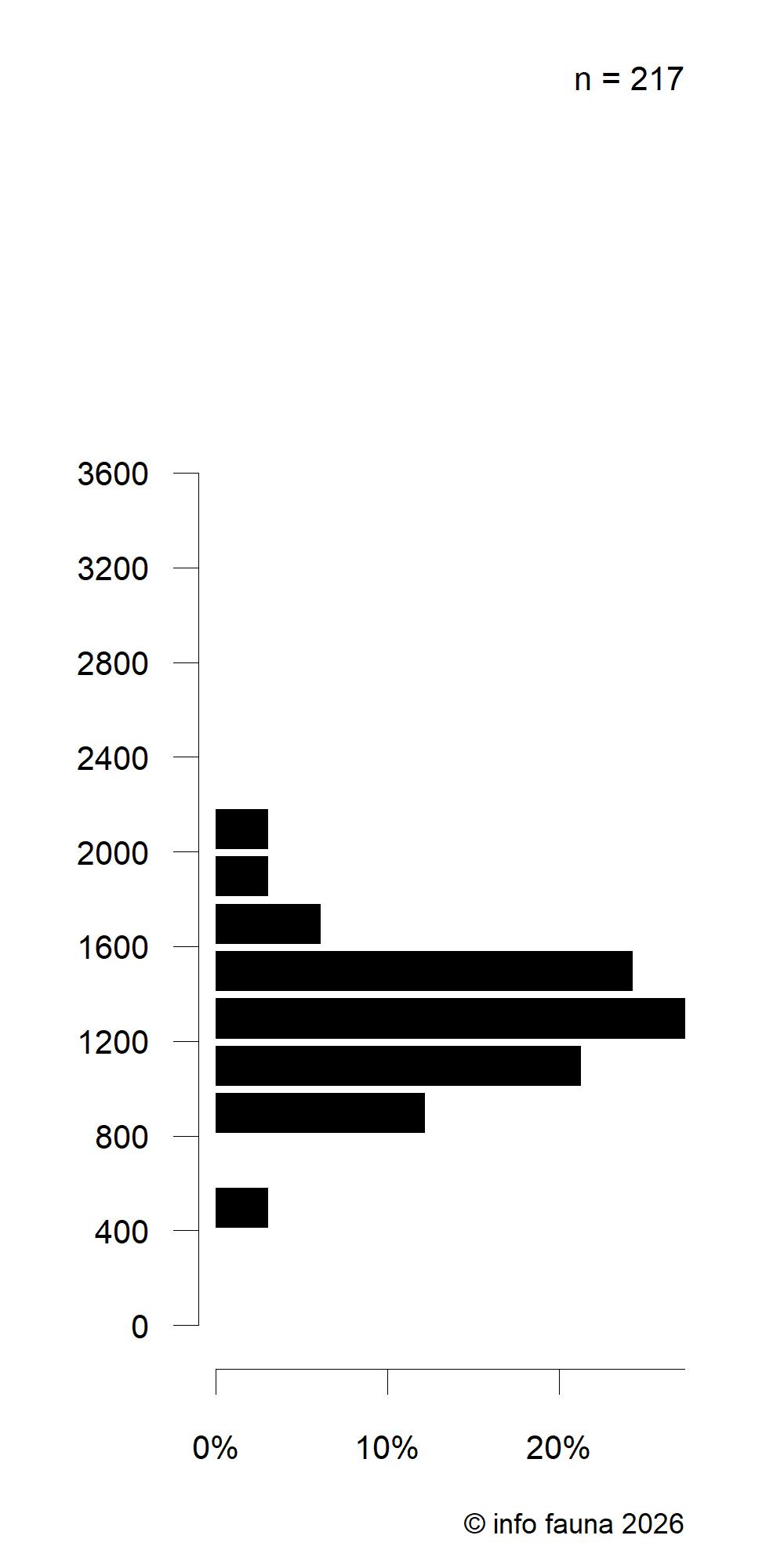
A. plagiata a une distribution très dispersée et limitée actuellement à la chaîne des Alpes (VS, GR, UR). L’espèce semble s’être très fortement raréfiée, notamment en Valais. Elle était historiquement présente également sur plusieurs sites du Plateau suisse. Au niveau européen, et en particulier au nord de sa distribution, A. plagiata a connu un fort déclin au cours des 50 dernières années, en lien notamment avec la disparition des habitations traditionnelles dont les murs étaient utilisés par l’espèce pour sa nidification. En Suisse, A. plagiata est avant tout une espèce montagnarde qui vole entre 800 m et 1600 m d’altitude

Distribution altitudinale d'Anthophora plagiata en Suisse.
Conservation
Cette page n'a malheureusement pas été traduite dans la langue sélectionnée. Elle s'affiche dans la langue de l'auteur.
Bedrohungsstatus
Anthophora plagiata wird in der Roten Liste als stark gefährdet (EN) eingestuft (Müller & Praz 2024) und ist eine national prioritäre Art (BAFU & InfoSpezies 2024). A. plagiata gehört zu den Bienenarten in der Schweiz, die einen besonders starken Rückgang erlitten haben. Kam die Art früher in der Region Genf, am Jurasüdfuss, im Wallis, im Misox und in verschiedenen Graubündner Tälern zum Teil nicht selten vor, sind die aktuellen Bestände stark isoliert, kleinflächig, individuenarm und auf wenige Lokalitäten im Wallis, im Berner Oberland und in Graubünden beschränkt. Da die Art möglicherweise die kritische Bestandesgrösse vielerorts bereits unterschritten hat, ist ein weiterer Rückgang zu befürchten.
Nationale Priorität
- Dringlichkeit: 1 (dringend)
- Handlungsebene: Artenförderung
Wichtigste Fördergebiete
- Wallis (v.a. Mittelwallis, Simplonsüdseite)
- Graubünden (Schanfigg, Domleschg, Albulatal, Unterengadin)
Wichtigste Lebensraumansprüche
- vegetationslose bis schütter bewachsene und gut besonnte Bodenstellen in horizontaler bis vertikaler Lage
- offene Wasserstellen
- grosses und vielfältiges Angebot an Blüten im Frühling und Sommer
- räumliche Nähe von Nistplätzen, offenen Wasserstellen und Nahrungsräumen
- Höhenlage: meist unter 1700 m Höhe
Wichtigste Gefährdungsursachen
- Fehlen von gut grabbaren Steilwänden, Abbruchkanten und vegetationslosen, vor Regen geschützten Bodenstellen in horizontaler Lage
- Fehlen von offenen und gut zugänglichen Wasserstellen in geringer Distanz zu den Nistplätzen.
- unzureichendes Angebot an Blüten
- zu grosse Distanzen zwischen geeigneten Nistplätzen, offenen Wasserstellen und guten Nahrungsräumen.
Wichtigste Erhaltungs- und Fördermassnahmen
- Erhaltung, Vergrösserung und Offenhalten von Steilwänden, Abbruchkanten und regengeschützten ebenen Bodenstellen an den aktuellen Vorkommensorten
- Neuschaffung von geeigneten Nistplätzen sowohl an den aktuellen Vorkommensorten als auch in deren näheren und weiteren Umgebung durch Abstechen von Steilwänden und Abbruchkanten bzw. durch Abschürfen der Vegetation an regengeschützten Stellen, z.B. unter Dachvorsprüngen von Heustadeln; dabei ist auf die Nähe von gut zugänglichen Wasserstellen zu achten (z.B. Bäche oder Quellaufstösse mit vegetationsarmen Randbereichen)
- Sicherstellung des leichten Zuganges zu offenen Wasserstellen in der Nähe aktueller und potenzieller Nistplätze
- Sicherstellung eines grossen und vielfältigen Blütenangebotes in der näheren Umgebung der aktuellen und potenziellen Nistplätze
- Gewährleistung geringer Distanzen zwischen (potenziellen) Nistplätzen, Wasserstellen und Nahrungsräumen (Zielgrösse maximal 300 m)