
Type de présence en Suisse
Indigène (INN)
ⓘⓧ
Degré de menace
Selon les Catégories et Critères de la Liste rouge de l’UICN ou selon Duelli et al. 1994.
(exp = appréciation d'expert·e·s)
Statut de protection (CH)
Selon les lois et ordonnances nationales spécifiques.
Degré de menace (CH)
Non menacé (LC)
Statut de protection (CH)
ⓘⓧ
Selon les lois et ordonnances mentionnées
–
Lois et ordonnances
–
ⓘⓧ
Selon l’aide à l’exécution : Liste des espèces prioritaires au niveau national.
Priorité nationale
–
Niveau d’action
–
Indications sur le niveau d’action
–
Urgence des mesures (CH)
–
Protection d’occurrences individuelles
–
Surveillance des populations
–
ⓘⓧ
Domaine agricole (OEA/UZL)
Espèce cible/caractéristique selon : Objectifs environnementaux pour l’agriculture "Espèces et milieux naturels".
(* = appréciation d'expert·e·s)
Forêts
2 : Espèce cible forestière selon Biodiversité en forêt : objectifs et mesures. Aide à l’exécution pour la conservation de la diversité biologique dans la forêt suisse (Imesch et al. 2015).
1 : Espèce cible forestière complémentaire, définie dans le cadre de plans d'actions OFEV (p.ex. Plan d'action Forêts claires).
Domaine agricole (OEA/UZL)
Z : Espèce cible
Forêts
–
✓
Taxon bien étudié, graphique proche de la situation réelle plus d'info
Carte
Carte des observations de Hoplitis leucomelana en Suisse (résolution 5x5 km).Voir la carte
Période
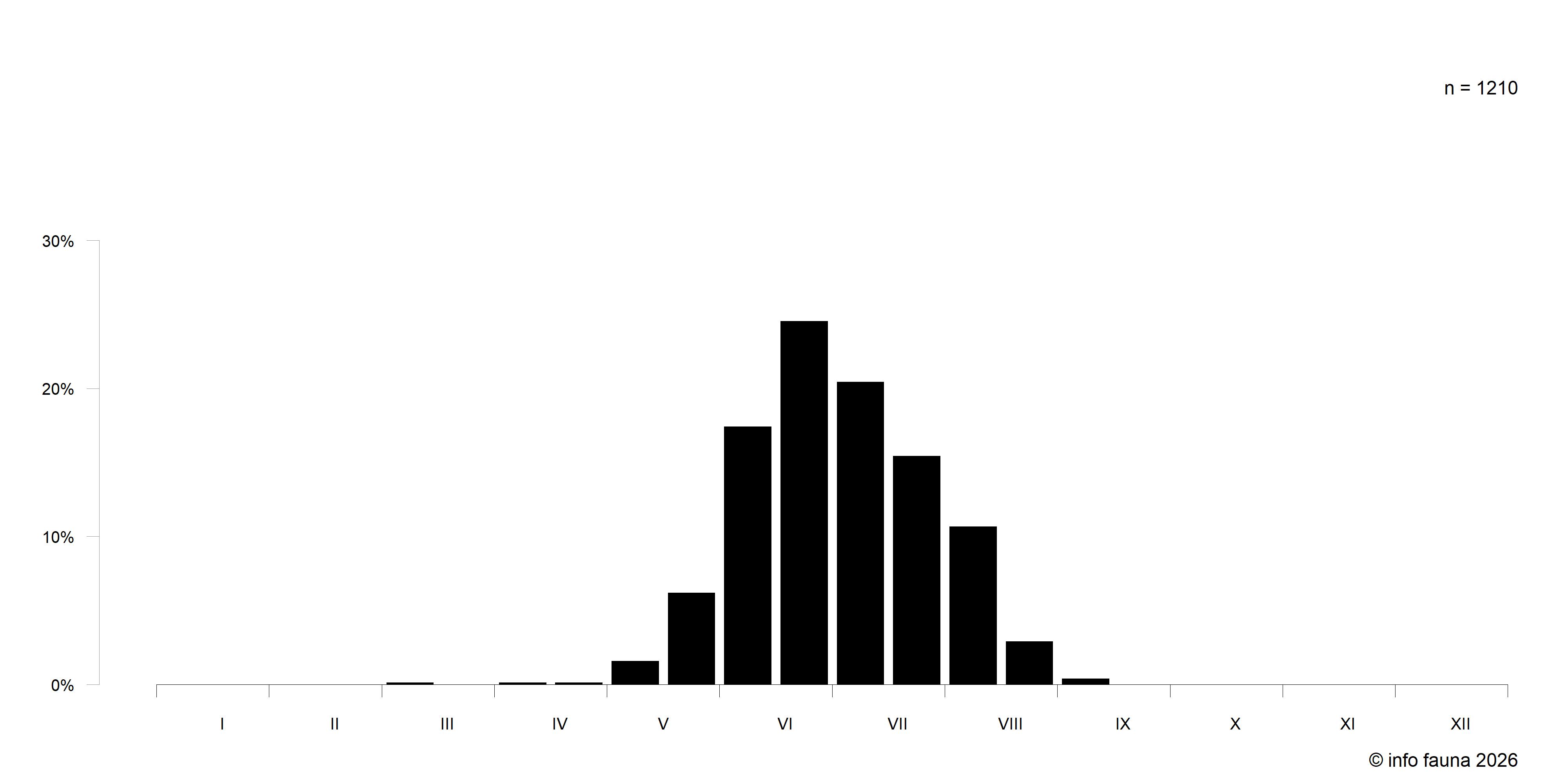
Période des observations de Hoplitis leucomelana en Suisse. Le graphique montre la proportion de toutes les observations par quinzaine.
Classification
- Arthropoda (Phylum)
- Insecta (Classe)
- Hymenoptera (Ordre)
- Apidae, Megachilinae (Famille)
- Hoplitis (Genre)
- Apidae, Megachilinae (Famille)
- Hymenoptera (Ordre)
- Insecta (Classe)
Portrait de l'espèce
Auteur-e-s
Andreas Müller
Portrait
Description et taxonomie

Femelle fermant l'entrée du nid avec du mortier végétal (Agasul ZH, 1991). Photo © Albert Krebs.
Hoplitis leucomelana est une abeille de petite à moyenne taille (6-9 mm) dont les deux sexes rappellent fortement les abeilles du genre Chelostoma en raison du corps allongé et peu poilu et des étroites bandes blanches des tergites. Toutefois, contrairement à ces dernières, H. leucomelana visite principalement les Fabaceae. Les femelles se distinguent de l'espèce similaire Hoplitis claviventris, qui possède également une brosse abdominale blanche, par leur corps plus étroit et leur taille généralement plus petite.
Les caractéristiques typiques des mâles, qui ne sont clairement visibles que lors d'un examen manuel, sont le dernier membre antennaire coudé et le tergite terminal arrondi.
Biologie et habitat
Habitat
Hoplitis leucomelana fréquente les lisières de forêts et de haies, les carrières de graviers et d’argile, les zones rudérales, les roselières et les zones d’habitation avec suffisamment de structures de tiges pérennes. Il semble qu'elle aime davantage la chaleur et qu'elle soit moins attachée aux forêts que son espèce-soeur H. claviventris qui a tendance à avoir sa principale distribution à des altitudes moyennes à élevées et qui colonise plus souvent les habitats boisés semi-ouverts.
Sources de pollen
H. leucomelana est polylectique avec une nette préférence pour les Fabaceae. Parmi les Fabaceae, Lotus est de loin la source de pollen la plus fréquemment visitée, mais Astragalus, Genista, Hippocrepis, Lathyrus, Medicago, Melilotus et Trifolium sont également utilisés. L'utilisation du pollen des cinq autres familles de plantes suivantes a également été démontrée : Asteraceae (Picris), Crassulaceae (Sedum), Lamiaceae (Origanum, Thymus, Salvia, Teucrium), Lythraceae (Lythrum) et Rosaceae (Rubus) (Westrich 1989, Banaszak & Romasenko 1998, Müller 2018).
Nidification
H. leucomelana niche dans des galeries orientées horizontalement à verticalement qu’elle creuse dans la moelle de tiges de plantes mortes (par ex. Artemisia, Onopordum, Rosa, Rubus, Verbascum) ou de rameaux (Acer, Corylus, Fraxinus, Sambucus), dont la moelle est librement accessible grâce à une cassure. Les galeries du nid sont souvent sinueuses, d'un diamètre de 2 à 3,5 mm et d'une profondeur pouvant atteindre 31 cm. Les côtés ensoleillés des massifs épais de ronces mortes sont des sites de nidification importants. Les cavités linéaires d'environ 4 cm de long des galles de roseaux abandonnés de la mouche du roseau (Lipara spec.) sont également régulièrement colonisées. On ne sait pas dans quelle mesure d'autres galeries existantes, telles que les galeries creusées par d’autres insectes dans la moelle des tiges, le bois mort ou les tiges de plantes creuses, sont également utilisés.

Femelle à l’entrée du nid (Agasul ZH, 1996). Photo © Albert Krebs.
Les nids contiennent 1-17 cellules à couvain disposées en ligne l'une derrière l'autre, qui sont séparées les unes des autres par des cloisons de feuilles mâchées. Dans de nombreux nids, des cellules vides de 2 à 15 mm de long sont édifiées entre les cellules à couvain, dans lesquelles sont souvent stockées des quantités différentes de particules de moelle ou de grains de sable. Le nid est fermé à l'extérieur par une paroi de mortier végétal d'une épaisseur maximale de 3 mm. La cavité entre la cellule à couvain la plus externe et la paroi du nid est parfois densément remplie de nombreuses particules étrangères (par exemple, petits cailloux, particules de moelle, fragments d'insectes). Cette barricade contre les parasites et les prédateurs du nid est parfois accompagnée par un ou deux murs de mortier végétal (Höppner 1904, Enslin 1925, Malyshev 1937, Grandi 1961, Danks 1970, Bonelli 1971, Westrich 1989, Banaszak & Romasenko 1998, Heneberg et al. 2014, Bogusch et al. 2015, Astapenková et al. 2017).

Cellules à couvain dans une tige de mûrier (Agasul ZH, 1997). Photo © Albert Krebs.
Espèces parasites
Les abeilles-coucous parasitant H. leucomelana sont Stelis minuta, Stelis ornatula et Stelis punculatissima. Stelis breviuscula, qui est mentionnée dans diverses publications, est peu susceptible de parasiter H. leucomelana. Les hyménoptères Gasteruption caudatum (Gasteruptionidae) et Sapyga quinquepunctata (Sapygidae) ont été signalés comme autres parasites alimentaires. Les parasitoïdes qui ont été identifiés sont les hyménoptères Eurytoma nodularis (Eurytomidae) et Melittobia acasta (Eulophidae) ainsi que plusieurs espèces d'ichneumons des genres Hoplocryptus, Perithous et Xylophrurus (Ichneumonidae) (Kasparyan 1981, Westrich 1989).
Comportement de reproduction
Le comportement de reproduction d’H. leucomelana n’est actuellement pas connu.
Distribution
Cycle de vie
Hoplitis leucomelana hiberne sous forme de larve au repos dans un cocon à l'intérieur de la cellule à couvain. L’espèce est univoltine. La période de vol principale des mâles s’étend de mi-mai à fin juillet, celle des femelles de fin mai à fin août (Enslin 1925).
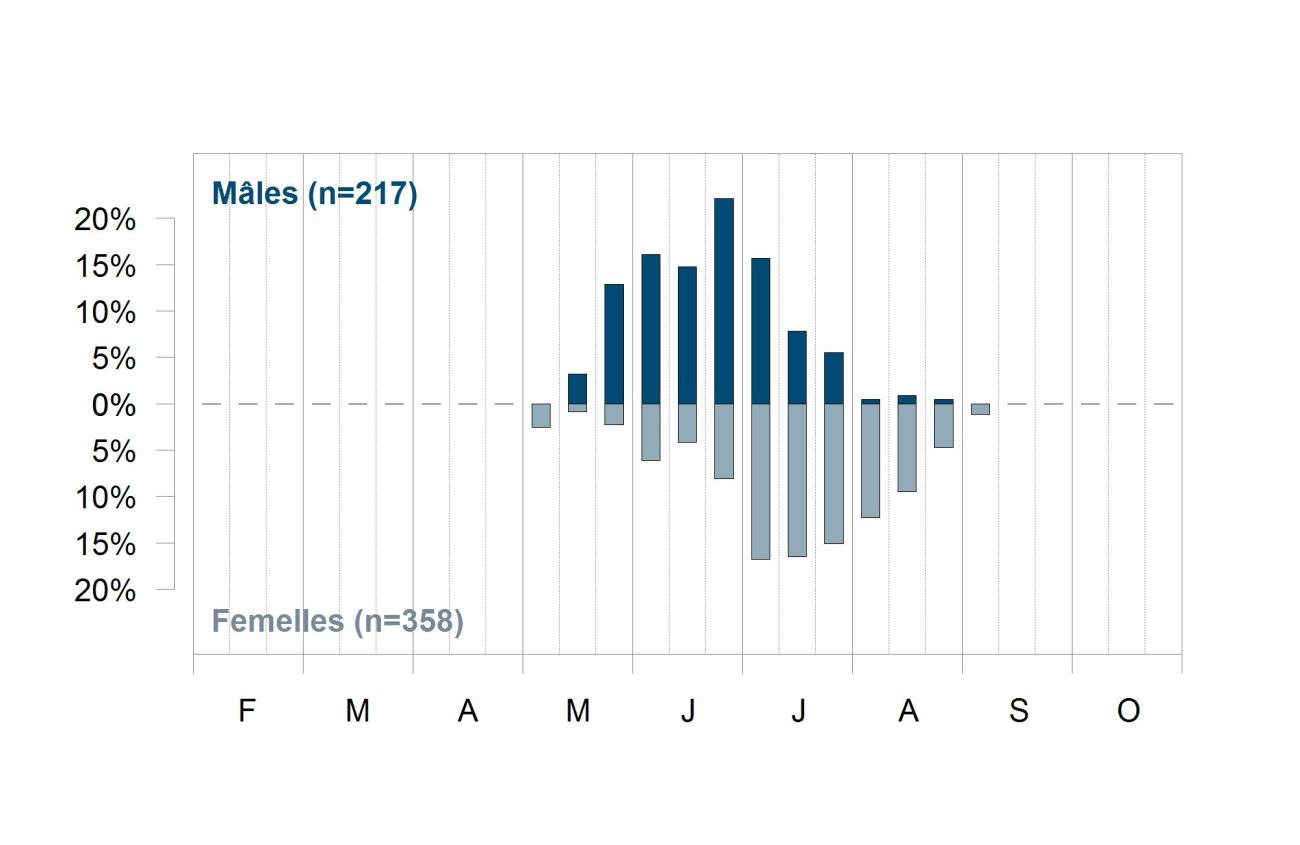
Phénologie d’Hoplitis leucomelana en Suisse.
Distribution
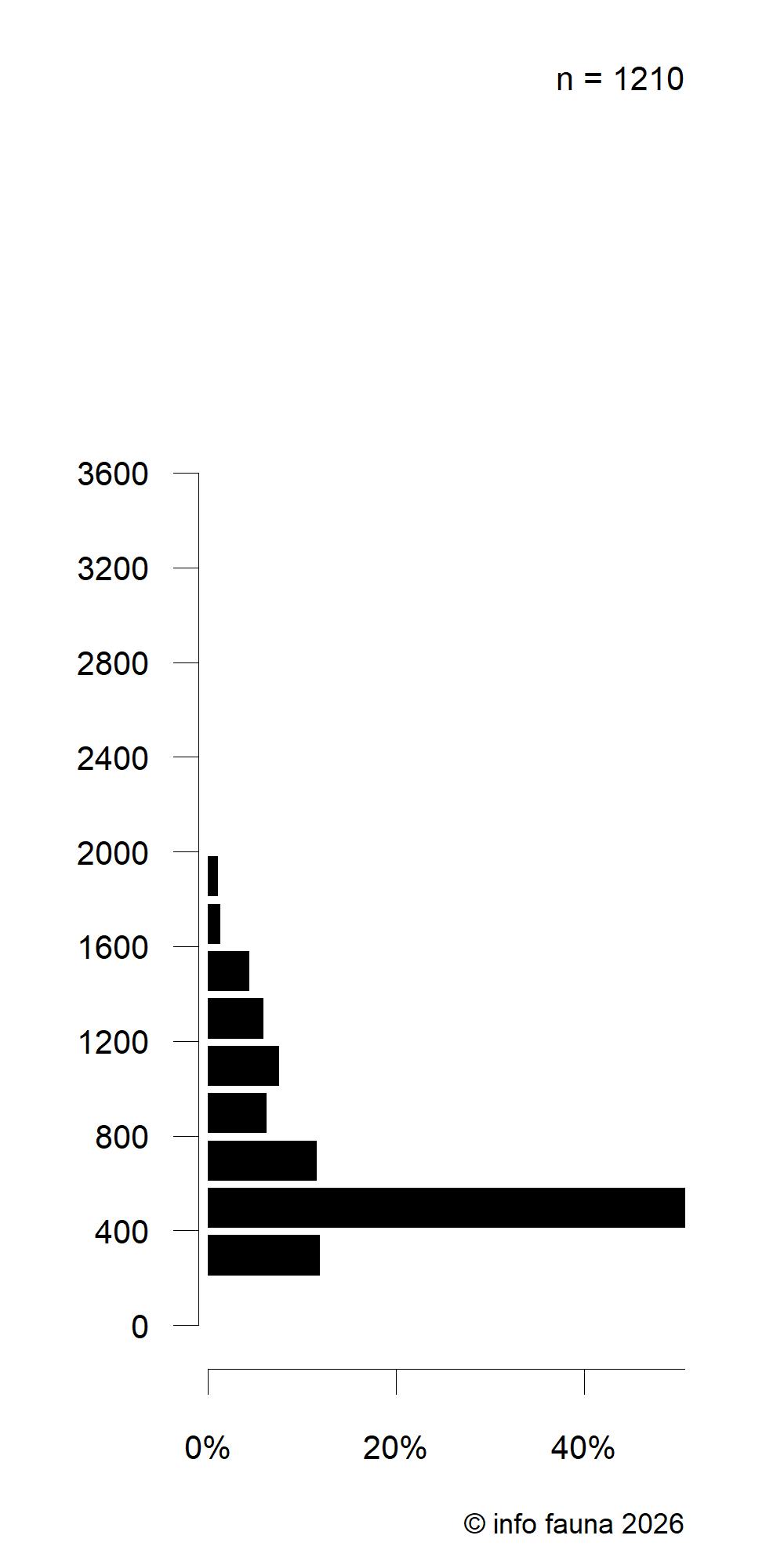
Hoplitis leucomelana est distribuée dans toute la Suisse jusqu'à 1500 m, en Valais jusqu'à 2000 m. il s’agit d’une espèce très répandue.

Distribution altitudinale d’Hoplitis leucomelana en Suisse.
Conservation
Cette page n'a malheureusement pas été traduite dans la langue sélectionnée. Elle s'affiche dans la langue de l'auteur.
Bedrohungsstatus
Hoplitis leucomelana wird in der Roten Liste als nicht bedroht (LC) eingestuft (Müller & Praz 2024). Damit gehört sie nicht zu den gefährdeten Arten und ist keine Rote Liste Art.