
Type de présence en Suisse
Indigène (INN)
ⓘⓧ
Degré de menace
Selon les Catégories et Critères de la Liste rouge de l’UICN ou selon Duelli et al. 1994.
(exp = appréciation d'expert·e·s)
Statut de protection (CH)
Selon les lois et ordonnances nationales spécifiques.
Degré de menace (CH)
Non menacé (LC)
Statut de protection (CH)
ⓘⓧ
Selon les lois et ordonnances mentionnées
–
Lois et ordonnances
–
ⓘⓧ
Selon l’aide à l’exécution : Liste des espèces prioritaires au niveau national.
Priorité nationale
–
Niveau d’action
–
Indications sur le niveau d’action
–
Urgence des mesures (CH)
–
Protection d’occurrences individuelles
–
Surveillance des populations
–
ⓘⓧ
Domaine agricole (OEA/UZL)
Espèce cible/caractéristique selon : Objectifs environnementaux pour l’agriculture "Espèces et milieux naturels".
(* = appréciation d'expert·e·s)
Forêts
2 : Espèce cible forestière selon Biodiversité en forêt : objectifs et mesures. Aide à l’exécution pour la conservation de la diversité biologique dans la forêt suisse (Imesch et al. 2015).
1 : Espèce cible forestière complémentaire, définie dans le cadre de plans d'actions OFEV (p.ex. Plan d'action Forêts claires).
Domaine agricole (OEA/UZL)
–
Forêts
–
✓
Taxon bien étudié, graphique proche de la situation réelle plus d'info
Carte
Carte des observations de Sphecodes albilabris en Suisse (résolution 5x5 km).Voir la carte
Période
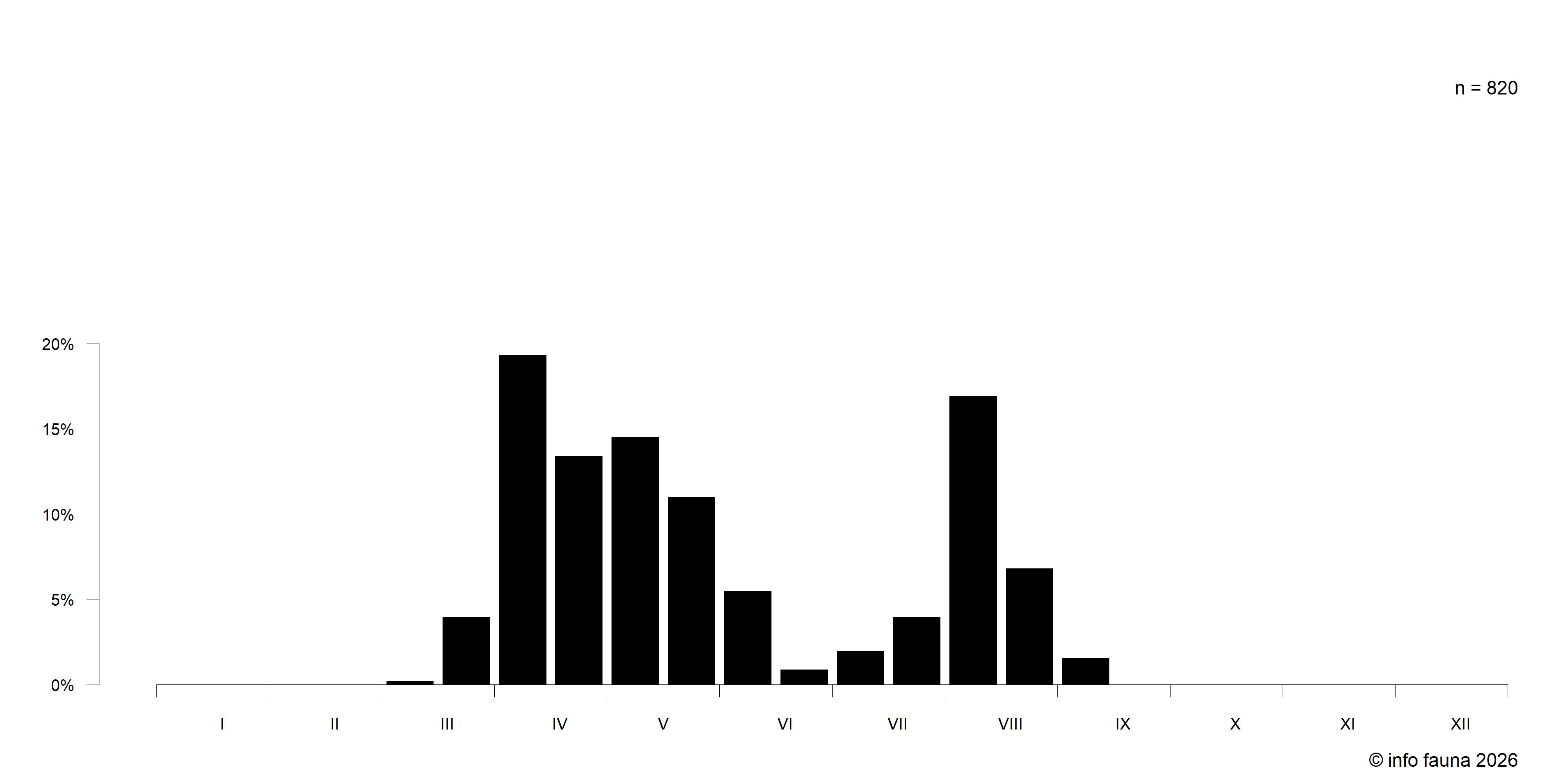
Période des observations de Sphecodes albilabris en Suisse. Le graphique montre la proportion de toutes les observations par quinzaine.
Classification
- Arthropoda (Phylum)
- Insecta (Classe)
- Hymenoptera (Ordre)
- Apidae, Halictinae (Famille)
- Sphecodes (Genre)
- Apidae, Halictinae (Famille)
- Hymenoptera (Ordre)
- Insecta (Classe)
Portrait de l'espèce
Auteur-e-s
Dimitri Bénon
Portrait
Description et taxonomie
Sphecodes albilabris est la plus grande espèce de genre Sphecodes en Suisse, les femelles comme les mâles pouvant atteindre jusqu’à 14 mm de long. Il s'agit d'une des rares espèces de Sphecodes qui peut être reconnue sur le terrain.
Chez la femelle, les ailes sont fortement enfumées, presque noires, l’abdomen est presque entièrement rouge à l'exception de l'extrémité du tergite 5 et du tergite 6, qui sont noires, et la pilosité du thorax et du haut de la face est noire. Le mésonotum est également densément ponctué et d'apparence mate. Ces critères, en combinaison avec la grande taille, permettent généralement l'identification de l'espèce sur le terrain.
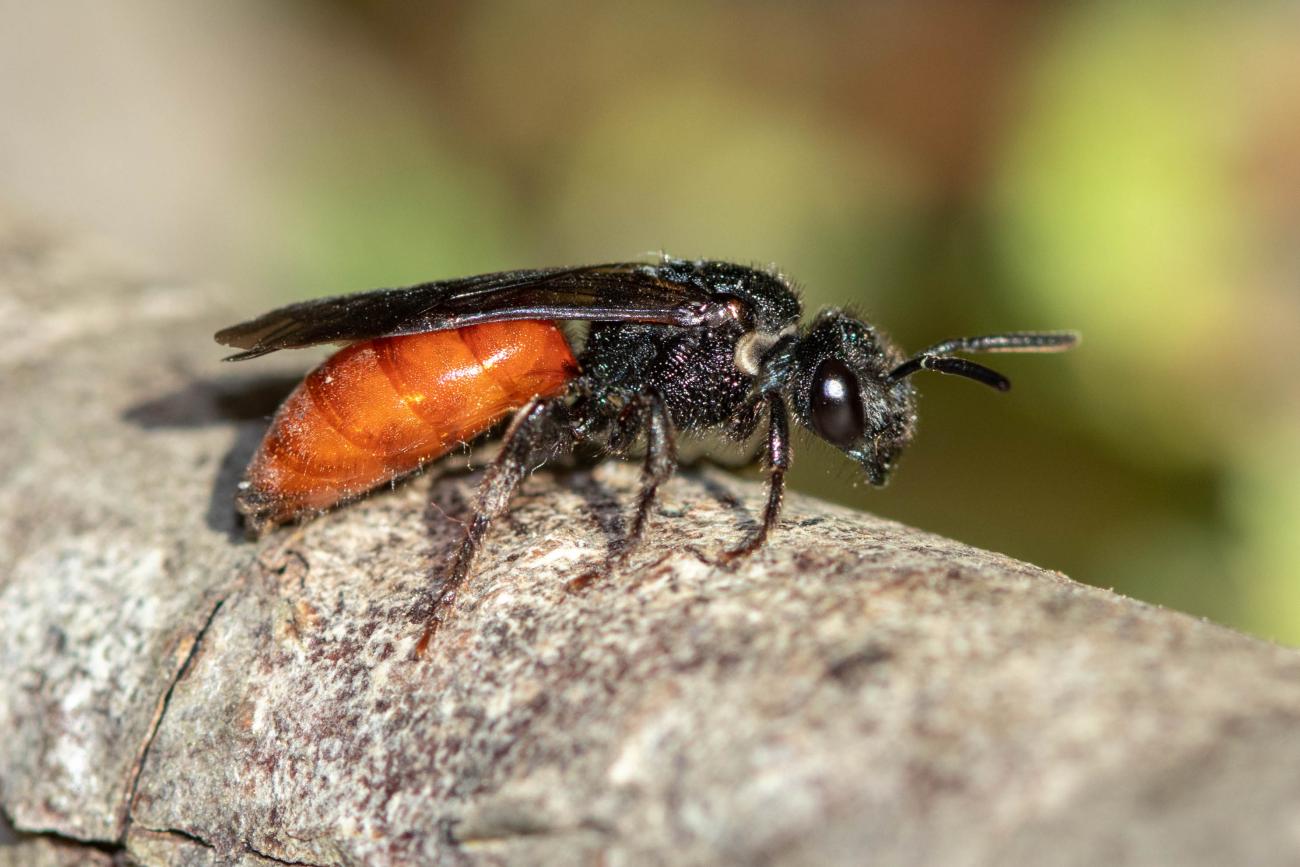
Une femelle de Sphecodes albilabris, reconnaissable à la grande taille du corps, aux ailes enfumées, à l'abdomen presqu'entièrement rouge, et à la pilosité sombre du mésonotum et d'une partie de la face (Estavayer FR, mi-avril 2021). Photo © Sophie Giriens.
Le mâle est également caractérisé par la grande taille et les ailes fortement enfumées; l'abdomen est entièrement rouge et le mésonotum est également densément ponctué et mat.
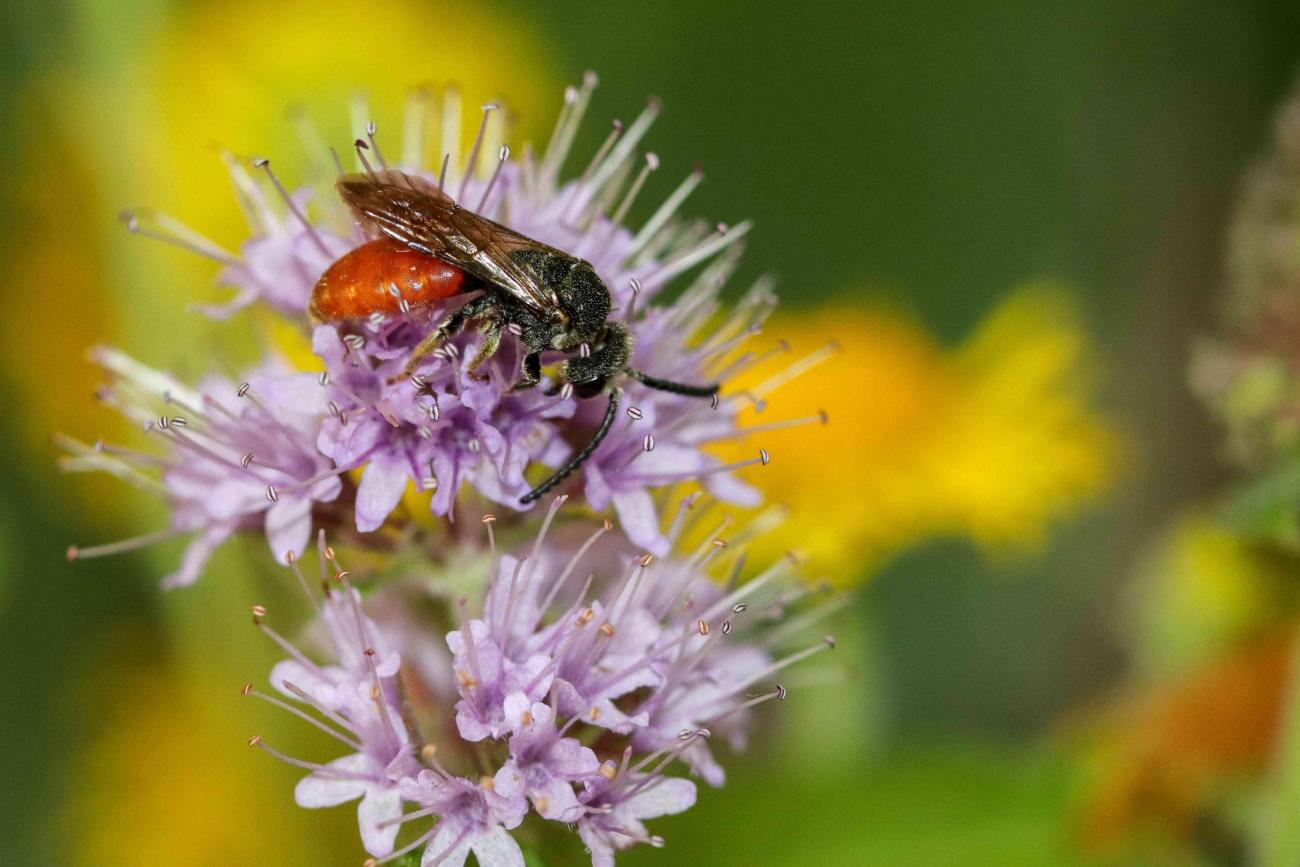
Une mâle de Sphecodes albilabris (Font FR, début septembre 2020). Photo © Sophie Giriens.
Chez les autres espèces de grande taille comme S. gibbus, les ailes sont moins moins enfumées, l’abdomen est plutôt orange et nettement noir à l’extrémité (chez la femelle : tergite 5 en entier et tergite 6 ; chez le mâle : tergites 4-7) et le mesonotum est très peu ponctué et nettement brillant.
Biologie et habitat
Hôte
L’hôte principal de Sphecodes albilabris est l’abeille printanière Colletes cunicularius. Deux hôtes secondaires plutôt estivaux sont également connus : Melliturga clavicornis et Halictus sexcinctus. (Blüthgen 1934, Rozen 1965, Westrich 1989, Amiet et al. 1999, Bogusch & Straka 2012).

Une femelle de Sphecodes albilabris quitte un nid de Colletes cunicularis (Hüntwangen ZH, 1997). Photo © Albert Krebs.
Distribution
Cycle de vie
Sphecodes albilabris est une abeille-coucou univoltine. Les femelles hivernantes fécondées sortent de leur diapause dès le mois de mars. La plupart d’entre elles volent uniquement jusqu’à la fin du mois de mai, ce qui correspond à la fin de la saison de vol de leur hôte principal Colletes cunicularius. Certaines femelles survivent jusqu’en été et peuvent parasiter d'autres espèces. La nouvelle génération, comprenant les mâles, apparait dès le mois de juillet et vole jusqu’en septembre. L'accouplement a lieu en fin d'été et seules les femelles fécondées passent l’hiver.
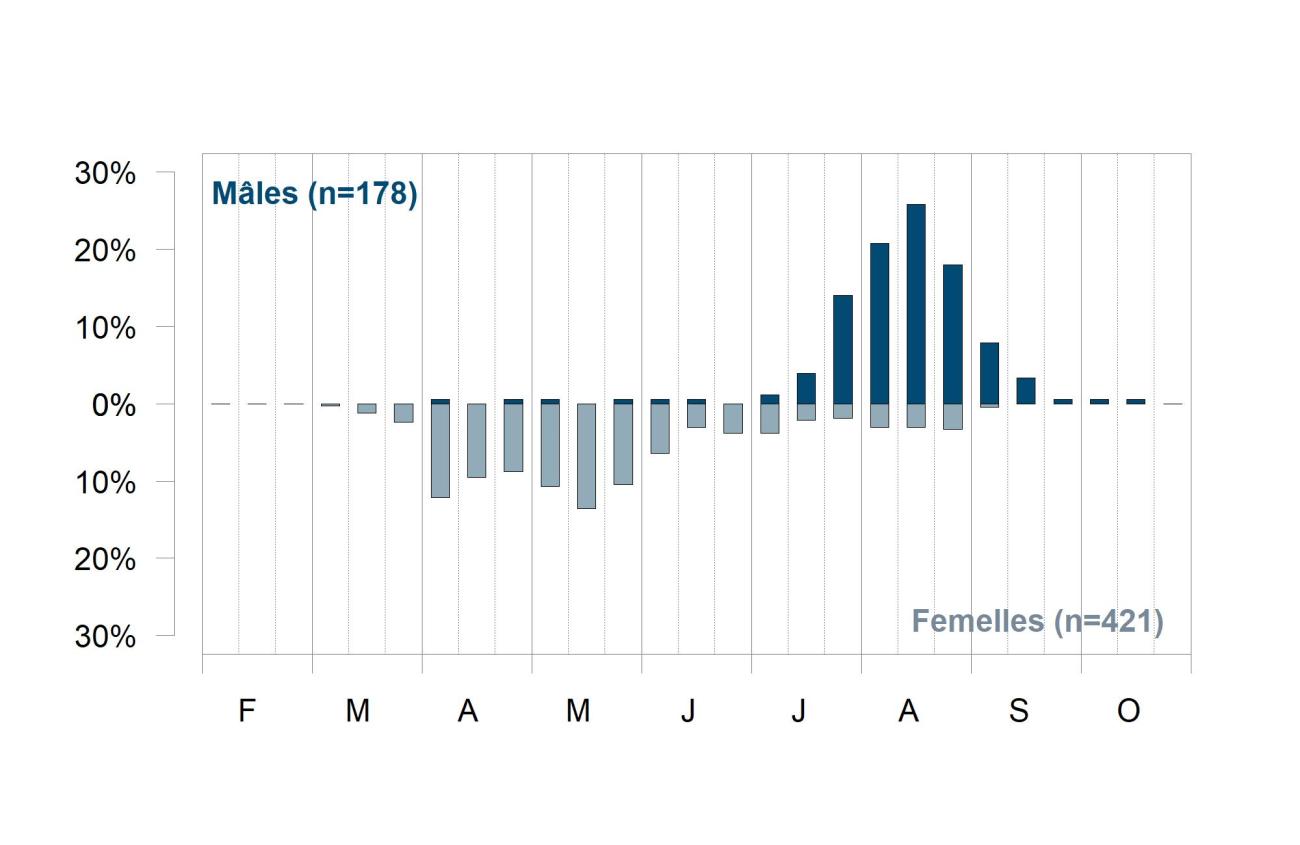
Phénologie de Sphecodes albilabris en Suisse.
Distribution
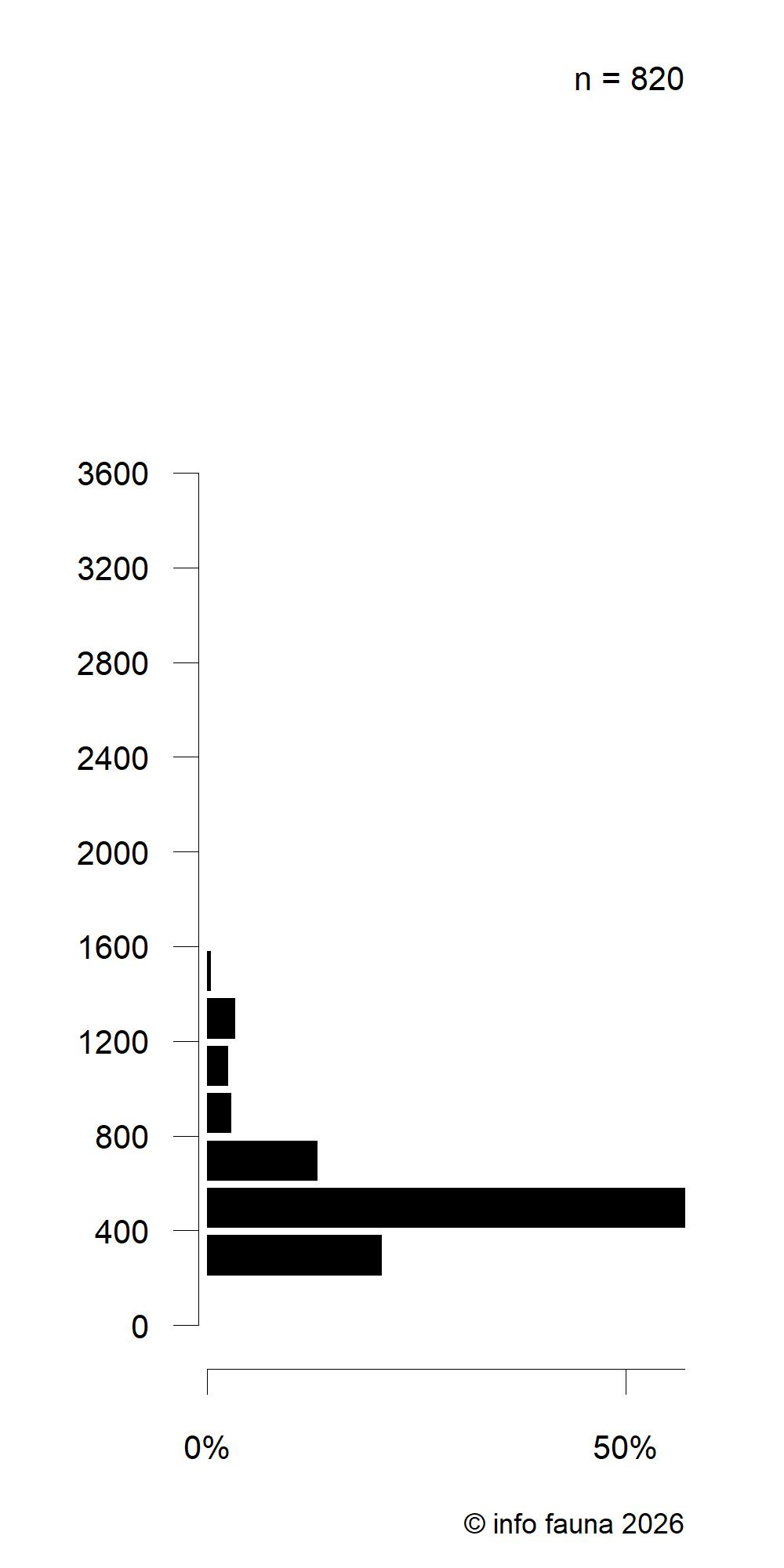
S. albilabris est une espèce largement distribuée dans toutes les régions de basse altitude en Suisse. On la retrouve sur une large partie du Plateau, le long de la chaîne du Jura ainsi que dans les vallées internes chaudes des Alpes et au nord du Tessin. L’espèce a connu une nette expansion au cours des 20 dernières années, notamment au nord des Alpes où l’espèce était très localisée au début des années 2000. Elle peut montrer jusqu’à plus de 1000 m sur les versants bien exposés.

Distribution altitudinale de Sphecodes albilabris en Suisse.
Conservation
Cette page n'a malheureusement pas été traduite dans la langue sélectionnée. Elle s'affiche dans la langue de l'auteur.
Bedrohungsstatus
Sphecodes albilabris wird in der Roten Liste als nicht bedroht (LC) eingestuft (Müller & Praz 2024). Damit gehört sie nicht zu den gefährdeten Arten und ist keine Rote Liste Art.