
Type de présence en Suisse
Indigène (INN)
ⓘⓧ
Degré de menace
Selon les Catégories et Critères de la Liste rouge de l’UICN ou selon Duelli et al. 1994.
(exp = appréciation d'expert·e·s)
Statut de protection (CH)
Selon les lois et ordonnances nationales spécifiques.
Degré de menace (CH)
Non menacé (LC)
Statut de protection (CH)
ⓘⓧ
Selon les lois et ordonnances mentionnées
–
Lois et ordonnances
–
ⓘⓧ
Selon l’aide à l’exécution : Liste des espèces prioritaires au niveau national.
Priorité nationale
–
Niveau d’action
–
Indications sur le niveau d’action
–
Urgence des mesures (CH)
–
Protection d’occurrences individuelles
–
Surveillance des populations
–
ⓘⓧ
Domaine agricole (OEA/UZL)
Espèce cible/caractéristique selon : Objectifs environnementaux pour l’agriculture "Espèces et milieux naturels".
(* = appréciation d'expert·e·s)
Forêts
2 : Espèce cible forestière selon Biodiversité en forêt : objectifs et mesures. Aide à l’exécution pour la conservation de la diversité biologique dans la forêt suisse (Imesch et al. 2015).
1 : Espèce cible forestière complémentaire, définie dans le cadre de plans d'actions OFEV (p.ex. Plan d'action Forêts claires).
Domaine agricole (OEA/UZL)
–
Forêts
–
✓
Taxon bien étudié, graphique proche de la situation réelle plus d'info
Carte
Carte des observations de Andrena wilkella en Suisse (résolution 5x5 km).Voir la carte
Période
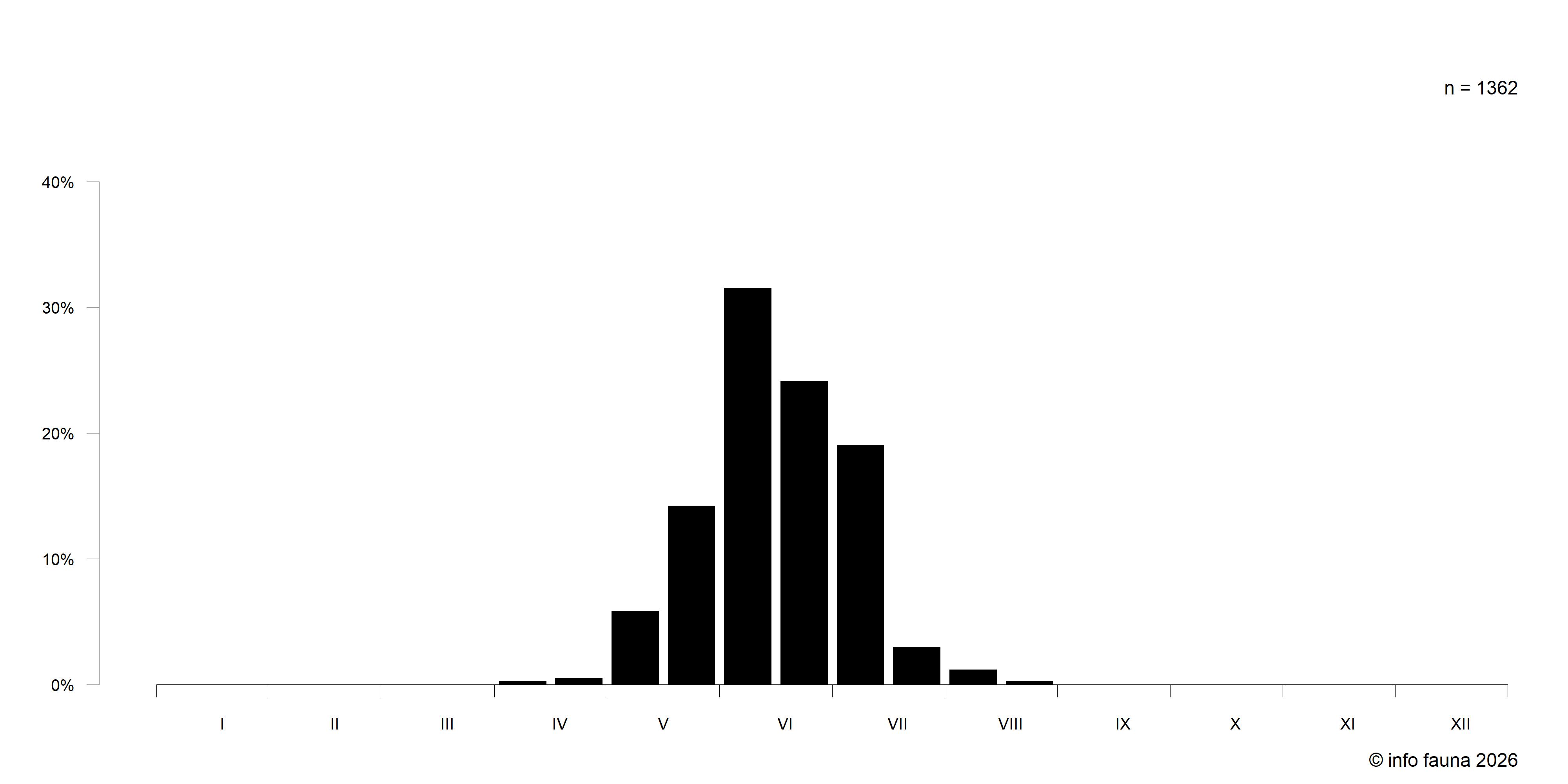
Période des observations de Andrena wilkella en Suisse. Le graphique montre la proportion de toutes les observations par quinzaine.
Classification
- Arthropoda (Phylum)
- Insecta (Classe)
- Hymenoptera (Ordre)
- Apidae, Andreninae (Famille)
- Andrena (Genre)
- Apidae, Andreninae (Famille)
- Hymenoptera (Ordre)
- Insecta (Classe)
Portrait de l'espèce
Auteur-e-s
Dimitri Bénon & Christophe Praz
Portrait
Description et taxonomie
Andrena wilkella appartient au sous-genre Taeniandrena, qui contient différentes espèces de taille moyenne à grande (en plus d'A. wilkella A. afzeliella, A. gelriae, A. intermedia, A. lathyri, A. ovata et A. russula). Ces espèces sont caractérisées par la forme ovale, presque triangulaire de l'abdomen, par les bandes de poils épaisses et denses sur les tergites ainsi que par leur association avec les Fabaceae, une famille de plante généralement peu visitée par les andrènes. L'identification de ces espèces est difficile sur le terrain.
La femelle d'A. wilkella est légèrement plus grande (11-22mm) que celle d'A. afzeliella. Le thorax a une pilosité brune à gris-brun, jamais orange vif comme chez A. russula. Les bandes de poils de la marge des tergites sont plus étroites que chez les autres espèces de Taeniandrena, à l'exception de la très rare A. ovata. La frange terminale est généralement orange, la scopa jaunâtre. Tibia et tarses postérieurs sont toujours orange-rouge. La femelle est difficile à séparer des autres espèces du sous-genre, même sous la loupe binoculaire.

Femelle d'Andrena wilkella. On distingue la frange terminale blanche, jaune-orange au centre (Argelès-sur-Mer, France, mi-juin 2014). Photo © David Genoud.
Les mâle ressemble à la femelle. Contrairement à A. afzeliella et A. russula, le segment antennaire 3 est nettement plus court que le 4. Ce caractère est partagé avec A. gelriae et A. intermedia, qui ne peuvent pas être séparées d'A. wilkella sur le terrain. Une identification certaine nécessite l'examen des genitalias au moyen d'une loupe binoculaire.

Mâle d'Andrena wilkella. Le segment antennaire 3, nettement plus court que le 4, est visible (Stansstad NW, début juin 2021). Photo © André Rey.
Biologie et habitat
Habitat
Andrena wilkella est une espèce des milieux ouverts . On la retrouve dans différents habitats tels que les prairies et pâturages extensifs, en particulier ceux riches en Trifolium, les lisières de forêt, les zones rudérales et les vignes.
Plante-hôtes
Andrena wilkella est probablement oligolectique sur Fabaceae. Elle récolte souvent sur les Fabaceae à petites fleurs, principalement sur le genre Trifolium. En Angleterre, Chambers (1968) considérait l'espèce comme polylectique, mais il est possible que ces résultats soient basés sur des erreurs d'identification avec l'espèce proche A. afzeliella. (Peeters et al. 2012, Wood & Roberts 2017, Westrich 2018, Praz et al. 2022).

Les fleurs du genre Trifolium constituent une source de pollen importante pour Andrena wilkella (Glovelier JU, juin 2017). Photo © Dimitri Bénon.
Nidification
Andrena wilkella niche dans la plupart des types de sol. Elle privilégie les sites avec une végétation clairsemée, par exemple le long de chemins ou dans des talus. L'espèce niche principalement de manière solitaire, mais elle semble pouvoir former parfois de grandes agrégations. (Perkins 1919a, Kocourek 1966, Meidell 1967, Peeters et al. 2012, Westrich 2018).
Parasite
Les nids d'A. wilkella sont parasités par l'abeille coucou Nomada striata, et peut-être également par Sphecodes reticulatus (Vegter 1993). L'espèce est également parasitée par Stylops thwaitei. (Amiet et al. 2010, Straka et al. 2015, Westrich 2018).
Comportements reproductifs
Les mâles patrouillent souvent au-dessus des plantes-hôtes, ou autour de buissons ou de petits arbres le long de circuits marqués à l'aide de phéromones. Plusieurs mâles peuvent marquer le même emplacement et on observe parfois de nombreux mâles parcourant plus ou moins le même circuit. (Tengö et al. 1990, Müller et al. 1997, Peeters et al. 2012, Else & Edwards 2018).
Distribution
Cycle de vie
Andrena wilkella est vraisemblablement univoltine. Elle a toutefois une longue période de vol qui s'étend de la fin du mois d'avril à début août. On trouve occasionnellement des individus fraîchement émergés en fin de saison, ce qui suggère une seconde génération partielle qui pourrait expliquer la période de vol particulièrement longue de l'espèce. L'espèce passe l'hiver à l'état de prépupe. (Kocourek 1966, Meidell 1967, Else & Edwards 2018).
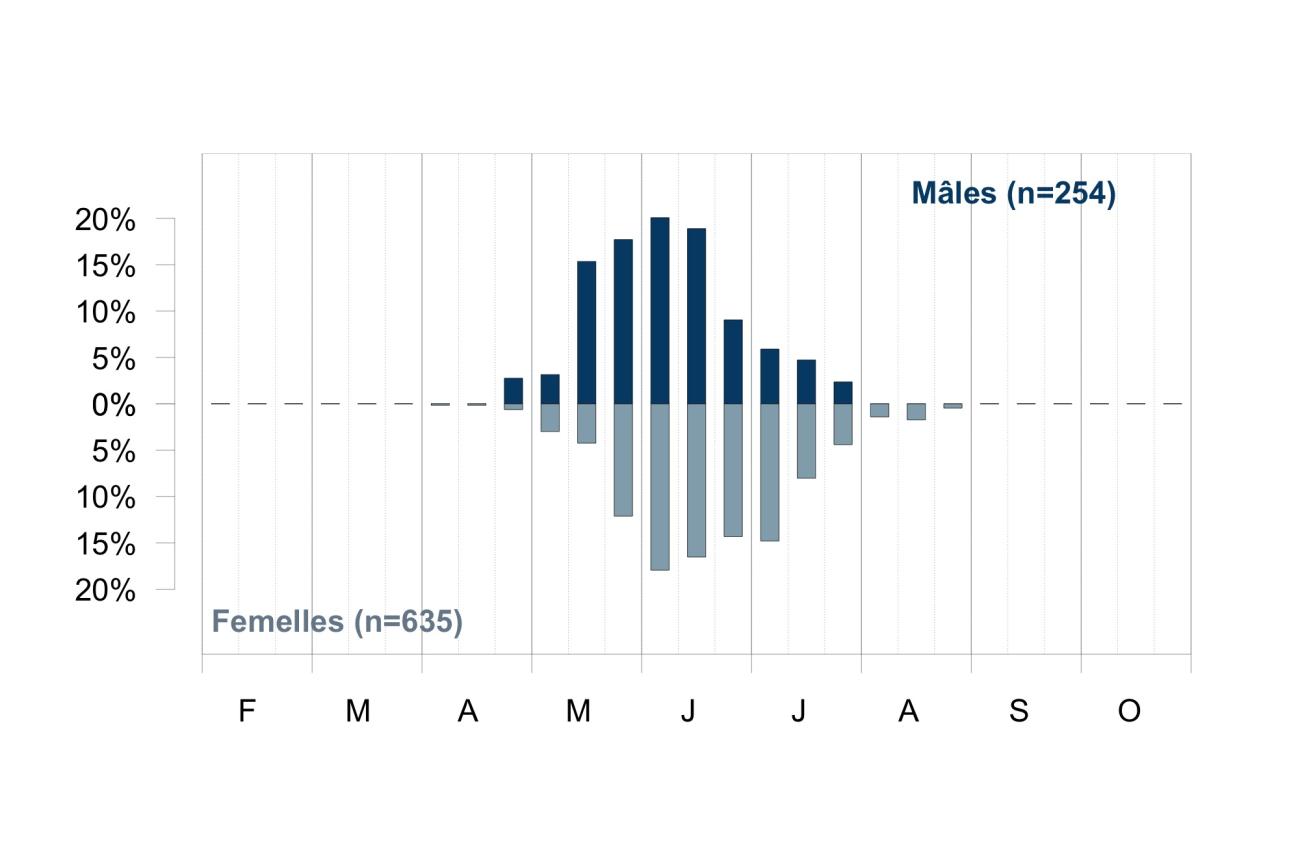
Phénologie d'Andrena wilkella en Suisse.
Distribution
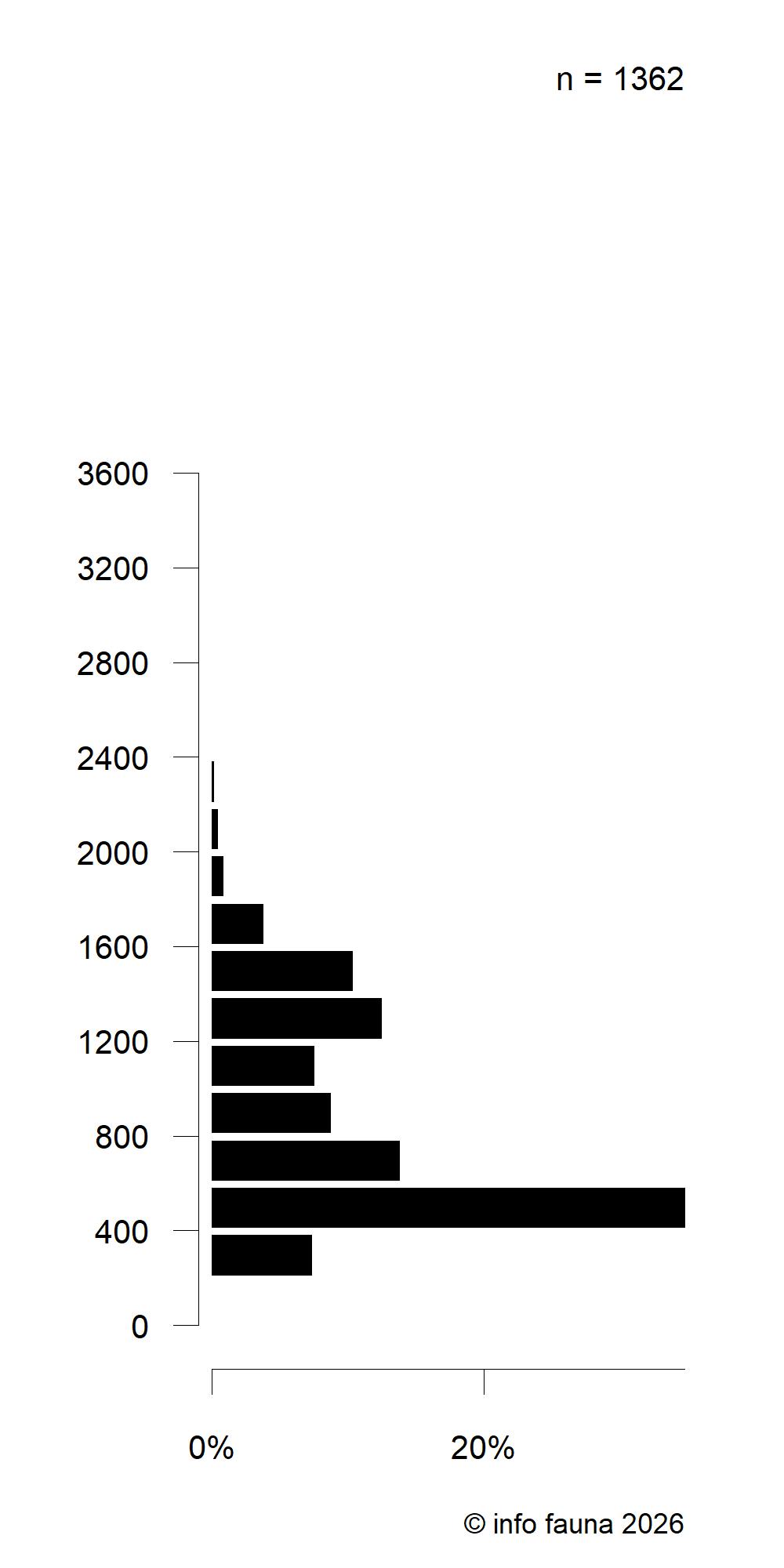
Andrena wilkella est largement répandue à basse et moyenne altitude en Suisse. Elle est légèrement moins fréquente qu'A. afzeliella. On la rencontre sur l'ensemble du Plateau suisse, au Tessin et dans la plupart des vallées internes des Alpes, dont la plaine du Rhône et la vallée du Rhin. Elle est moins fréquente en montagne. On l'observe principalement entre 400 m et 1600 m d'altitude, rarement jusqu'à plus de 2000 m.
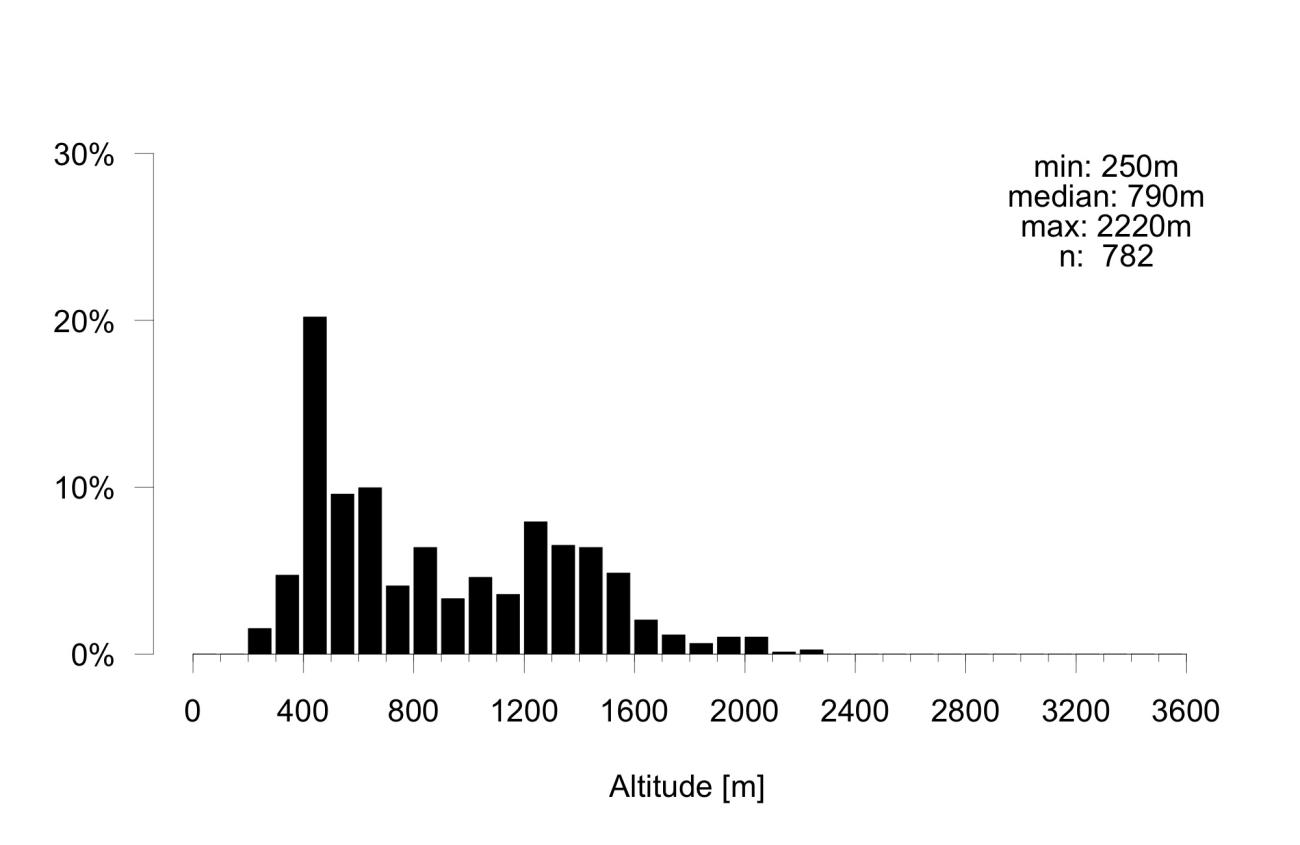
Distribution altitudinale d'Andrena wilkella en Suisse.
Conservation
Cette page n'a malheureusement pas été traduite dans la langue sélectionnée. Elle s'affiche dans la langue de l'auteur.
Bedrohungsstatus
Andrena wilkella wird in der Roten Liste als nicht bedroht (LC) eingestuft (Müller & Praz 2024). Damit gehört sie nicht zu den gefährdeten Arten und ist keine Rote Liste Art.