
Type de présence en Suisse
Indigène (INN)
ⓘⓧ
Degré de menace
Selon les Catégories et Critères de la Liste rouge de l’UICN ou selon Duelli et al. 1994.
(exp = appréciation d'expert·e·s)
Statut de protection (CH)
Selon les lois et ordonnances nationales spécifiques.
Degré de menace (CH)
Vulnérable (VU)
Statut de protection (CH)
ⓘⓧ
Selon les lois et ordonnances mentionnées
–
Lois et ordonnances
–
ⓘⓧ
Selon l’aide à l’exécution : Liste des espèces prioritaires au niveau national.
Priorité nationale
Oui
Niveau d’action
LF(+GL) : Conservation des habitats
Indications sur le niveau d’action
–
Urgence des mesures (CH)
3 : souhaitable et utile
Protection d’occurrences individuelles
–
Surveillance des populations
2 : suffisant
ⓘⓧ
Domaine agricole (OEA/UZL)
Espèce cible/caractéristique selon : Objectifs environnementaux pour l’agriculture "Espèces et milieux naturels".
(* = appréciation d'expert·e·s)
Forêts
2 : Espèce cible forestière selon Biodiversité en forêt : objectifs et mesures. Aide à l’exécution pour la conservation de la diversité biologique dans la forêt suisse (Imesch et al. 2015).
1 : Espèce cible forestière complémentaire, définie dans le cadre de plans d'actions OFEV (p.ex. Plan d'action Forêts claires).
Domaine agricole (OEA/UZL)
–
Forêts
–
✓
Taxon bien étudié, graphique proche de la situation réelle plus d'info
Carte
Carte des observations de Andrena ferox en Suisse (résolution 5x5 km).Voir la carte
Période
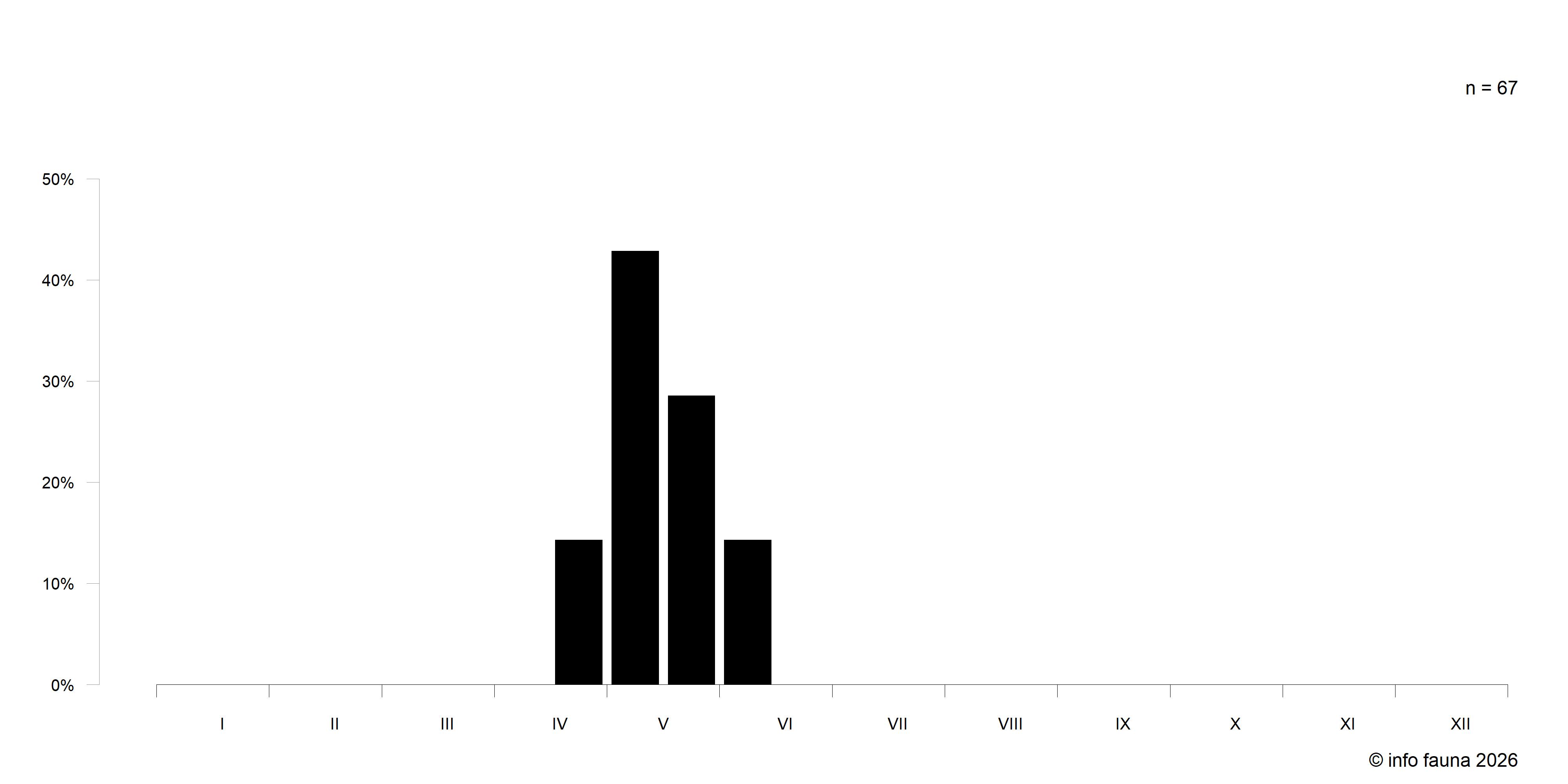
Période des observations de Andrena ferox en Suisse. Le graphique montre la proportion de toutes les observations par quinzaine.
Classification
- Arthropoda (Phylum)
- Insecta (Classe)
- Hymenoptera (Ordre)
- Apidae, Andreninae (Famille)
- Andrena (Genre)
- Apidae, Andreninae (Famille)
- Hymenoptera (Ordre)
- Insecta (Classe)
Portrait de l'espèce
Auteur-e-s
Dimitri Bénon
Portrait
Description et taxonomie
Andrena ferox est une espèce de taille moyenne à grande (10-13 mm). Les femelles sont difficiles à identifier sur le terrain. Elles possèdent une pilosité majoritairement brun-jaune à brun-gris. La scopa est jaune or, contrairement à A. scotica et A. trimmerana qui ont la scopa bicolore, brune et blanche. La frange terminale brune à noire. Les tergites sont mats et recouverts sur leur marge d'une bande de poils lâche. Le tibia et les tarses des pattes postérieures sont orange. Ce critère permet de séparer l'espèce d'A. bucephala qui fréquente les mêmes milieux. A. ferox ressemble aussi à A. tibialis, mais cette dernière a l'aire dorsale du propodeum très grossièrement ridée. Ce caractère est difficile à observer sur le terrain et doit être examiné avec une loupe de terrain.

Femelle d'Andrena ferox. La couleur orange du tibia 3 est bien visible sous la scopa jaune-or (France, début mai 2014). Photo © David Genoud.
Les mâles sont plus petits et plus fins (9-12 mm) et peuvent être identifiés sur le terrain avec l'abeille en main et une bonne connaissance du genre. Ils possèdent souvent une tête large avec des tempes sont très développées, en particulier chez les individus de grande taille. La pilosité est brun clair, y compris sur la face, et la marge des tergites est souvent rougeâtre. Les mandibules sont longues et les joues ont dans la règle une dent aigüe à leur base, comme les mâles printaniers d'A. trimmerana. Par rapport à ces derniers, le tibia postérieur est orange et le segment antennaire 3 est plus long que large (tibia postérieur sombre et segment antennaire 3 au plus aussi long que large chez A. trimmerana). Les mâles d'A. ferox ressemblent superficiellement aux mâles d'A. bucephala et d'A. nuptialis , qui n'ont toutefois pas de dent sous la joue à la base de la mandibule. (Falk 2015).
Biologie et habitat
Habitat
Andrena ferox est une espèce forestière qu'on retrouve en Suisse exclusivement dans les chênaies thermophiles. Elle préfère probablement les sols légers, ce qui limite vraisemblablement sa distribution en Suisse. (Falk 2015).
Sources de pollen
L'espèce est polylectique avec une forte préférence pour le pollen du genre Quercus (Fagaceae). Elle récolte aussi le pollen de Sapindaceae (Acer) et de Rosaceae (Crataegus laevigata). Il est possible qu'A. ferox utilise aussi le pollen d'autres espèces d'arbres: aux Pays-Bas, il semble que l'espèce récolte le pollen de Pinus (Pinacaceae) et Juglans regia (Juglandaceae) lorsque le chêne est en fin de floraison. (Leys 1978, Else & Edwards 2018, Westrich 2018).

Femelle d'Andrena ferox en train de récolter du pollen (France, Département de l'Aude, mi-mai 2014). Photo © David Genoud.
Nidification
Andrena ferox est une espèce communale: elle niche en agrégations plus ou moins grandes et la même entrée du nid est utilisée par plusieurs femelles. Les nids peuvent être très populeux, avec exceptionnellement près de 1000 femelles nichant dans un même nid. Chaque nid se compose d'une entrée qui se divise en plusieurs galeries au bout desquelles se trouvent les cellules à couvain. Les nids sont soit creusés directement dans le sol, soit les femelles agrandissent des cavités existantes comme des anciens terriers ou des orifices dans des murs. Les sites de nidification se trouvent parfois en pleine forêt mais également dans des prairies sèches ou des pâturages, ou dans des décrochements de sol dans des talus. (Leys 1978, Ayasse et al. 1990, Amiet et al. 2010, Martin 2014, Else & Edwards 2018).
Espèces parasites
L'espèce est parasitée par Nomada mutica. N. marshamella est probablement un parasite occasionnel: plusieurs individus ont été observés volant près de nids d'A. ferox, et un individu a même été retrouvé à l'intérieur d'un nid aux Pays-Bas. Il est possible que N. flava soit également un parasite occasionnel. Des individus frais des diptères Myopa buccata et Bombylius major ont été observés sortant d'un nid d'A. ferox. (Yarrow & Guichard 1941, Smit 1996, Edwards & Tefler 2002, Amiet et al. 2010, , Westrich 2018).
Comportement de reproduction
Les mâles d'A. ferox sont le plus souvent observés en train de patrouiller autours d'arbres et d'arbustes (en particulier Quercus) à proximité des sites de nidifications. Ces vols se font généralement à plusieurs mètres au-dessus du sol. Kocourek (1966) a observé des accouplements sur des feuilles d'arbres, à 4-5 m de hauteur. (Kocourek 1966, Ayasse et al. 1990, Westrich 2018)
Distribution
Cycle de vie
Andrena ferox est une espèce univoltine. Elle vole entre la fin du mois de mars et début juin. D'après Else (2012), les mâles et les femelles ont une émergence synchronisée.
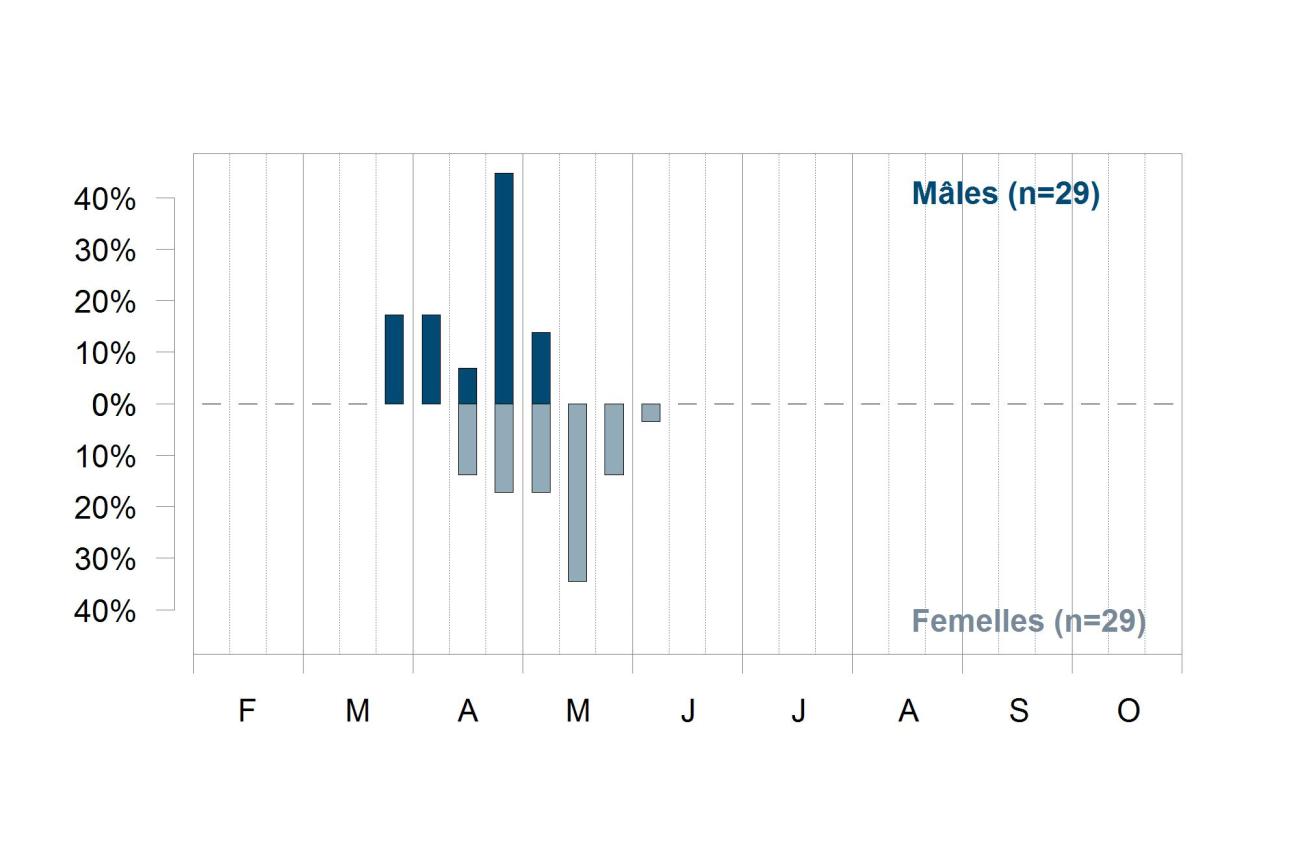
Phénologie d'Andrena ferox en Suisse.
Distribution
On connait peu la distribution d'Andrena ferox en Suisse en raison des moeurs discrêtes de l'espèce et de son lien avec des habitats forestiers peu prospectés. Au Tessin par exemple, les seules observations proviennent d'échantillonnages effectués à l'aide de pièges colorés. L'espèce n'y a plus été observée depuis 1997, bien qu'une observation récente de l'abeille-coucou spécialisée Nomada mutica atteste de sa présence. Des observations récentes de cette Nomada dans le Val Poschiavo et dans le Jura Vaudois indiquent qu'A. ferox est présente dans ces régions même si elle n'y a pas été observée récemment.
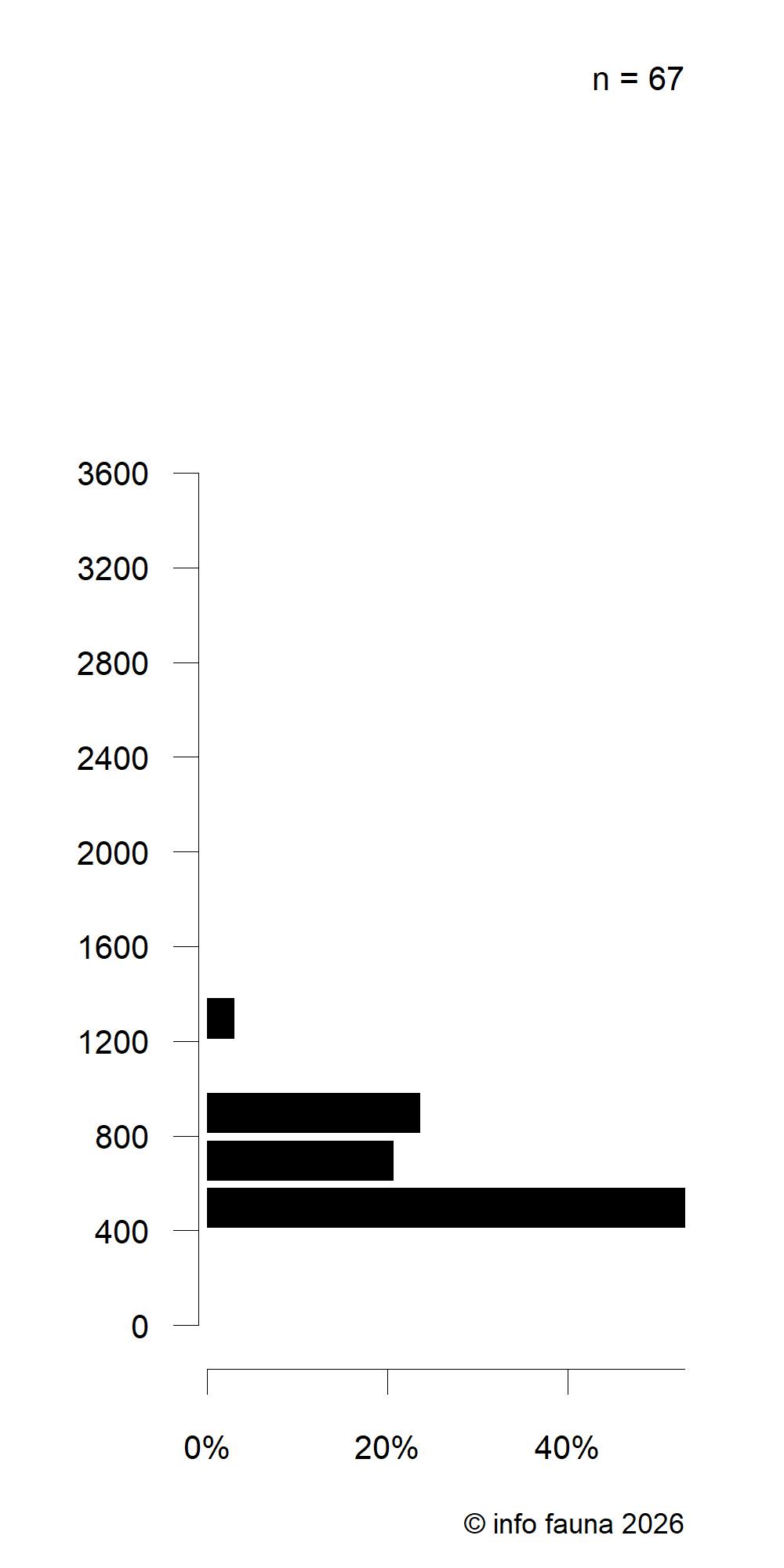
En Suisse, A. ferox est connue du Valais entre Martigny et Rarogne, au Tessin, très localement dans les Grisons près de Rothenbrunnen, ainsi que le long du pied du Jura entre Genève et le canton de Neuchâtel. Une donnée ancienne isolée provient également du canton de Bern, et d'après la distribution de Nomada mutica l'espèce doit être présente au Val Poschiavo. Il s'agit d'une espèce de basse altitude qui vole au dessous de 800m.

Distribution altitudinale d'Andrena ferox en Suisse.
Conservation
Cette page n'a malheureusement pas été traduite dans la langue sélectionnée. Elle s'affiche dans la langue de l'auteur.
Bedrohungsstatus
Andrena ferox wird in der Roten Liste als verletzlich (VU) eingestuft (Müller & Praz 2024) und ist eine national prioritäre Art (BAFU & InfoSpezies 2024). Aktuelle Funde von A. ferox und ihrem exklusiven Brutparasiten Nomada mutica
liegen nur von wenigen Stellen am Jurasüdfuss, im Wallis, an der Alpensüdflanke und im Domleschg vor. Es ist aber zu erwarten, dass diese vor allem in der Baumschicht pollensammelnde und dadurch sehr schwer erfassbare Art in besonders thermophilen und eichendominierten Wäldern häufiger und weiter verbreitet ist als es die aktuellen Nachweise vermuten lassen.
Nationale Priorität
- Dringlichkeit: 3 (wünschbar und sinnvoll)
- Handlungsebene: Ökologische Infrastruktur
Wichtigste Fördergebiete
- Mittel- und Unterwallis
- Tessin
- Puschlav
- Jurasüdfuss
- Domleschg
Wichtigste Lebensraumansprüche
- grosses Angebot von im Frühling blühenden Bäumen, insbesondere von Quercus spec. (Fagaceae)
- vegetationslose bis schütter bewachsene Bodenstellen an besonnter bis halbschattiger Lage
- räumliche Nähe von Nahrungsräumen und Nistplätzen (Zielgrösse maximal 300 m)
- Höhenlage: meist unter 800 m Höhe