
Type de présence en Suisse
Indigène (INN)
ⓘⓧ
Degré de menace
Selon les Catégories et Critères de la Liste rouge de l’UICN ou selon Duelli et al. 1994.
(exp = appréciation d'expert·e·s)
Statut de protection (CH)
Selon les lois et ordonnances nationales spécifiques.
Degré de menace (CH)
Non menacé (LC)
Statut de protection (CH)
ⓘⓧ
Selon les lois et ordonnances mentionnées
–
Lois et ordonnances
–
ⓘⓧ
Selon l’aide à l’exécution : Liste des espèces prioritaires au niveau national.
Priorité nationale
–
Niveau d’action
–
Indications sur le niveau d’action
–
Urgence des mesures (CH)
–
Protection d’occurrences individuelles
–
Surveillance des populations
–
ⓘⓧ
Domaine agricole (OEA/UZL)
Espèce cible/caractéristique selon : Objectifs environnementaux pour l’agriculture "Espèces et milieux naturels".
(* = appréciation d'expert·e·s)
Forêts
2 : Espèce cible forestière selon Biodiversité en forêt : objectifs et mesures. Aide à l’exécution pour la conservation de la diversité biologique dans la forêt suisse (Imesch et al. 2015).
1 : Espèce cible forestière complémentaire, définie dans le cadre de plans d'actions OFEV (p.ex. Plan d'action Forêts claires).
Domaine agricole (OEA/UZL)
–
Forêts
–
✓
Taxon bien étudié, graphique proche de la situation réelle plus d'info
Carte
Carte des observations de Andrena bicolor en Suisse (résolution 5x5 km).Voir la carte
Période
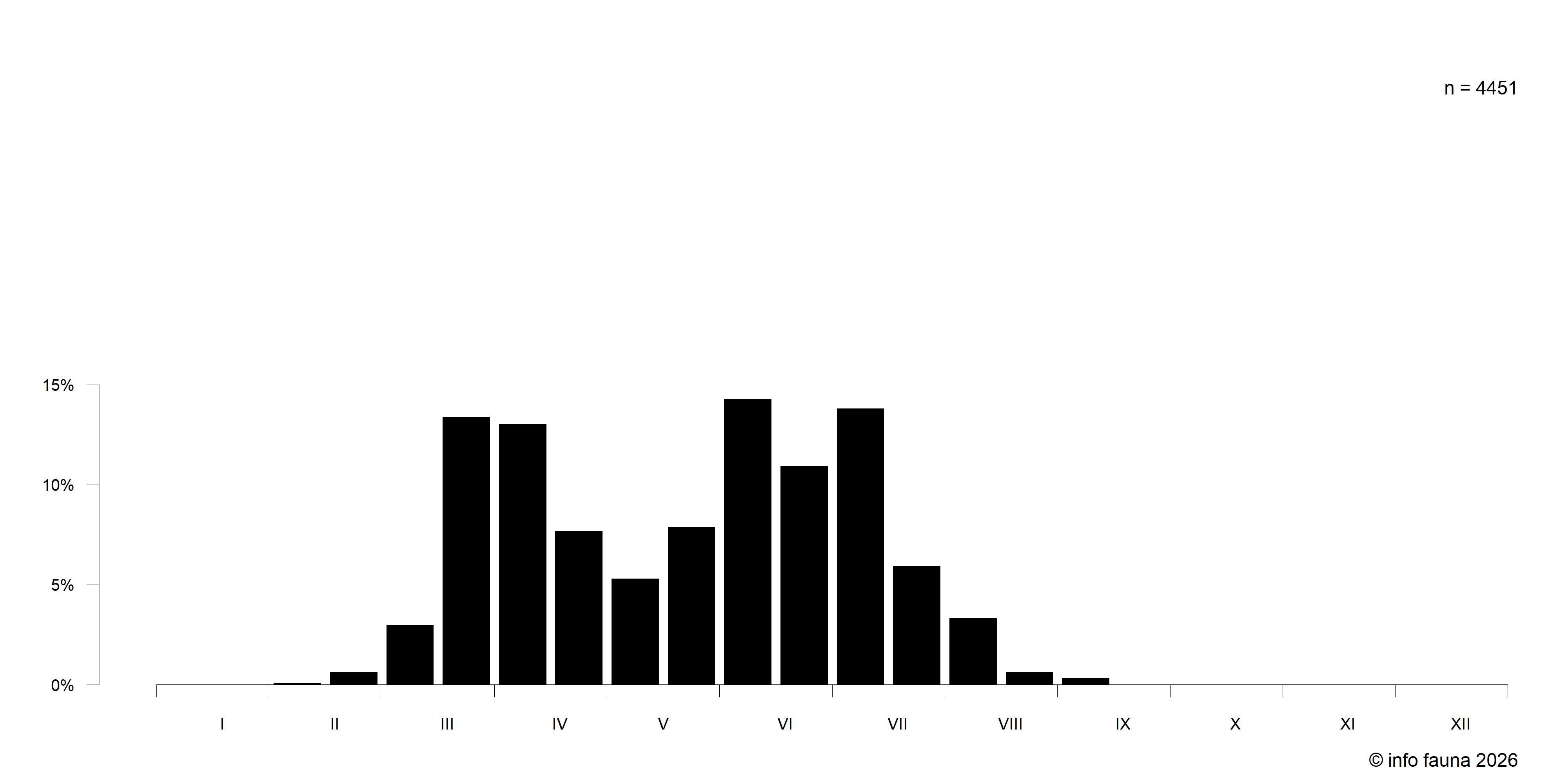
Période des observations de Andrena bicolor en Suisse. Le graphique montre la proportion de toutes les observations par quinzaine.
Classification
- Arthropoda (Phylum)
- Insecta (Classe)
- Hymenoptera (Ordre)
- Apidae, Andreninae (Famille)
- Andrena (Genre)
- Apidae, Andreninae (Famille)
- Hymenoptera (Ordre)
- Insecta (Classe)
Portrait de l'espèce
Auteur-e-s
Christophe Praz
Portrait
Description et taxonomie
Andrena bicolor est une des espèces les plus communes du genre Andrena. Comme son nom latin l'indique, la femelle est caractérisée par une pilosité bicolore, noire sur la tête, les côtés du thorax ainsi qu’à l'extrémité de l'abdomen (y compris la frange terminale), et brun-orange sur le dessus du thorax et sur les premiers segments de l'abdomen. La scopa est brun-orange. A basse altitude, l'espèce peut être reconnue sur le terrain dans une grande partie des cas. L'espèce très rare A. varians peut présenter une pilosité similaire, mais chez cette espèce légèrement plus grande la pilosité des tergites 1 et 2 est nettement plus longue que celle du reste de l'abdomen et la scopa est bicolore (noire à l’extérieur et blanchâtre vers l’intérieur). On trouve occasionnellement des femelles d’A. bicolor avec une pilosité plus claire, dans les cas extrêmes la pilosité de la face et des côtés du thorax étant entièrement brun-orange. Ces formes, plus fréquentes pour la deuxième génération et au sud du pays, ne peuvent pas être séparées sur le terrain d'espèces proches comme A. fulvata, A. rufula, A. symphyti ou A. vulpecula, qui sont toutefois toutes des espèces printanières. Dans les Alpes, les femelles ne peuvent pas être séparées sur le terrain des espèces proches A. allosa et A. amieti. La femelle d’A. montana peut être séparée grâce à sa pilosité principalement gris-clair et la frange terminale orange. A. ruficrus peut être reconnue grâce à la coloration rouge-orange du tibia des pattes arrières.

Femelle d'Andrena bicolor prenant le soleil dans une fleur de Campanula. On peut voir la pilosité typique de l'espèce, noire sur la face et l'arrière de l'abdomen, brune sur le thorax et les premiers tergites (Neuchâtel NE, mi-juin 2017). Photo © Dimitri Bénon.
Le mâle d’A. bicolor est caractérisé comme la femelle par la pilosité noire de la face, des côtés du thorax et de l'extrémité de l'abdomen, et brune du thorax et des premiers segments de l'abdomen. A basse altitude, une détermination est généralement possible sur le terrain. L'espèce proche A. fulvata a la pilosité de la face claire et de longues mandibules, contrairement à A. bicolor. A nouveau, on trouve de manière isolée, principalement pour la deuxième génération, des mâles d'A. bicolor avec la pilosité de la face plus claire; ces formes ne peuvent être séparées sur le terrain, en particulier des espèces printanières A. ruficrus, A. rufula, A. symphyti et A. vulpecula. Dans les Alpes, une séparation d'avec les espèces proches A. amieti, A. allosa et A. montana est difficile, mais ces trois espèces ont la pilosité de la face majoritairement gris-clair.

Mâle de Andrena bicolor sur une fleur de Cyclamen (Neuchâtel NE, fin mars 2018). Photo © Sophie Giriens.
La systématique du groupe d'espèces proche de A. bicolor est complexe. Le statut des deux espèces alpines proches A. allosa et A. amieti n'a été clarifié que récemment. Enfin, les données génétiques suggèrent que deux espèces cryptiques pourraient exister au sein de A. bicolor en Europe. Une de ces deux formes (A. bicolor clade 2) semble répandue dans tout le pays, alors que l'autre (A. bicolor clade 1) n'a été trouvée jusqu'ici qu'en Valais. (Schmidt et al. 2015, Praz et al. 2019, Gueuning et al. 2020).
Biologie et habitat
Habitat
Andrena bicolor est une espèce ubiquiste qui fréquente la plupart des milieux, y compris dans les zones urbaines et les milieux forestiers, de la plaine à la limite supérieure des forêts.
Sources de pollen
A. bicolor est largement polylectique et visite d'après la littérature 15 familles de plantes. Les deux générations sont polylectiques, mais la génération estivale montre une préférence plus ou moins marquée pour le pollen de Campanulaceae, comme l'espèce proche A. amieti. Des analyses sur les préférences olfactives des femelles de chacune des deux générations n'ont toutefois pas montré de différences entre les générations. Les raisons de cette préférence restent donc mystérieuses. Au printemps, l'espèce est largement polylectique sans préférence marquée pour une famille de plantes. On la rencontre aussi bien sur des plantes herbacées que sur des arbustes comme les Salix. (Stöckhert in Schmiedeknecht 1930, Westrich 2018, Müller, Amiet & Krebs 1997, Milet-Pinheiro et al. 2016, Wood & Roberts 2017).
Nidification
L'espèce niche dans des galeries creusées dans le sol, sans montrer de préférence pour un type particulier de substrat. Elle niche principalement de manière individuelle. (Westrich 2018).

Femelle de Andrena bicolor quittant le nid (Monthey VS, début avril 2018). Photo © Sophie Giriens.
Espèces parasites
A. bicolor est parasitée par Nomada fabriciana. Des individus stylopisés sont connus. (Westrich 2006, Westrich 2018).
Distribution
Cycle de vie
Andrena bicolor est bivoltine, la première génération volant de mars à avril et la seconde de fin mai à début août. En altitude, la première génération peut s'étendre jusqu'en juin. A. bicolor est une des premières abeilles à être active au printemps et les premiers individus peuvent être observés à la fin du mois de février certaines années.

Phénologie d'Andrena bicolor en Suisse.
Distribution
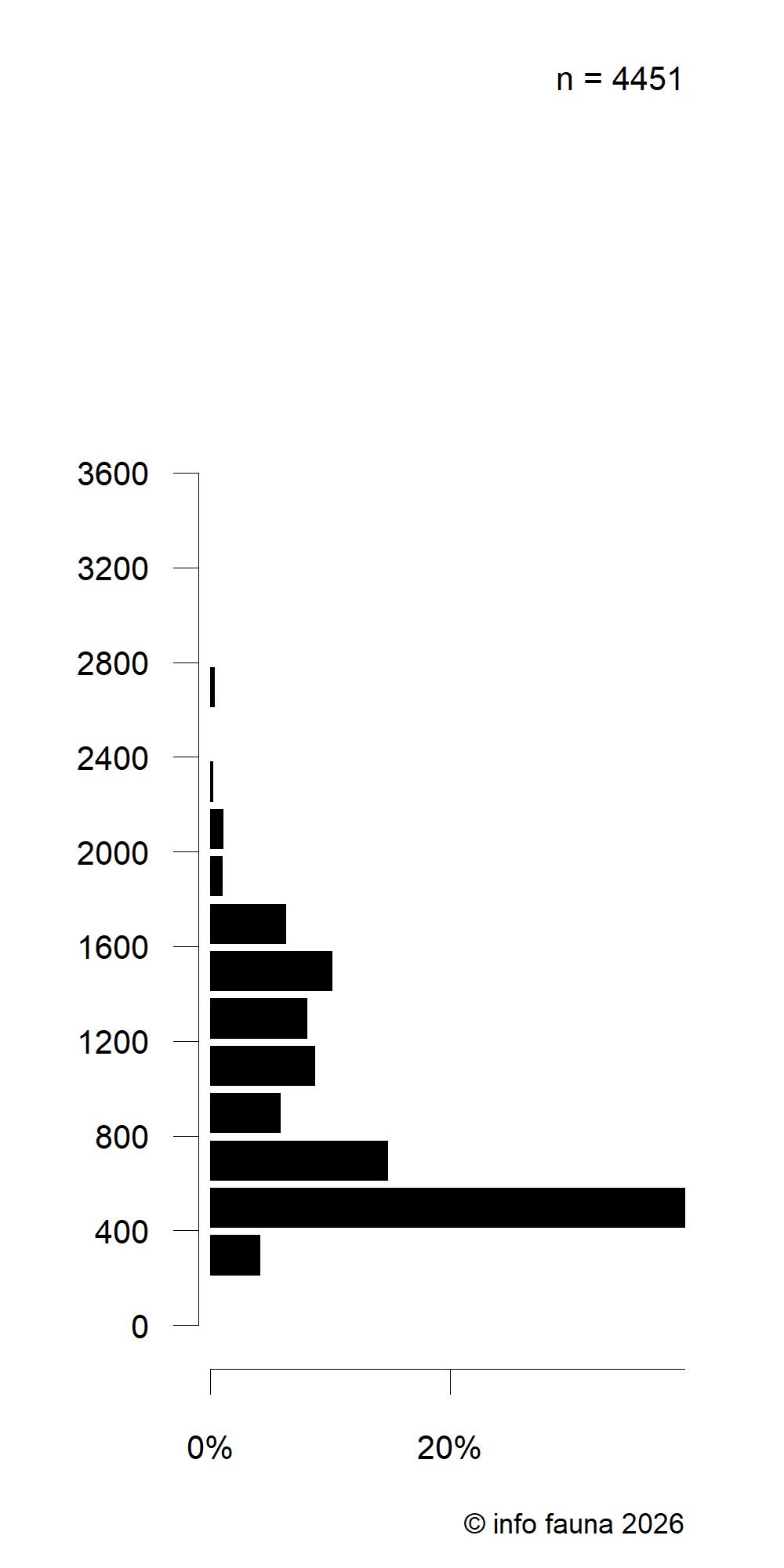
A. bicolor est une des espèces les plus communes de Suisse et se retrouve sur tout le territoire jusqu'à plus de 2000m d'altitude.

Distribution altitudinale d'Andrena bicolor en Suisse.
Conservation
Cette page n'a malheureusement pas été traduite dans la langue sélectionnée. Elle s'affiche dans la langue de l'auteur.
Bedrohungsstatus
Andrena bicolor wird in der Roten Liste als nicht bedroht (LC) eingestuft (Müller & Praz 2024). Damit gehört sie nicht zu den gefährdeten Arten und ist keine Rote Liste Art.