Salta al contenuto principale

Hylaeus pfankuchi

(Alfken, 1919)
Tipo di presenza in Svizzera

Indigena (INN)

Minacce e protezione

Grado di minaccia
Secondo le Categorie e i criteri della Lista Rossa dell’UICN o secondo Duelli et al. 1994.
(exp = valutazione degli/delle esperti/e)

Status di protezione (CH)
Ai sensi delle leggi e alle ordinanze nazionali specifiche.

Grado di minaccia (CH)

Vulnerabile (VU)

Statut de protection (CH)

Ai sensi delle leggi e delle ordinanze citate

Lois et ordonnances

Leggi e Ordinanze

Conservazione
Priorità nazionale
Si
Livelli operativi

LF(+GL): Promozione degli habitat

Indicazioni sul livello operativo
Urgenza temporale con cui attuare (CH)

2: necessario e importante

Protezione popolazioni isolate
Monitoraggio delle popolazioni

2: sufficiente

Specie bersaglio e ecologia

Settore agricolo (OEA/UZL)
Specie bersaglio/caratteristiche secondo: Obiettivi ambientali per l’agricoltura “Specie e habitat”.
(* = valutazione degli/delle esperti/e)

Foreste
2: Specie forestale bersaglio secondo: Biodiversität und Wald: Ziele und Massnahmen. Vollzugshilfe zur Erhaltung und Förderung der biologischen Vielfalt im Schweizer Wald (Imesch et al. 2015).

1: Specie forestale bersaglio complementare, definita nell’ambito dei piani d’azione UFAM (ad es. Piano d’azione Boschi radi FR/DE)

Settore agricolo (OEA/UZL)
Foreste

    Taxon ben studiato, mappa vicina alla distribuzione reale Maggiori informazioni

    Mappa
    Hylaeus pfankuchi
    Mappa delle osservazioni di Hylaeus pfankuchi in Svizzera (risoluzione 5x5 km).Visualizza la mappa
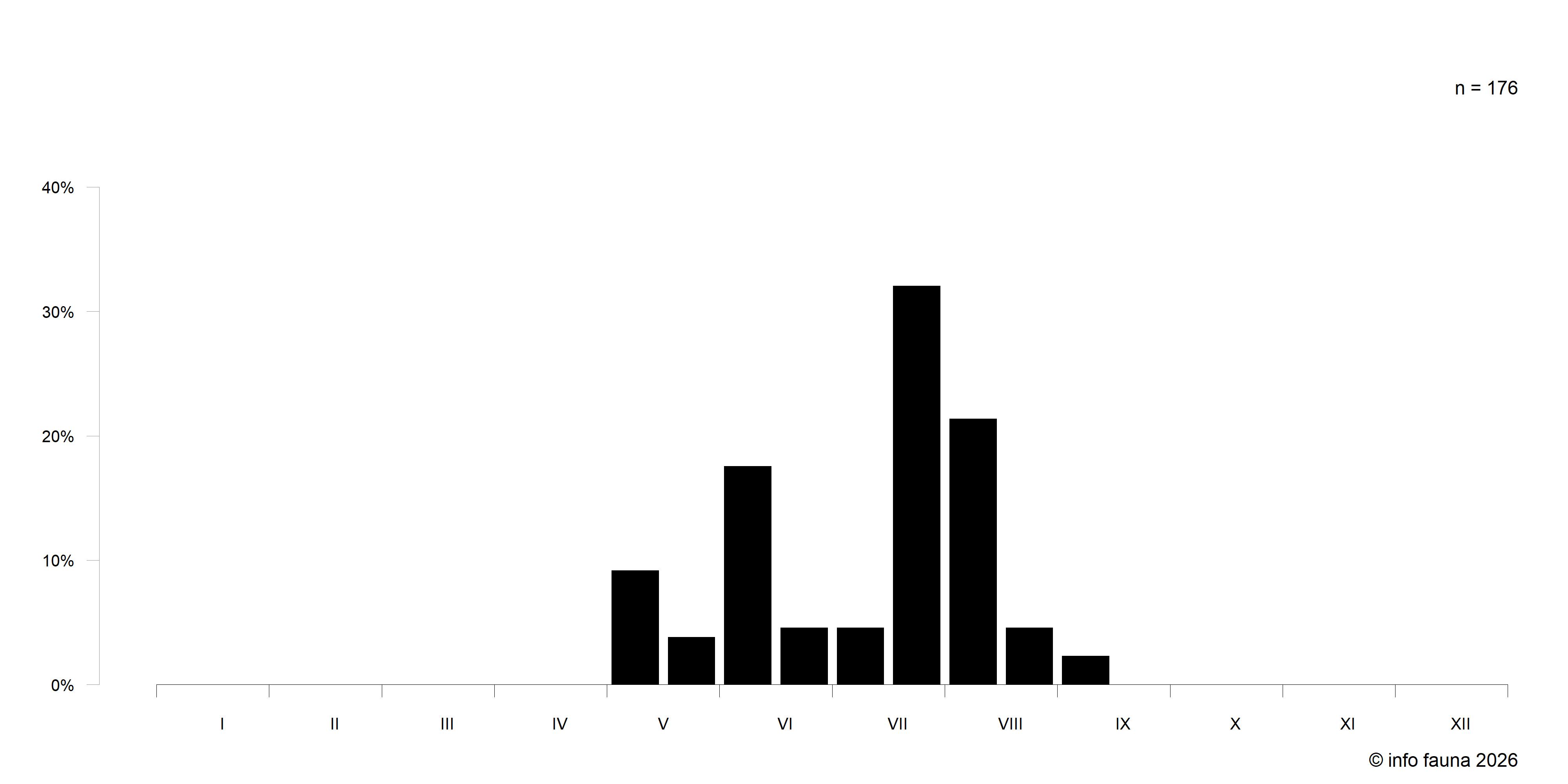
    Periodo delle osservazioni di Hylaeus pfankuchi in Svizzera. Il grafico mostra la proporzione di tutte le osservazioni per quindicina.
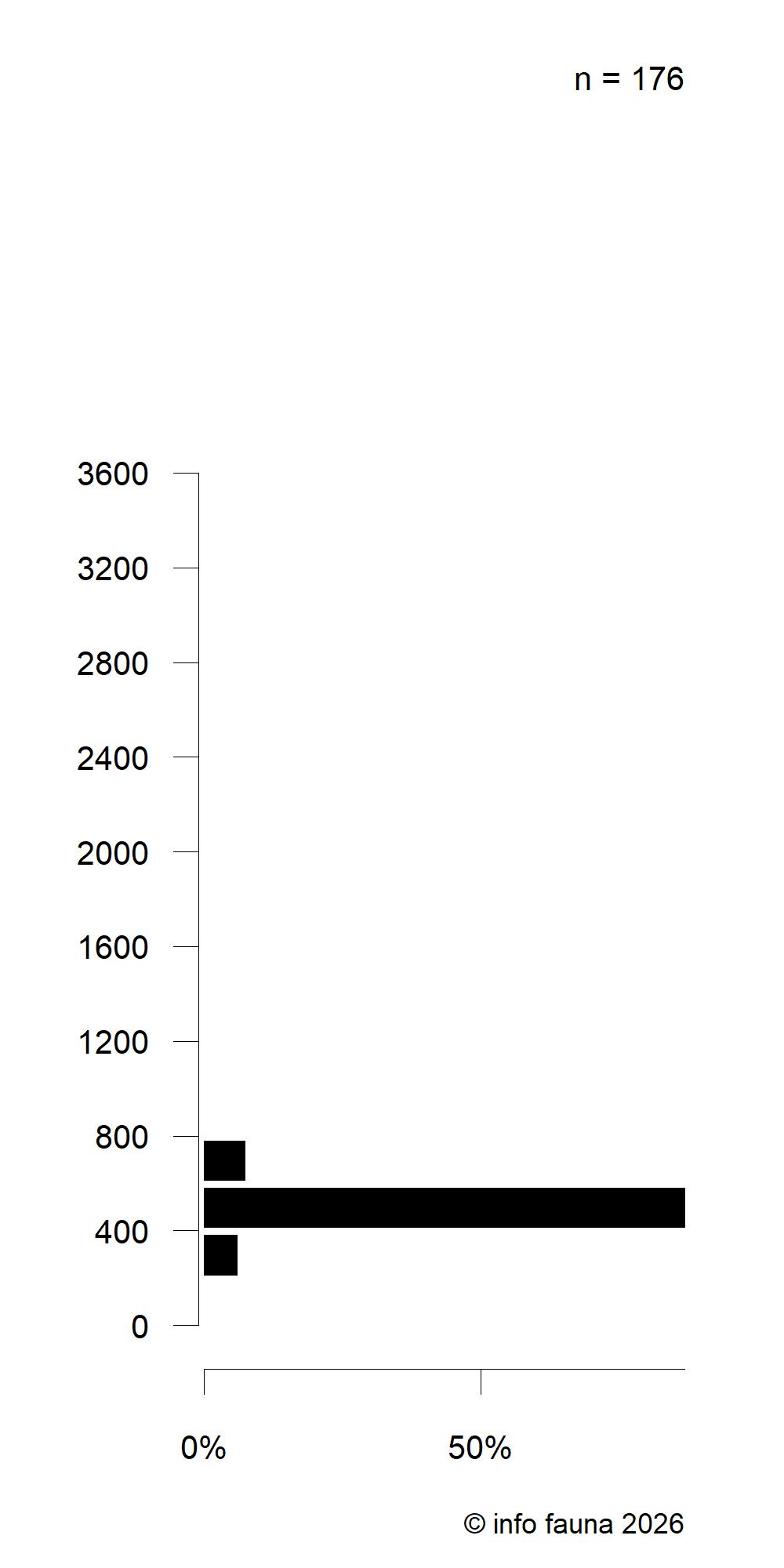
    Altitudine delle osservazioni di Hylaeus pfankuchi in Svizzera. Il grafico mostra la proporzione di tutte le osservazioni per fasce altitudinali di 200 m. 

    Classificazione

    • Arthropoda (Phyllum)
      • Insecta (Classe)
        • Hymenoptera (Ordine)
          • Colletinae (Famiglia)
            • Hylaeus (Genere)

    Riferimenti bibliografici

    Liste der National Prioritären Arten der Schweiz
    BAFU, & InfoSpecies (2024). Liste der National Prioritären Arten der Schweiz . BAFU & InfoSpecies.
    A threefold plant specialist
    Müller, A., Weibel, U., & Lenz, R. (2024). A threefold plant specialist. Alpine Entomology 8, 131-146.
    Rote Liste der Bienen
    Müller, A., & Praz, C. (2024). Rote Liste der Bienen. Gefährdete Arten der Schweiz. Umwelt-Vollzug.
    The hidden diet - examination of crop content reveals distinct patterns of pollen host use by Central European bees of the genus Hylaeus (Hymenoptera, Colletidae)
    Müller, A. (2023). The hidden diet - examination of crop content reveals distinct patterns of pollen host use by Central European bees of the genus Hylaeus (Hymenoptera, Colletidae). Alpine Entomology, 7, 21-35.
    Anmerkungen zu Bau und Funktion sexualdimorpher Antennenstrukturen bei Maskenbienen (Hymenoptera, Anthophila, Colletidae)
    Dathe, H.H. (2009). Anmerkungen zu Bau und Funktion sexualdimorpher Antennenstrukturen bei Maskenbienen (Hymenoptera, Anthophila, Colletidae). Entomologische Nachrichten und Berichte, 53, 151-156.
    Larvae and nests of aculeate Hymenoptera nesting in reed galls induced by Lipara spp
    Astapenková, A., Heneberg, P., & Bogusch, P. (2017). Larvae and nests of aculeate Hymenoptera nesting in reed galls induced by Lipara spp. PLoS ONE, 12(1), e0169592.
    Larvae and nests of aculeate Hymenoptera (Hymenoptera: Aculeata) nesting in reed galls induced by Lipara spp. (Diptera: Chloropidae) with a review of species recorded
    Astapenková, A., Heneberg, P., & Bogusch, P. (2017). Larvae and nests of aculeate Hymenoptera (Hymenoptera: Aculeata) nesting in reed galls induced by Lipara spp. (Diptera: Chloropidae) with a review of species recorded. Part II. PLoS ONE, 12(1), e0169592.
    Rote Liste der Bienen Deutschlands (Hymenoptera, Apidae)
    Westrich, P., Frommer, U., Mandery, K., Riemann, H., Ruhnke, H., Saure, C., & Voith, J. (2008). Rote Liste der Bienen Deutschlands (Hymenoptera, Apidae). Eucera, 3, 33-87.
    Verbreitung, Lebensraum und Blütenbesuch der Seidenbiene Colletes sierrensis Frey-Gessner, 1901 (Hymenoptera, Apidae)
    Westrich, & P (2008). Verbreitung, Lebensraum und Blütenbesuch der Seidenbiene Colletes sierrensis Frey-Gessner, 1901 (Hymenoptera, Apidae). Entomologische Nachrichten und Berichte, 52, 85-91.
    Zur Überflutungstoleranz von Stechimmen in Gallen von Lipara lucens (Diptera: Chloropidae)
    Westrich, P. (2008). Zur Überflutungstoleranz von Stechimmen in Gallen von Lipara lucens (Diptera: Chloropidae). Eucera, 1, 1-16.
    Die Neophyten Solidago canadensis und Solidago gigantea als Pollenquellen der Seidenbiene Colletes collaris Dours (Hymenoptera: Apidae)
    Westrich, & P (2008). Die Neophyten Solidago canadensis und Solidago gigantea als Pollenquellen der Seidenbiene Colletes collaris Dours (Hymenoptera: Apidae). Eucera, 1, 30-32.
    Flexibles Pollensammelverhalten der ansonsten streng oligolektischen Seidenbiene Colletes hederae Schmidt & Westrich (Hymenoptera: Apidae)
    Westrich, & P (2008). Flexibles Pollensammelverhalten der ansonsten streng oligolektischen Seidenbiene Colletes hederae Schmidt & Westrich (Hymenoptera: Apidae). Eucera, 1, 17-29.
    Epeolus fallax, ein Brutparasit von Colletes hederae und eine für Deutschland neue Bienenart (Hymenoptera, Apidae)
    Westrich, P., Bülles, & J (2016). Epeolus fallax, ein Brutparasit von Colletes hederae und eine für Deutschland neue Bienenart (Hymenoptera, Apidae). Eucera, 10, 15-26.
    Taschenlexikon der Wildbienen Mitteleuropas
    Scheuchl, E., & Willner, W. (2016). Taschenlexikon der Wildbienen Mitteleuropas. Quelle & Meyer, 917p.
    Larvae and nests of six aculeate Hymenoptera (Hymenoptera: Aculeata) nesting in reed galls induced by Lipara spp
    Bogusch, P., Astapenková, A., & Heneberg, P. (2015). Larvae and nests of six aculeate Hymenoptera (Hymenoptera: Aculeata) nesting in reed galls induced by Lipara spp. (Diptera: Chloropidae) with a review of species recorded. PLoS ONE, 10(6), e0130802.