
Type de présence en Suisse
Indigène (INN)
ⓘⓧ
Degré de menace
Selon les Catégories et Critères de la Liste rouge de l’UICN ou selon Duelli et al. 1994.
(exp = appréciation d'expert·e·s)
Statut de protection (CH)
Selon les lois et ordonnances nationales spécifiques.
Degré de menace (CH)
Non menacé (LC)
Statut de protection (CH)
ⓘⓧ
Selon les lois et ordonnances mentionnées
–
Lois et ordonnances
–
ⓘⓧ
Selon l’aide à l’exécution : Liste des espèces prioritaires au niveau national.
Priorité nationale
–
Niveau d’action
–
Indications sur le niveau d’action
–
Urgence des mesures (CH)
–
Protection d’occurrences individuelles
–
Surveillance des populations
–
ⓘⓧ
Domaine agricole (OEA/UZL)
Espèce cible/caractéristique selon : Objectifs environnementaux pour l’agriculture "Espèces et milieux naturels".
(* = appréciation d'expert·e·s)
Forêts
2 : Espèce cible forestière selon Biodiversité en forêt : objectifs et mesures. Aide à l’exécution pour la conservation de la diversité biologique dans la forêt suisse (Imesch et al. 2015).
1 : Espèce cible forestière complémentaire, définie dans le cadre de plans d'actions OFEV (p.ex. Plan d'action Forêts claires).
Domaine agricole (OEA/UZL)
–
Forêts
–
✓
Taxon bien étudié, graphique proche de la situation réelle plus d'info
Carte
Carte des observations de Colletes cunicularius en Suisse (résolution 5x5 km).Voir la carte
Période
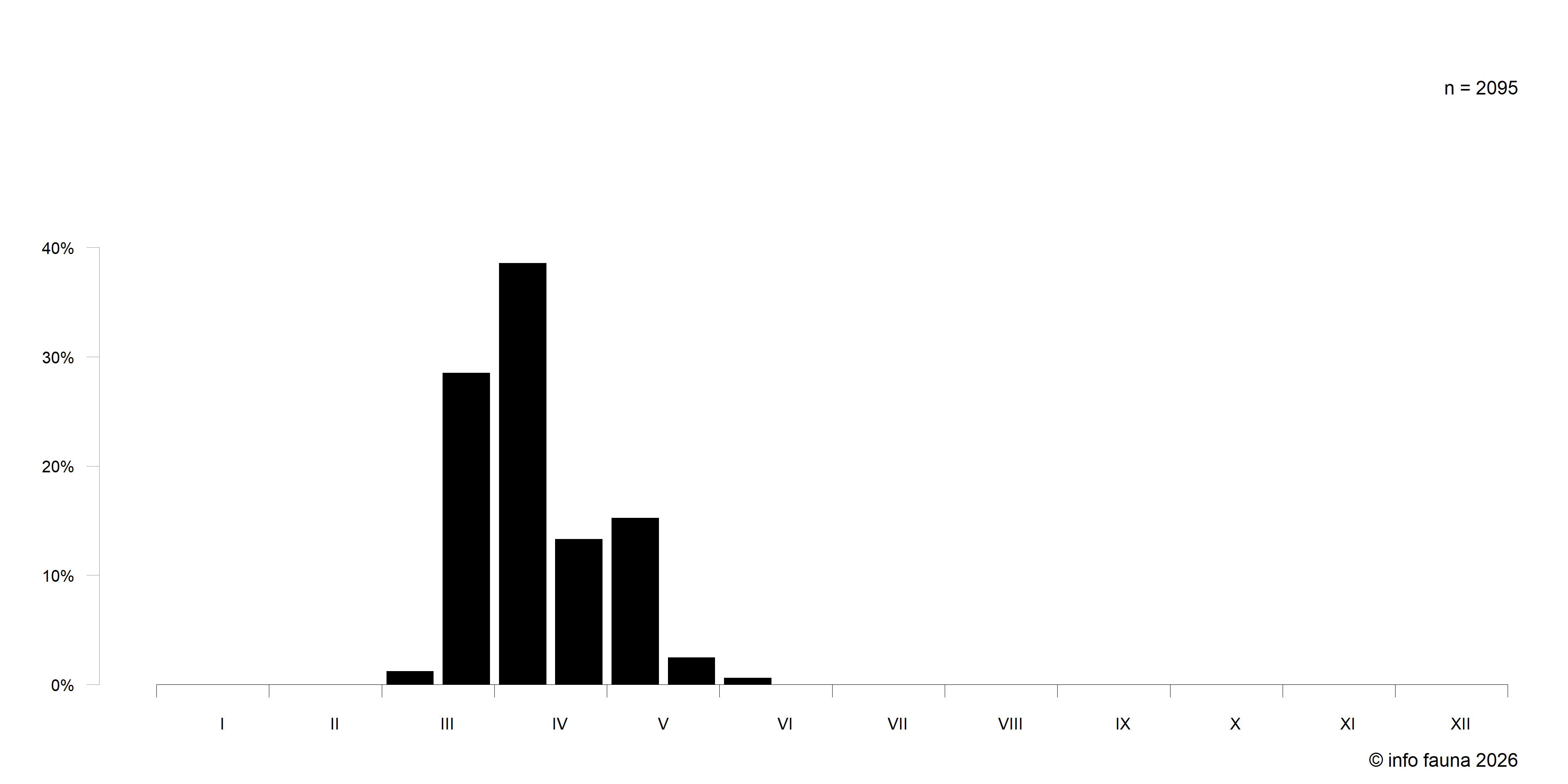
Période des observations de Colletes cunicularius en Suisse. Le graphique montre la proportion de toutes les observations par quinzaine.
Classification
- Arthropoda (Phylum)
- Insecta (Classe)
- Hymenoptera (Ordre)
- Apidae, Colletinae (Famille)
- Colletes (Genre)
- Apidae, Colletinae (Famille)
- Hymenoptera (Ordre)
- Insecta (Classe)
Portrait de l'espèce
Auteur-e-s
Andreas Müller
Portrait
Description et taxonomie
Colletes cunicularius est une espèce de grande taille (13-14 mm) dont les femelles, à la différence des autres espèces indigènes de Colletes, ne portent pas de bandes de poils pâles distinctes sur les marges terminales des tergites. Les femelles de Colletes cunicularius ressemblent beaucoup à l'abeille domestique et à certaines espèces d'Andrena, mais lorsqu'elles sont examinées à la main, elles se distinguent par leur langue bilobée étonnamment courte et par la forte odeur de citron qu'elles sécrètent lorsqu'elles sont menacées.

Colletes cunicularius est une espèce printanière recouverte d'une pilosité longue relativement dense, ce qui la distingue fortement des autres espèces du genre. Photo © Dimitri Bénon.
Les mâles mesurent entre 12-14 mm et ressemblent extérieurement aux femelles. Ils sécrètent également cette odeur typique de citron lorsqu’ils sont menacés.

Mâle sur Salix (Buttes NE, fin mars 2017). Photo © Dimitri Bénon.
Biologie et habitat
Habitat
Colletes cunicularius est considéré comme une espèce typique des plaines fluviales inondables. Cependant, l'espèce colonise également d'autres habitats caractérisés par d’importantes populations de Salix, d’Acer ou de Rosaceae arborescentes, ainsi que par des sols meubles et particulièrement sableux, tels que les carrières de sable et de gravier, les digues de rivières et les talus de chemin de fer, les prairies riches en structure et parfois les agglomérations.
Sources de pollen
C. cunicularius est une espèce polylectique, mais en Europe centrale, elle préfère collecter le pollen sur Salix (Salicaceae) et d'autres arbustes et arbres, comme par exemple Acer (Sapindaceae), Malus, Prunus, Pyrus et Sorbus (Rosaceae), Ilex (Aquifoliaceae), Sambucus (Adoxaceae), Quercus (Fagaceae) ou Euonymus (Celastraceae) et seulement exceptionnellement sur des plantes herbacées telles que Taraxacum (Asteraceae) ou Ranunculus (Ranunculaceae). En dehors de l'Europe centrale, les Anacardiaceae, Brassicaceae, Cistaceae, Ericacae, Fabaceae, Grossulariaceae, Resedaceae et Rhamnaceae ont également été identifiées comme étant des sources de pollen utilisées par l’espèce. Jusqu'à sept vols de collecte de pollen sont effectués par jour. Pour l'approvisionnement d'une seule cellule à couvain en pollen de Salix, sept à neuf pelotes de pollen sont nécessaires (Bischoff et al. 2003, Müller & Kuhlmann 2008, Peeters et al. 2012, Else & Edwards 2018, Westrich 2018).

Colletes cunicularius collecte le pollen préférentiellement sur Salix sp. (Hüntwangen ZH, 1997). Photo © Albert Krebs.
Nidification
C. cunicularius niche dans galeries qu’elle creuse dans un sol généralement dépourvu de végétation ou seulement recouvert d'une végétation clairsemée, le plus souvent sur un sol plat ou légèrement incliné, plus rarement sur des escarpements verticaux. L’espèce colonise essentiellement les sols sableux, également lorsque ceux-ci sont recouverts d'une couche d'humus plus ou moins épaisse. C. cunicularius construit généralement des nids en agrégations de petite à grande taille, comprenant jusqu'à plusieurs milliers de nids et pouvant atteindre une densité de 30 nids par mètre carré. Les nids sont constitués d'un passage principal de 8-10 mm de large et en moyenne d'un peu moins de 30 cm allant jusqu’à un maximum de 80 cm de long. La galerie s'enfonce d'abord en diagonale dans le sol sur une longueur de quelques centimètres avant de continuer verticalement vers le fond. Au bout du tunnel principal, l’espèce ménage un tunnel latéral plus ou moins horizontal de 2 à 6 cm de long au bout duquel une cellule à couvain est creusée. Après avoir refermé la première cellule à couvain, un deuxième passage latéral est creusé au-dessus du premier passage latéral et il se termine à nouveau par une cellule à couvain. La terre excavée est utilisée pour refermer le premier passage latéral avant que d'autres cellules à couvain soient construites et approvisionnées de la même manière. Un nid contient jusqu'à huit cellules à couvain, toutes situées à l'extrémité de passages latéraux horizontaux ou inclinés, qui se ramifient à partir du passage principal dans différentes directions et généralement à une courte distance les uns au-dessus des autres et fermés par de la terre après l'achèvement de la cellule à couvain. Pour assurer l'étanchéité du dernier passage latéral ainsi que de la partie la plus basse du passage principal, C. cunicularius utilise la terre accumulée dans le petit cône qui s’est formé autour de l'entrée du nid au début de la construction. La plus grande partie du passage principal, cependant, n'est pas obstruée. Les cellules à couvain sont tapissées d'une membrane très fine, semblable à de la cellophane, transparente et imperméable à l'eau. Cette membrane est constituée par les sécrétions abdominales de la glande de Dufour qui sont appliquées avec la langue bilobée spécialisée et qui, grâce à l'ajout de sécrétions thoraciques des glandes salivaires, se solidifient en une pellicule ferme. Comme chez C. daviesanus, avant l'approvisionnement de la cellule à couvain, une membrane en forme de langue est fixée sur la paroi inférieure de la cellule. Le point d'attache de la membrane sert éventuellement à déterminer l'état actuel de remplissage de la cellule à couvain en pollen et en nectar. Après la ponte, l'extension en forme de langue est dépliée et soigneusement collée aux bords de la paroi cellulaire. Des couches de membrane supplémentaires sont ensuite appliquées sur cette fermeture primaire avant que le conduit menant à la cellule ne soit rebouché. Les femelles construisent souvent deux à trois nids pendant leur période de vol. Selon les observations de Malyshev (1927), le stade de l'œuf dure environ cinq semaines chez C. cunicularius ce qui est une période inhabituellement longue pour les abeilles (Malyshev 1927, Albans et al. 1980, O'Toole & Raw 1991, Bischoff 2000, Vereecken et al. 2006, Janvier 2012, Else & Edwards 2018, Westrich 2018).

Les femelles se rassemblent pour nicher en agrégations de petite à grande taille, principalement dans les sols sableux. (Teufen ZH, 1994). Photo © Albert Krebs.

Cellule à couvain du genre Colletes, avec en jaune la réserve de pollen bien visible à travers la membrane protectrice. Photo © Andreas Müller.
Espèces parasites
C. cunicularius est parasitée par l'abeille-coucou Sphecodes albilabris. Le diptère Leucophora personata (Anthomyiidae) est probablement un parasite alimentaire de C. cunicularius et le grand bombyle Bombylius major (Bombyliidae) a été identifié comme parasitoïde de l’espèce (Malyshev 1927, Vereecken et al. 2006, Edwards 2018, Westrich 2018).
Comportement de reproduction
Les mâles patrouillent au-dessus des agrégats de nids à la recherche de femelles prêtes à éclore afin de s’y accoupler. En effet, la plupart des mâles sont déjà actifs lorsque les premières femelles commencent à éclore. Dans les grandes agrégations de nids, les mâles concentrent leurs vols de recherche sur de petites zones où ils peuvent y être observés pendant des jours. Les mâles patrouillant interrompent régulièrement leur vol pour inspecter l'entrée des nids ou pour s'enfouir à l’intérieur en direction des femelles en train d'éclore. Des expériences ont montré que les vibrations des muscles du vol indirect et les sécrétions des glandes mandibulaires, qui sont produites ou libérées pendant l'activité d’excavation des femelles, permettent aux mâles de localiser précisément les femelles en train d'éclore, même si elles se trouvent encore à plusieurs centimètres de profondeur dans le sol. La substance principale contenue dans les glandes mandibulaires est le linalol, une molécule produisant une odeur semblable à celle du citron, que les mâles sécrètent également. Cette substance permet probablement non seulement aux deux sexes de se repérer, mais elle joue également un rôle important dans la défense contre les ennemis. Par exemple, les spécimens tenus entre les doigts sécrètent de grandes quantités de linalol. Des grappes contenant jusqu'à quarante mâles se forment souvent autour d'une femelle en train d'éclore et tous tentent de s'accoupler avec elle. Si le linalol est principalement responsable de la rencontre entre les sexes, les hydrocarbures à longue chaîne présents sur la cuticule des femelles sont les véritables déclencheurs des tentatives de copulation des mâles. Dans ce processus, les mâles préfèrent les femelles étrangères dont l'odeur est significativement différente de celles de leur propre agrégation de nids, ce qui réduit peut-être les effets délétères de l'accouplement entre individus apparentés. Les femelles ne s'accouplent qu'une seule fois. Les femelles déjà accouplées ne sont plus attractives pour les mâles : il est possible que cela soit dû à une production plus faible de linalol et une modification de la composition des hydrocarbures cuticulaires chez ces femelles. Les copulations durent 2-30 min et sont accompagnées de vibrations audibles des muscles du vol indirect des mâles. Ces vibrations sont susceptibles de fournir aux femelles des informations sur la qualité du mâle. Dans la région méditerranéenne, les mâles de C. cunicularius sont les pollinisateurs spécifiques de sept espèces d'orchidées du genre Ophrys, qui imitent les phéromones sexuelles des abeilles femelles et attirent ainsi les mâles (Bergström & Tengö 1978, Cane & Tengö 1981, Larsen et al. 1986, O'Toole & Raw 1991, Borg-Karlson et al. 2003, Peakall & Schiestl 2004, Vereecken et al. 2007, Paulus 2018).

Les mâles patrouillent au-dessus des agrégations de nids et attendent que les femelles éclosent (Hüntwangen ZH, 1997). Photo © Albert Krebs.

Accouplement de Colletes cunicularius (Hüntwangen ZH 1997). Photo © Albert Krebs.
Distribution
Cycle de vie
Colletes cunicularius passe l’hiver sous forme d'imago dans la cellule à couvain. L'espèce est univoltine bien que les observations de Malyshev (1927) suggèrent que certaines des larves peuvent avoir un développement bisannuel et survivre le premier hiver sous forme de larve au repos. Parmi les espèces indigènes de Colletes, C. cunicularius fait figure d'exception en volant déjà au printemps. La période de vol principale des mâles s'étend de la mi-mars à la fin avril, celle des femelles de la fin mars à la mi-mai. La durée de vie moyenne des mâles est de moins de dix jours (Malyshev 1927, Peakall & Schiestl 2004, Westrich 2018).
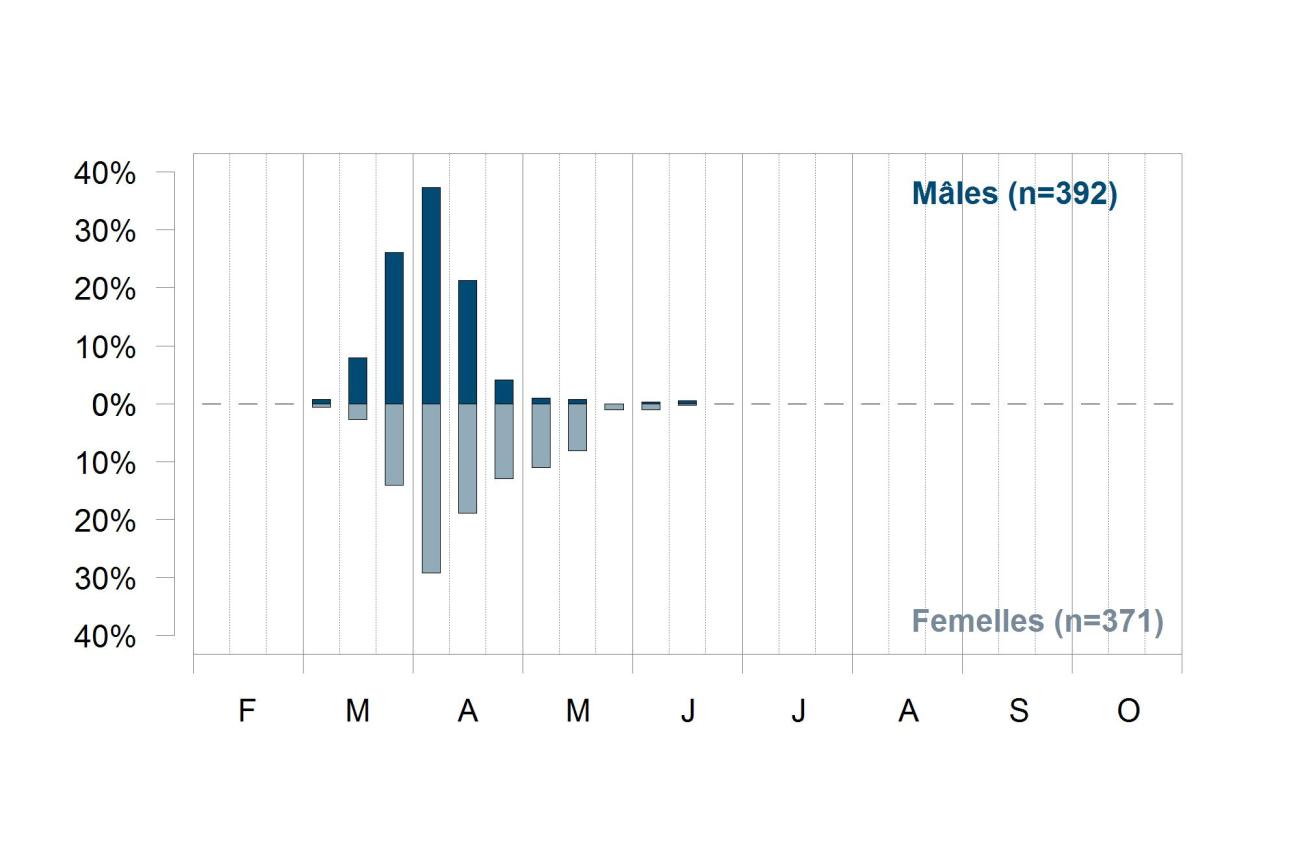
Phénologie de Colletes cunicularius en Suisse.
Distribution
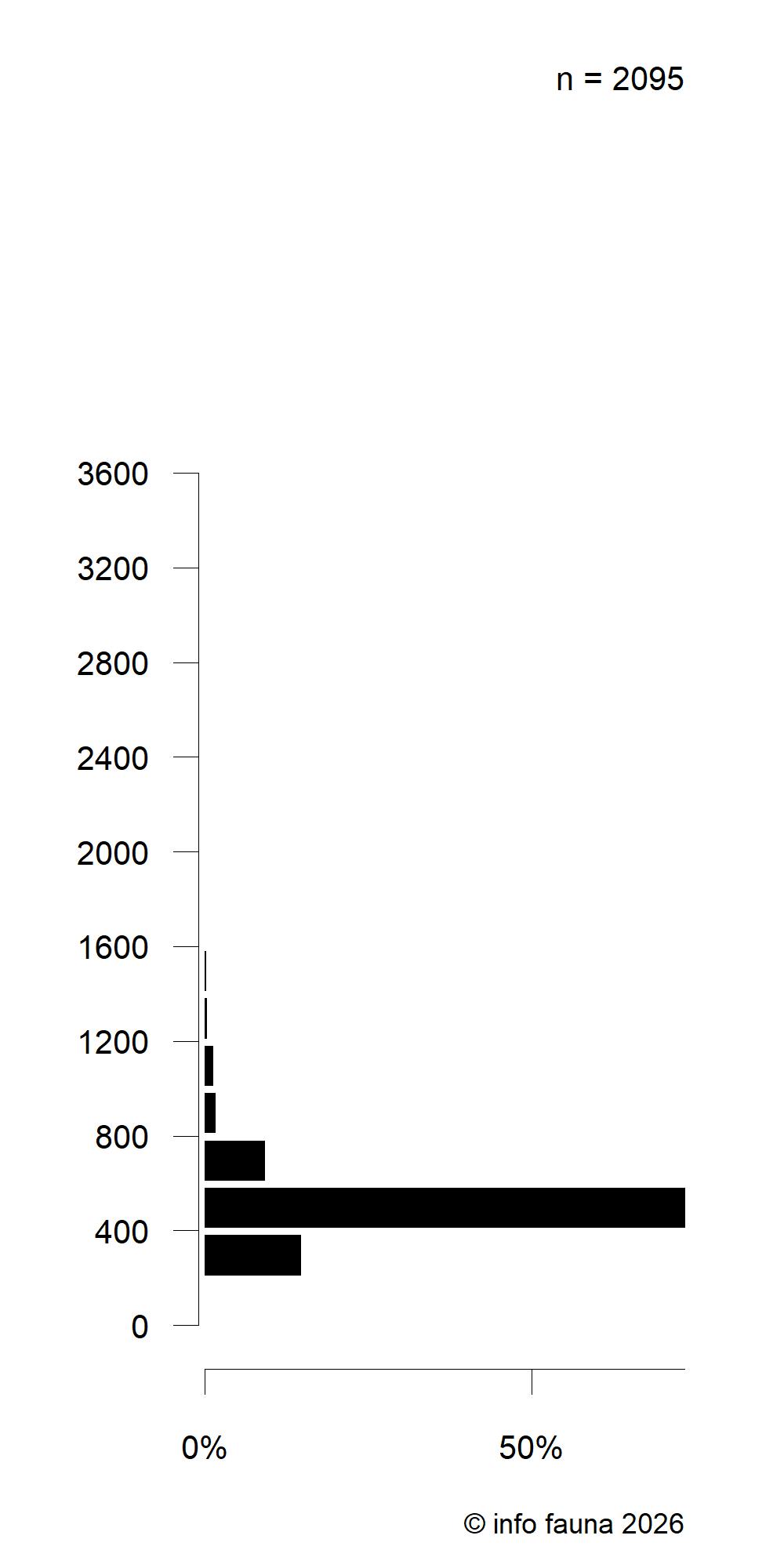
C. cunicularius est bien répandue en Suisse. Comme l'espèce ne s'installe qu'occasionnellement au-dessus de 700 m, elle est absente d'une grande partie des Alpes et du Jura, à l'exception des vallées. Hormis une ancienne et incertaine mention de l’espèce au Tessin, il n'y a pas d'observations de C. cunicularius sur le flanc sud des Alpes. C. cunicularius est une espèce commune, surtout dans les zones à sol meuble.
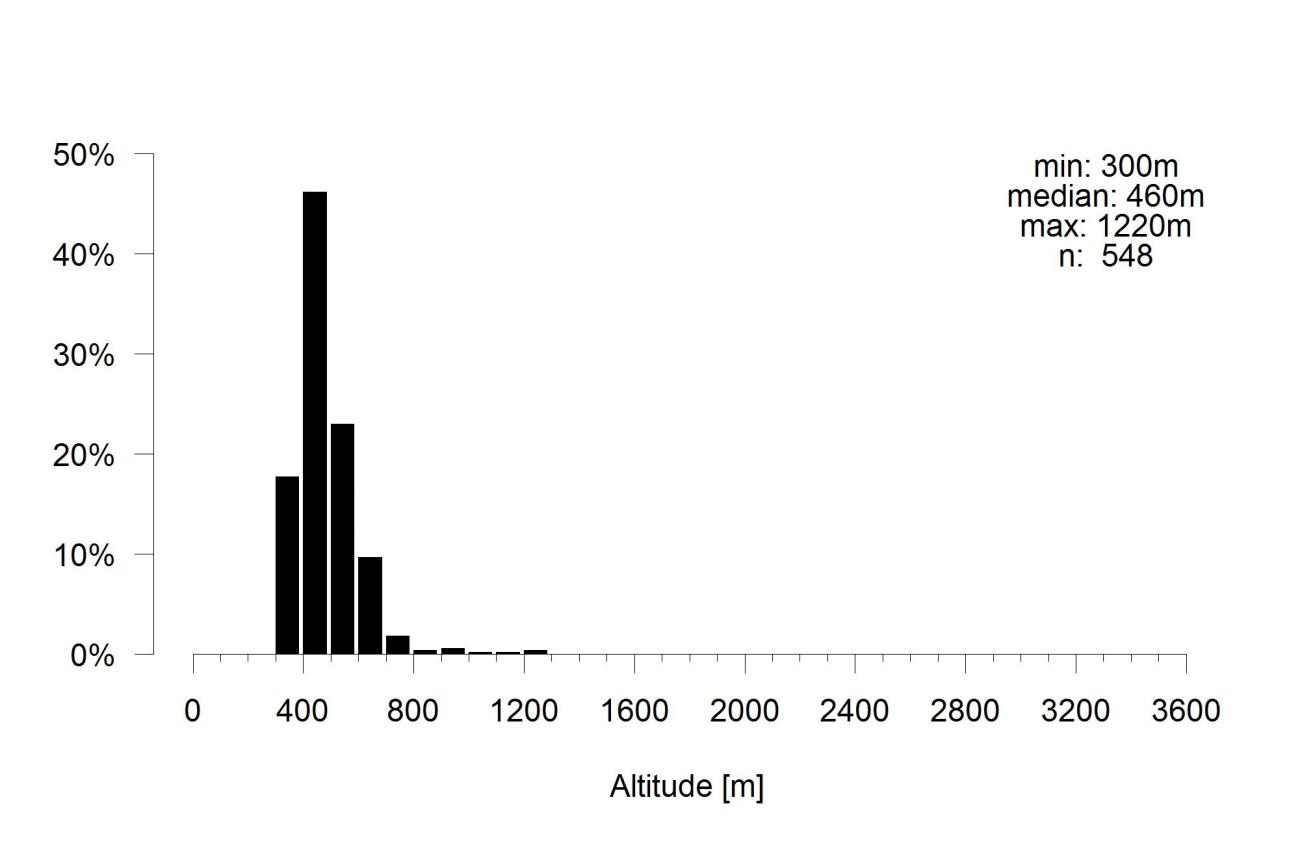
Distribution altitudinale de Colletes cunicularius en Suisse.
Conservation
Cette page n'a malheureusement pas été traduite dans la langue sélectionnée. Elle s'affiche dans la langue de l'auteur.
Bedrohungstatus
Colletes cunicularius wird in der Roten Liste als nicht bedroht (LC) eingestuft (Müller & Praz 2024). Damit gehört sie nicht zu den gefährdeten Arten und ist keine Rote Liste Art.