Carabus glabratus latior
Born, 1895
Type de présence en Suisse
Indigène (INN)
ⓘⓧ
Degré de menace
Selon les Catégories et Critères de la Liste rouge de l’UICN ou selon Duelli et al. 1994.
(exp = appréciation d'expert·e·s)
Statut de protection (CH)
Selon les lois et ordonnances nationales spécifiques.
Degré de menace (CH)
Quasi menacé (NT)
Statut de protection (CH)
ⓘⓧ
Selon les lois et ordonnances mentionnées
–
Lois et ordonnances
–
ⓘⓧ
Selon l’aide à l’exécution : Liste des espèces prioritaires au niveau national.
Priorité nationale
–
Niveau d’action
–
Indications sur le niveau d’action
–
Urgence des mesures (CH)
–
Protection d’occurrences individuelles
–
Surveillance des populations
–
ⓘⓧ
Domaine agricole (OEA/UZL)
Espèce cible/caractéristique selon : Objectifs environnementaux pour l’agriculture "Espèces et milieux naturels".
(* = appréciation d'expert·e·s)
Forêts
2 : Espèce cible forestière selon Biodiversité en forêt : objectifs et mesures. Aide à l’exécution pour la conservation de la diversité biologique dans la forêt suisse (Imesch et al. 2015).
1 : Espèce cible forestière complémentaire, définie dans le cadre de plans d'actions OFEV (p.ex. Plan d'action Forêts claires).
Domaine agricole (OEA/UZL)
–
Forêts
–
✓
Taxon bien étudié, graphique proche de la situation réelle plus d'info
Carte
Carte des observations de Carabus glabratus latior en Suisse (résolution 5x5 km).Voir la carte
Période
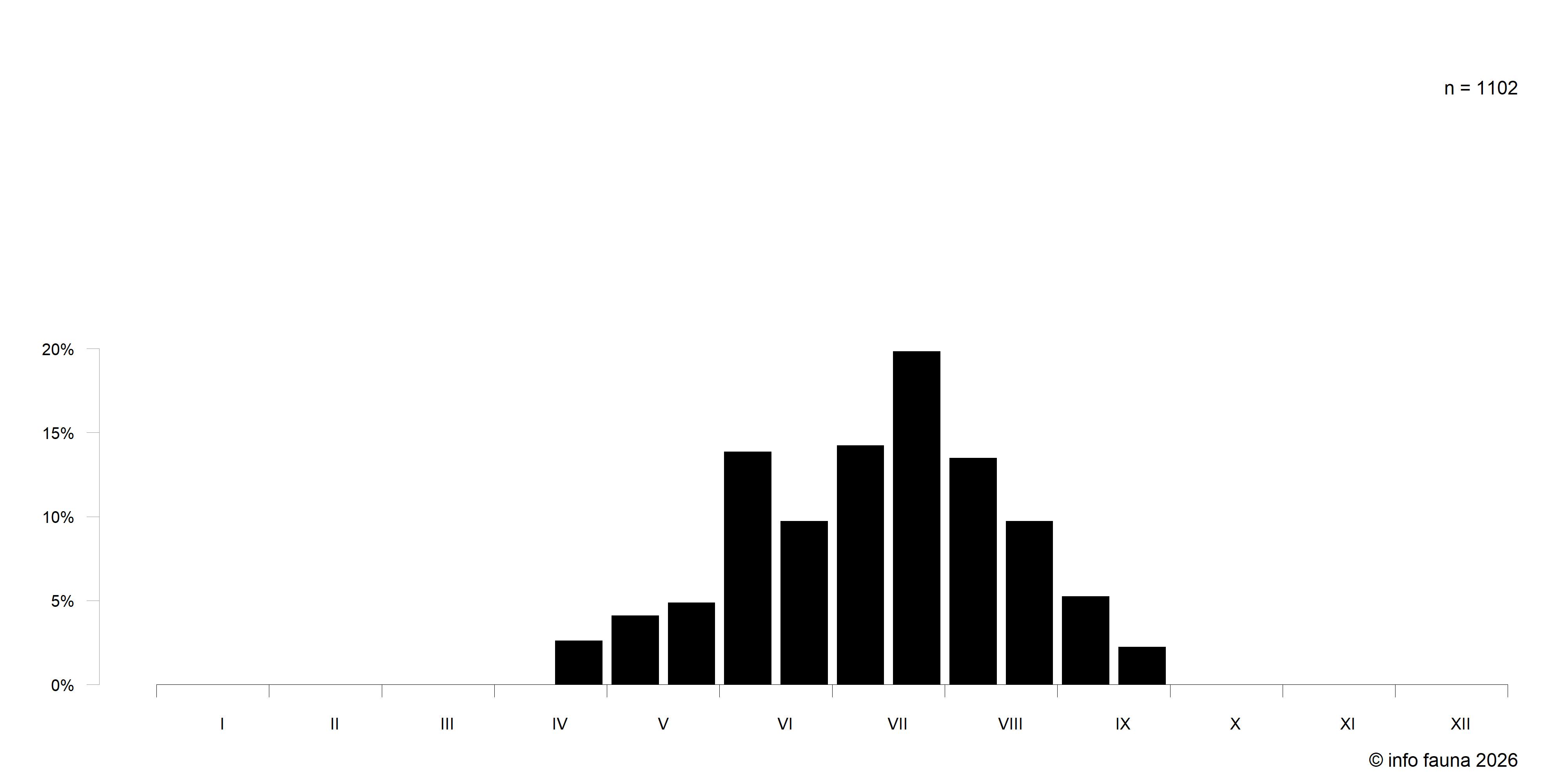
Période des observations de Carabus glabratus latior en Suisse. Le graphique montre la proportion de toutes les observations par quinzaine.
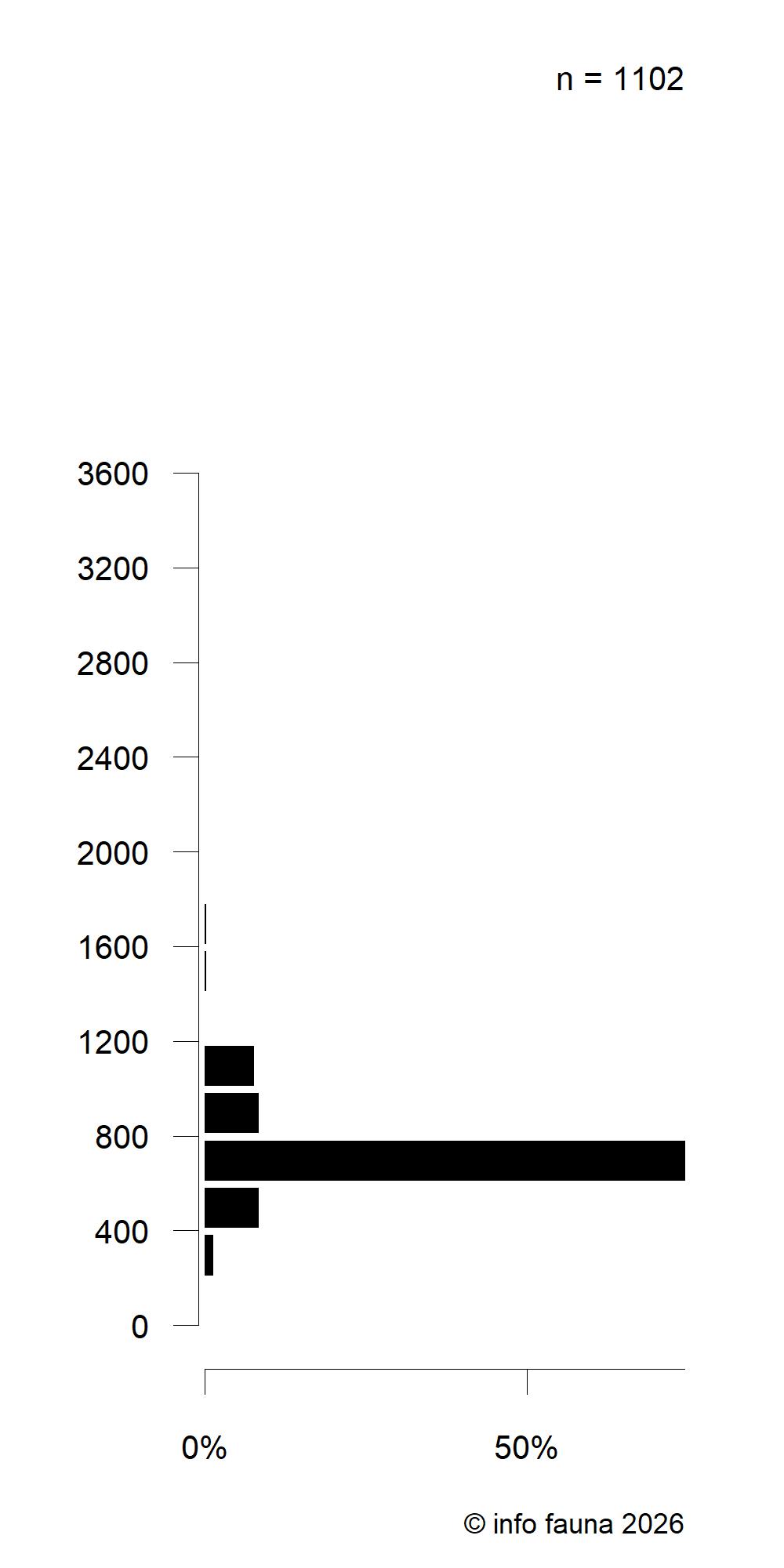
Classification
- Arthropoda (Phylum)
- Insecta (Classe)
- Coleoptera (Ordre)
- Carabidae (Famille)
- Carabus (Genre)
- Carabidae (Famille)
- Coleoptera (Ordre)
- Insecta (Classe)
Plus d'informations
Références bibliographiques
The life cycles and age of Carabus g/abratus Paykull and C
Houston, W. (1981). The life cycles and age of Carabus g/abratus Paykull and C. problematicus Herbst. (Col.: Carabidae) on moorland in northern England.. Ecol. Entomol., 6, 263-271.
Carabid Beetles in Their Environments. A Study on Habitat Selection by Adaptations in Physiology and Behaviour
Thiele, H. (1977). Carabid Beetles in Their Environments. A Study on Habitat Selection by Adaptations in Physiology and Behaviour. Zoophysiology and Ecology, 10.
The life cycles and growth of Carabus glabratus and C
Refseth, D. (1984). The life cycles and growth of Carabus glabratus and C. violaceus in Budelan, central Norway.. Ecol. Entomol., 9, 449-455.
Faunistik der Sandlaufkäfer und Laufkäfer der Schweiz (Cicindelidae & Carabidae) Coleoptera Teil 1 / Text
Marggi, W. (1992). Faunistik der Sandlaufkäfer und Laufkäfer der Schweiz (Cicindelidae & Carabidae) Coleoptera Teil 1 / Text. Dokumenta Faunistica 13.
Les Carabes de France
Forel, J., & Leplat, J. (1995). Les Carabes de France. I. Venette.
Rote Liste der in Baden-Württemberg gefährdeten Sandlaufkäfer und Laufkäfer (Col., Cicindelidae et Carabidae) 2
Trautner, J. (1996). Rote Liste der in Baden-Württemberg gefährdeten Sandlaufkäfer und Laufkäfer (Col., Cicindelidae et Carabidae) 2. Fassung (Stand Dezember 1996). Arten- u. Biotopschutzprogramm Baden-Württ. 1, 3(Ergänzungsliefertermin IIIB), 49-54.
Host-plant specialization in Western Palearctic Anthidine bees
Müller, A. (1996). Host-plant specialization in Western Palearctic Anthidine bees. Ecological Monographs, 66, 235-257.
Coleoptera, Carabidae. Ecology-Atlas
Luka, H., Marggi, W., Huber, C., Gonseth, Y., & Nagel, P. (2009). Coleoptera, Carabidae. Ecology-Atlas. Fauna Helvetica 24.
Tribus Brachinini, Omophronini, Cicindelini, Cychrini, Carabini
Trautner, J. (2017). Tribus Brachinini, Omophronini, Cicindelini, Cychrini, Carabini. In Trautner, J. (Ed.), Die Laufkäfer Baden-Württembergs, 1, 71-122. Stuttgart: Eugen-Ulmer.
Carabini & Cychrini
Arndt, E., & Trautner, J. (2006). Carabini & Cychrini. In Freude H., Harde K. W., Lohse G. A. & Klausnitzer B. (Eds.), Die Käfer Mitteleuropas. Band 2. Adephaga 1: Carabidae (Laufkäfer), 2. Auflage (pp. 28-64). Heidelberg / Berlin: Spektrum-Verlag.
Laufkäfer als charakteristische Arten in Bayerns Wäldern - eine methodenkritische Auseinandersetzung mit Definition und Verfahren zur Herleitung charakteristischer Arten und zur Frage von Artengemeinschaften, unter besonderer Berücksichtigung der nac
Müller-Kroehling, S. (2015). Laufkäfer als charakteristische Arten in Bayerns Wäldern - eine methodenkritische Auseinandersetzung mit Definition und Verfahren zur Herleitung charakteristischer Arten und zur Frage von Artengemeinschaften, unter besonderer Berücksichtigung der nach §30 BNatschG geschützten Waldgesellschaften und der Wald-Lebensraumtypen des Anhanges I der FFH-Richtlinie und vergleichenden Einbeziehung natürlicherweise waldfreier Sonderstandorte im Wald. Technischen Universität München.
Coléoptères d’Europe. Vol
Du Chatenet, G. (2005). Coléoptères d’Europe. Vol. 1 Adephaga.. Verrières le Buisson: NAP.
Relict populations in ancient woodlands: genetic differentiation, variability and power of dispersal of Carabus glabratus (Coleoptera, Carabidae) in north-western Germany.
Assmann, T., & Günther, J. (2000). Relict populations in ancient woodlands: genetic differentiation, variability and power of dispersal of Carabus glabratus (Coleoptera, Carabidae) in north-western Germany.. In Natural History and Applied Ecology of Carabid Beetles (pp. 197-206). Sofia, Moscow: Pensoft Publishers.