
Type de présence en Suisse
Introduite, invasive (NLS)
ⓘⓧ
Degré de menace
Selon les Catégories et Critères de la Liste rouge de l’UICN ou selon Duelli et al. 1994.
(exp = appréciation d'expert·e·s)
Statut de protection (CH)
Selon les lois et ordonnances nationales spécifiques.
Degré de menace (CH)
Non applicable au niveau régional (NA)
Statut de protection (CH)
ⓘⓧ
Selon les lois et ordonnances mentionnées
–
Lois et ordonnances
–
ⓘⓧ
Selon l’aide à l’exécution : Liste des espèces prioritaires au niveau national.
Priorité nationale
–
Niveau d’action
–
Indications sur le niveau d’action
–
Urgence des mesures (CH)
–
Protection d’occurrences individuelles
–
Surveillance des populations
–
ⓘⓧ
Domaine agricole (OEA/UZL)
Espèce cible/caractéristique selon : Objectifs environnementaux pour l’agriculture "Espèces et milieux naturels".
(* = appréciation d'expert·e·s)
Forêts
2 : Espèce cible forestière selon Biodiversité en forêt : objectifs et mesures. Aide à l’exécution pour la conservation de la diversité biologique dans la forêt suisse (Imesch et al. 2015).
1 : Espèce cible forestière complémentaire, définie dans le cadre de plans d'actions OFEV (p.ex. Plan d'action Forêts claires).
Domaine agricole (OEA/UZL)
–
Forêts
–
✓
Taxon bien étudié, graphique proche de la situation réelle plus d'info
Carte
Carte des observations de Nyctereutes procyonoides en Suisse (résolution 5x5 km).Voir la carte
Période
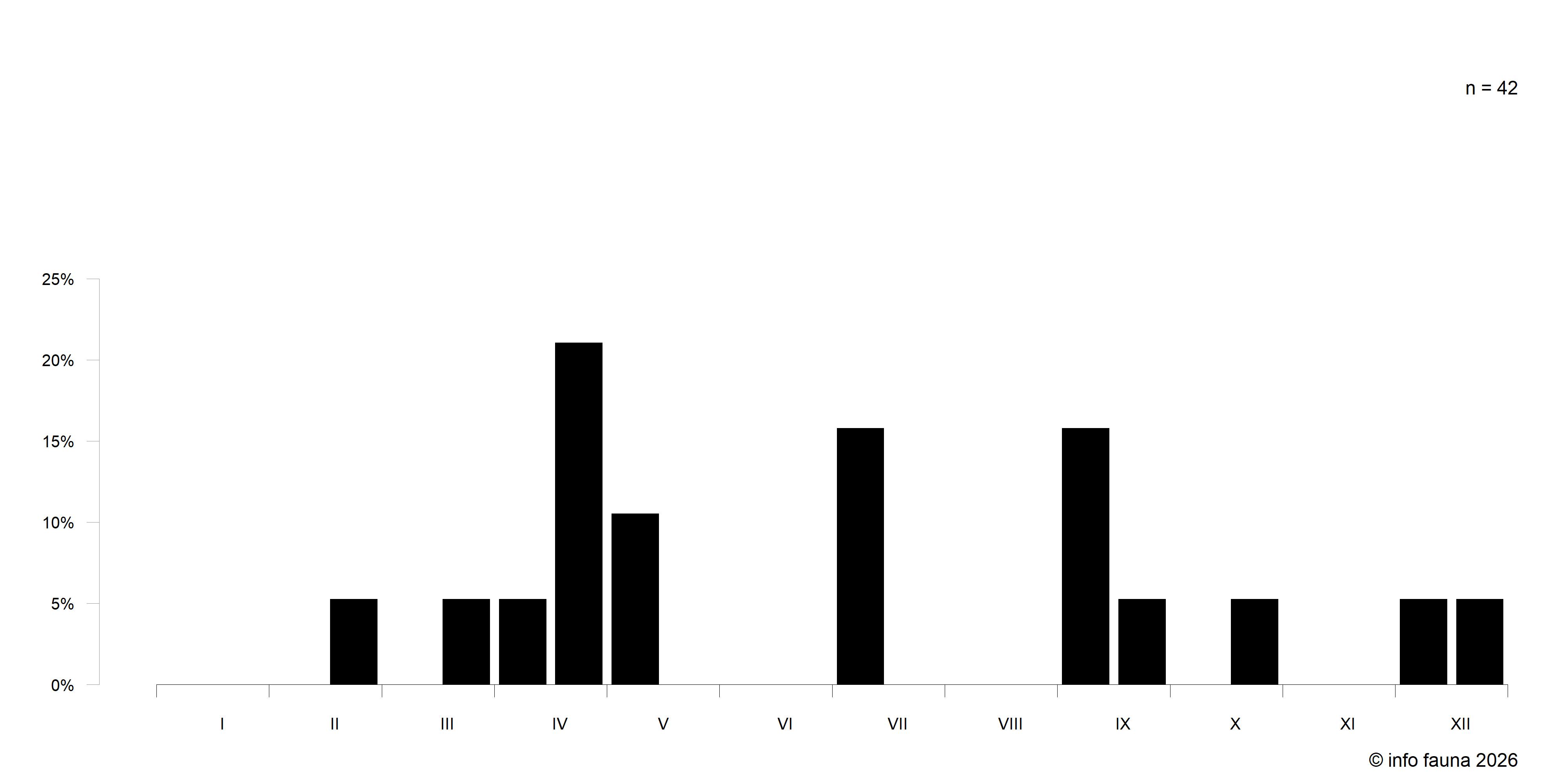
Période des observations de Nyctereutes procyonoides en Suisse. Le graphique montre la proportion de toutes les observations par quinzaine.
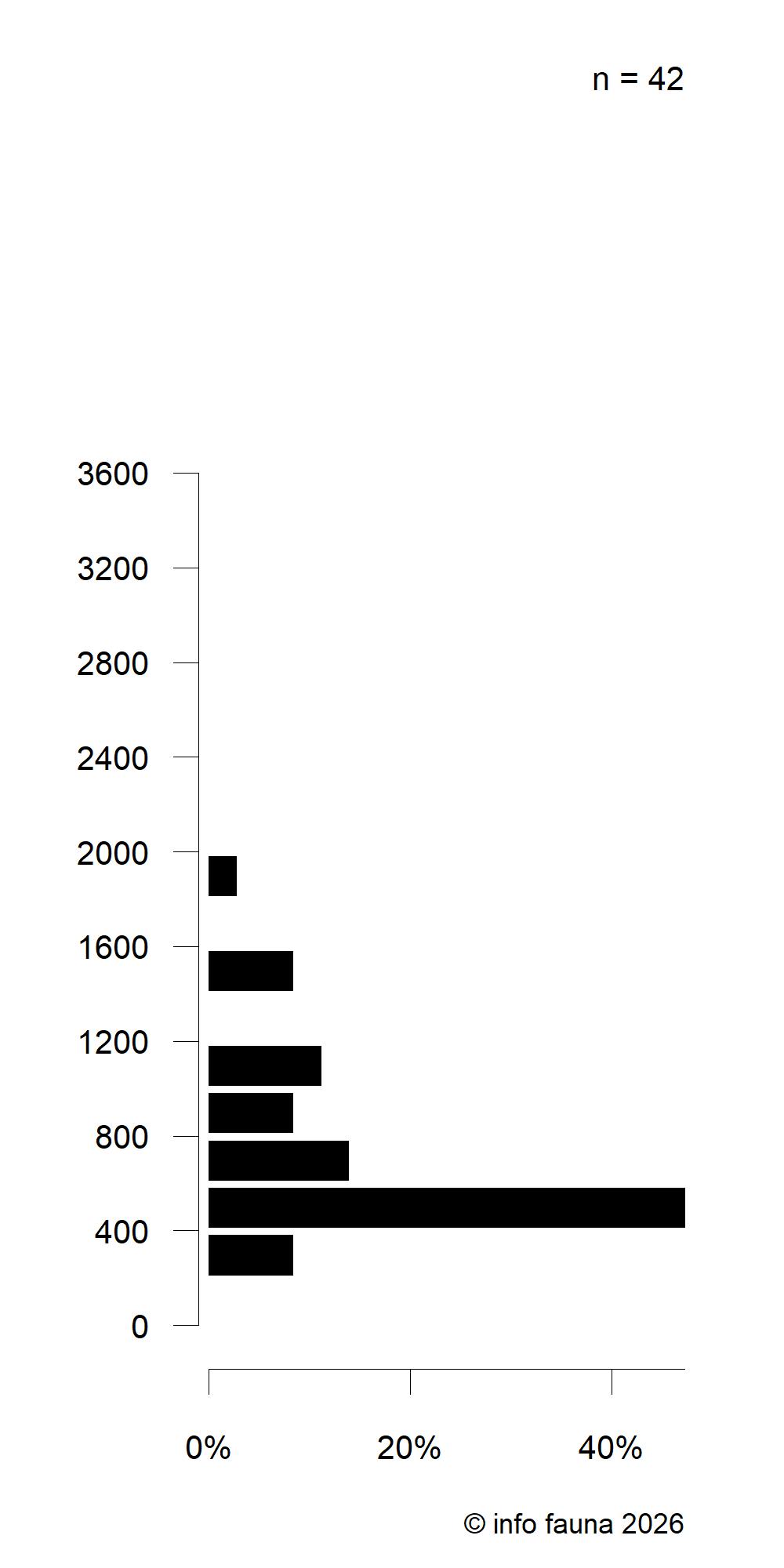
Classification
- Chordata (Phylum)
- Mammalia (Classe)
- Carnivora (Ordre)
- Canidae (Famille)
- Nyctereutes (Genre)
- Canidae (Famille)
- Carnivora (Ordre)
- Mammalia (Classe)
Portrait de l'espèce
Auteur-e-s
Sarah Hummel
Portrait
Description
Le chien viverrin, également connu sous les noms de Tanuki ou de chien martre (de l’allemand «Marderhund»), est le plus petit représentant de la famille des canidés d’Europe centrale. Les caractéristiques les plus frappantes sont son masque noir, ses longs poils autour du visage («favoris») et son museau allongé typique des chiens. Son masque facial ressemble à celui du raton laveur (Procyon lotor), mais contrairement à celui-ci, la coloration claire du bas du visage se poursuit entre les yeux et laisse ainsi le masque facial apparaître «divisé». En comparaison avec les autres membres des canidés comme le renard roux (Vulpes vulpes) ou le loup (Canis lupus), sa queue est plutôt courte (25 cm) et ne présente pas non plus le motif rayé typique du raton laveur. Sa fourrure longue et dense, combinée à son cou court, à sa petite tête aux oreilles courtes et à ses pattes plutôt courtes, donne au chien viverrin une apparence trapue. Se déplaçant sur la pointe des orteils comme les autres canidés, il a une démarche souple par laquelle il est facile à distinguer du raton laveur avec son aspect «bossu» et lourdaud. Le pelage d’hiver est beaucoup plus long et dense que le pelage d’été, mais d’une couleur similaire. Celle-ci est très variable, les tons gris-beige dominent sur les flancs, tandis que les couleurs brun-noir prédominent sur le ventre et le dos.
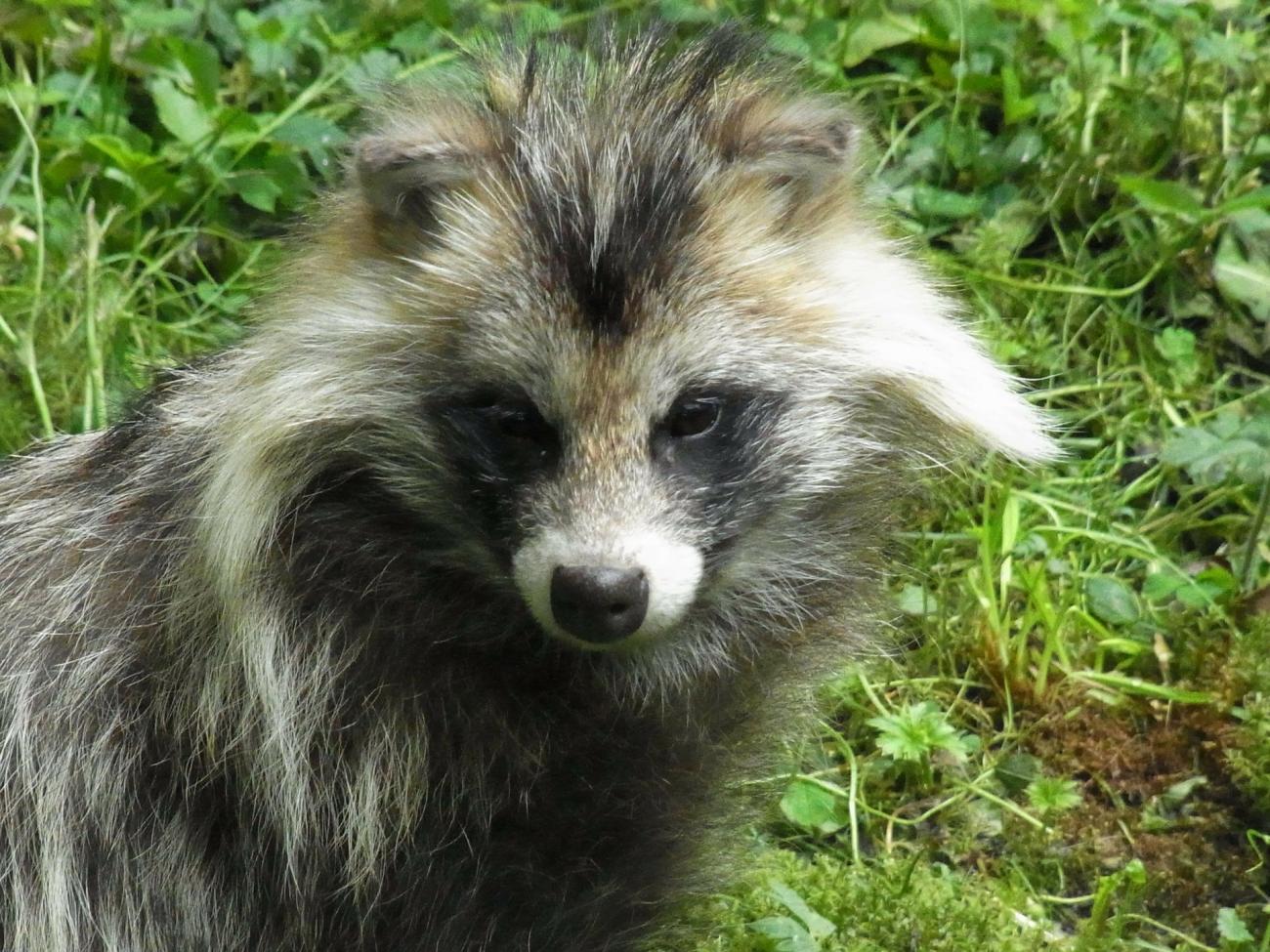

Plus petit représentant des canidés en Europe centrale, le chien viverrin (Nyctereutes procyonoides) présente un museau allongé et une collerette de poils («favoris») caractéristiques. La couleur du pelage est très variable oscillant entre les tons gris-beige sur les flancs et le brun-noir sur le ventre et le dos. Photo © Pixabay.
Biologie et habitat
Habitat
Le chien viverrin préfère une structure de paysage en mosaïque avec des champs et de petites zones forestières et semble avoir un grand attachement aux plans d’eau. Il privilégie les paysages fluviaux et les plaines inondables pour y établir ses zones d’itinérances, où des prairies humides, des roselières, des lacs ou des étangs lui offrent de bonnes conditions de vie. Il est considéré comme un habitant des régions de plaine, bien que certains témoignages proviennent des Grisons, à bien plus de 1000 mètres d’altitude. Reste à savoir s’il parviendra à s’établir durablement à de telles altitudes en Suisse.
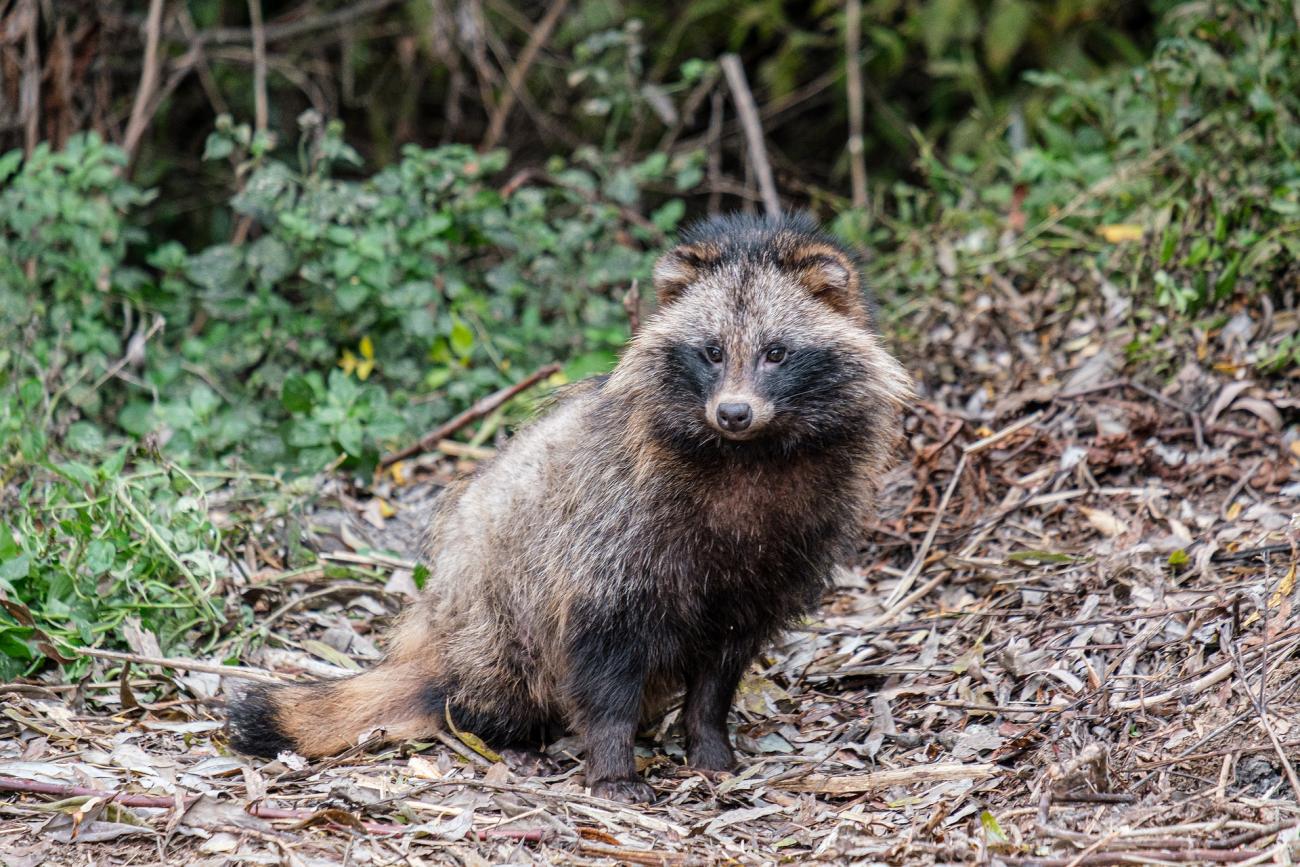
Le chien viverrin (Nyctereutes procyonoides) est considéré comme un habitant de plaine privilégiant les habitats en mosaïque composés de champs et de zones boisées. Il semble également nécessiter la présence de plans d’eau. Photo © Pixabay
Régime alimentaire
Le chien viverrin est un omnivore opportuniste, dont le régime alimentaire varie fortement en fonction de la saison et de l’habitat. Il se nourrit de matières végétales, de fruits, de petits mammifères, d’amphibiens, de poissons, d’insectes, d’escargots, d’oiseaux et de leurs œufs, de reptiles mais aussi de déchets et de charognes. La recherche de nourriture des chiens viverrins ressemble plus à celle d’un cueilleur qu’à celle d’un chasseur actif et ressemble ainsi plus à celle du blaireau (Meles Meles) qu’à celle du renard roux (Vulpes vulpes).
Comportement
Le chien viverrin est actif au crépuscule et la nuit et dort généralement toute la journée dans des terriers de renards et de blaireaux abandonnés ou bien caché dans une végétation dense, entre des souches d’arbres ou dans des troncs creux. Il construit rarement ses propres terriers. Dans le nord de son aire de répartition, le chien viverrin hiverne partiellement alors que dans les régions plus tempérées, par exemple en Allemagne, il est actif toute l’année.
Les chiens viverrins ne sont pas territoriaux, mais les zones d’itinérance sont marquées par plusieurs fosses d’évacuation des excréments, dites «latrines». Les zones d’itinérance des mâles et des femelles peuvent se chevaucher complètement et les animaux se déplacent souvent en couples. Lors de fortes densités de population, on peut même observer la formation de groupes. Les couples peuvent rester ensemble toute leur vie.
Reproduction
La période de reproduction de plusieurs jours a lieu entre février et avril. Après une gestation d’en moyenne 61 jours, 3 à 10 petits naissent entre avril et juin. Les mâles participent à l’élevage des chiots et leur fournissent de la nourriture, de même qu’à la mère. À l’âge de 3 à 4 mois, les jeunes deviennent indépendants et atteignent leur maturité à l’âge de 8 à 10 mois.
Distribution
Situation mondiale et en Europe
L’aire de répartition naturelle du chien viverrin, originaire d’Asie de l’Est, comprend la Sibérie orientale, la Corée, le nord-est de la Chine et le Japon. Sa longue et épaisse fourrure en a fait un animal très prisé pour le commerce de fourrure. Il a donc été élevé et libéré à grande échelle en Ukraine en 1928 et, à partir des années 1940, également en Russie occidentale. De là, le chien viverrin s’est rapidement répandu vers l’ouest, pour finalement s’installer en Europe centrale et orientale, où il a formé des populations parfois importantes. Dans les années 1960 et 1970, il a atteint l’Allemagne et la France. Depuis, sa propagation s’est poursuivie, mais semble s’être quelque peu ralentie ces dernières années.
Comme les populations de chiens viverrins en Europe sont basées sur des introductions artificielles, il est considéré comme une espèce exotique (néozoaire). En 2017, il a été inscrit sur la liste des espèces exotiques envahissantes préoccupantes pour l’Union européenne (liste noire), raison pour laquelle aucun statut de menace (NA) n’a été défini.
De ce fait, il est chassé de manière intensive dans certains cas. En Allemagne, par exemple, environ 30'000 chiens viverrins ont été tués chaque année entre 2008 et 2019. Toutefois, le chien viverrin est touché, comme le renard roux, par le virus de la maladie de Carré et la gale (transmise par des acariens), ce qui entraîne des déclins massifs des populations certaines années, reflétés dans les statistiques de chasse.
Situation en Suisse
En 1997, un premier chien viverrin a été signalé à Leuggern AG, probablement immigré depuis l’Allemagne. Depuis lors, plus de 30 observations ont été confirmées, la plupart concernant des victimes de la route ainsi que des observations fortuites.
Le chien viverrin est considéré comme un néozoaire envahissant, c’est pourquoi aucun statut d’espèce menacée (NA) n’a été défini. Bien que sa chasse soit autorisée toute l’année, elle ne joue pas (encore) de rôle important en Suisse. Seul un animal a été abattu en 2012, un également en 2017. Jusqu’à présent, les individus observés dont on connaît le sexe étaient exclusivement des mâles subadultes et adultes, qui peuvent parcourir de longues distances à la recherche de nouveaux territoires. Il n’y a pas de signes de reproduction réussie à ce jour. A l’heure actuelle, les observations en Suisse proviennent des cantons du Jura, de Fribourg, de Berne, d’Argovie, de Zurich, de Saint-Gall et d’Uri. Un bon tiers de tous les signalements proviennent du canton des Grisons, où le chien viverrin a probablement immigré depuis la Bavière et le Liechtenstein. Le peu d’éléments dont nous disposons laisse penser qu’aucune population permanente n’a encore été établie en Suisse, mais compte tenu du développement de l’espèce dans notre pays voisin, l’Allemagne, ce n’est peut-être qu’une question de temps.
Mesures
Les potentiels effets négatifs sur la faune locale du chien viverrin en tant que nouveau prédateur sont discutés de manière controversée, comme cela est également le cas pour le raton laveur. Toutefois, le régime alimentaire du chien viverrin est extrêmement vaste et il semble occuper une niche alimentaire entre le renard roux et le blaireau. La composition de son alimentation présente une large gamme de chevauchements saisonniers avec ces deux espèces, mais une coexistence des trois espèces paraît possible sans problème, car elles diffèrent notamment dans leur comportement de chasse. En tant que chasseur et cueilleur plutôt passif, le chien viverrin consomme beaucoup moins d’oiseaux que le renard roux, alors que la proportion d’amphibiens peut être saisonnièrement très élevée et, selon l’habitat, peut dépasser 50%. Au niveau local, une mise en danger supplémentaire des populations d’amphibiens déjà affaiblies est donc à craindre. Néanmoins, d’autres études ont conclu que le régime alimentaire du chien viverrin est principalement composé de charognes, de déchets et de plantes (maïs et fruits), ce qui souligne la flexibilité écologique de cette espèce et rend son impact difficile à évaluer. Par conséquent, un éventuel préjudice ne peut être évalué qu’au niveau local, par exemple dans une réserve naturelle.
Il est probable que l’aspect le plus important dans la propagation du chien viverrin soit son rôle de vecteur de maladies. Ses caractéristiques biologiques en font un support et un vecteur idéal pour divers pathogènes. Les espèces envahissantes comme le chien viverrin pourraient donc devenir de plus en plus importantes en Europe dans l’épidémiologie de certaines maladies transmissibles. Cela concerne notamment la rage, la gale, la maladie de Carré, la trichinellose, la tularémie («peste du lapin») et le ténia du renard, et ce tant pour la faune sauvage, les animaux d’élevage que pour les humains.
Il est donc recommandé de continuer à surveiller la propagation du chien viverrin et d’évaluer régulièrement son influence. Cependant, le mode de vie discret et sa propagation continuelle limitent considérablement les chances de succès des mesures de contrôle.